Welcome to the blog of the Tasmanian branch of the Children's Book Council of Australia!

Friday, 25 September 2020

Now and Then … and Then Again

Fiona Levings reflects on the inspiration and historical perspectives inspired by her own home and captured so evocatively in her recent picture book, Now and Then. A fascinating examination of the history of a home, set in Margate, Tasmania.

I never expected to write a picture book about my house. 

Cover of Now and Then by Fiona Levings.

We moved to Margate about ten years ago. The little house, sitting in the bush by a creek, had won us over instantly. We knew from the construction that it was built in the early 20th century but that was about it. Its history was a mystery - and with a new baby and busy lives, it was fixing to stay that way.

But the house had other ideas. 


Four years ago a car parked in our drive and an older gentleman came to the door. A stranger; he introduced himself as Doug and told me that he used to live in my house. He had dropped by to visit the place where he grew up. Could he take a look around?


Doug grew up in the 1940’s and he had many memories of life at that time. Standing on the front verandah of the house he pointed at the window to the right of the front door, smiled, and said “that was my room.”  Turning to look I spied my son Jem’s room through the window to the left and in that instant I saw the spread of a picture book: a room occupied by a modern child on the left and one belonging to a child eighty years ago, on the right. It was now and it was then.
 

The page spread that started it all.

I think most creative people would be familiar with that particular species of idea that won’t go away. Now and Then insisted on existence. With Doug’s permission, and having picked his mind further, the parallels and contrasts between his Margate life eighty years ago and that of Jem’s modern world had to be captured. Two boys, who live in the same house, go to the same school and play in the same creek in a little town near the end of the earth. It is one the smallest pieces of history I can imagine and yet, it works. Taking it into the classroom has been a joy as kids explore the illustrations to discover for themselves the ways our world has changed over time – and the ways that people have stayed the same.

Generations of kids have lived in our house and played in its creek. The world may have changed a lot over that time
but some things can still be relied on.

And, you know, a few weeks after the book came out another car appeared in my driveway and another stranger, this time a lady, got out. Her name was Lynne and it turns out that she, too, grew up in this house, about fifty years ago. And what did she ask about first?  


“Is the creek still there?”
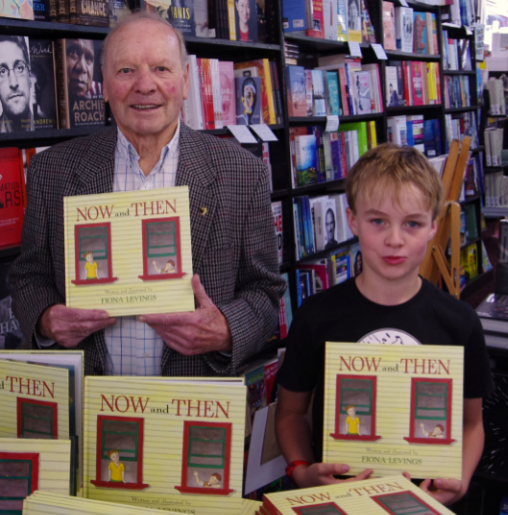
Doug and Jem at the launch of Now and Then at Petrarch's, Launceston (December, 2019).

......................

Fiona Levings is a Tasmanian-based author and illustrator of children’s picture books. Now and Then, published by Forty South Publishing, was listed as a notable book in the 2020 CBCA Book Awards. Copies are available in bookstores or online at www.fortysouth.com.au.

Web:  http://fionalevings.blogspot.com/ 

FB:  https://www.facebook.com/themoonbowmaker 

IG:  https://www.instagram.com/themoonbowmaker/ 


Friday, 18 September 2020

The Little Treehouse That Could

The weekly grocery shop provides access to books – this week Lyndon Riggall considers the merits of a recent commercial promotion.


It’s a fascinating thing, the use of children’s merchandise as a means of encouraging commercial loyalty. Newspapers have been trying it for years to boost circulation (with there being no more sure sign of a struggling rag than a “one-a-day” DVD collecting promotion), and now it seems as if a trip to the supermarket without some kind of Ooshie, Little Shop or Discovery Garden product is a trip wasted—though where many of these objects end up for the long haul can only be a topic for grim speculation. You can imagine my surprise, then, when Coles announced that their latest venture was to hand out Little Treehouse books by Andy Griffiths and Terry Denton with every purchase.

The works of Griffiths and Denton are, in my mind, a curious example of the disparity between the CBCA’s consistent judgment and the nature of children’s reading on the ground level. Kids go to the Just… series and the Treehouse books in droves, but questions of their literary merit mean that they typically miss out on recognition of the kind offered by the Children’s Book of the Year awards. The concerns that might be directed towards Griffiths and Denton in times past continue with this mass-market publication, including the usual accusations that they produce texts that are “potty humour,” “promote violence” or are “disgusting” (the claims of which, I have no doubt, serve often to increase rather than diminish their readership). Griffiths has always said that his work is a subversive riff on such old-fashioned improvement literature as Hilaire Belloc’s Cautionary Tales, but whether the books are harmless fun in a world with no boundaries or encouragement of reckless misbehaviour is nevertheless up for debate. My weighing in on the issue: are the Little Treehouse books really inappropriate for children’s reading? No. Do kids love them? You bet they do.


Andy Griffiths with display of the Little Treehouse Books
Coles. (2020, July 27). Coles new collectables to inspire 
little readers
.
Research conducted by Coles itself found that 88% of parents said that they encouraged their children to read. What percentage of parents regularly purchased books for their children? 22%. We know that access to books make a huge difference in the literacy of children, and even if the Little Treehouse campaign was not supplemented with links to the Indigenous Literacy Foundation and a creative writing competition, it would be hard to argue that the charming, mischievous Treehouse books aren’t a huge step in the right direction from a company whose previous best efforts included mass production of inedible miniature plastic versions of groceries. 

As educators, parents, and members of the community, we know that the solution to illiteracy is found in a number of places… it is found in libraries, in schools, in bookshops and in the corners of every loungeroom and bedroom in the country. Nevertheless, we need gateways. We need books that enchant, inspire, and give children a rush of glee and dissident delight. We need books that fall into hands unbidden; that bring reading into everyday life, dragging it kicking and screaming into places we never saw it before; challenging the notions of who readers are, and what being a reader is. 


Should we need a major supermarket chain to shell out free books just to get kids reading? I wish we didn’t. Nevertheless, somewhere in Australia, a child is holding a tiny book from one of the most successful teams in our country’s legacy of children’s literature, and they only have it because they got it for free at a supermarket. They are reading and laughing. Tomorrow, they are going to want more. 


I hope that we will, eventually, have a plan for tomorrow. Today, I’m just glad that they can find Andy and Terry in the treehouse. 


Lyndon Riggall is a writer and teacher from Launceston. You can find him at http://lyndonriggall.com and @lyndonriggall on Twitter.

Friday, 11 September 2020

Representations of War in Australian and Ukrainian Picturebooks

 This week’s post presents a snapshot of doctoral research undertaken by Halyna Pavlyshyn. Her insights and discussion have a strong focus on visual literacy as Halyna compares and contrasts the techniques employed by illustrators in these selected titles.

The comparison of Australian and Ukrainian picturebooks representing war reveals a number of tendencies. While the war is condemned in both cultures - it is represented as a gory, horrific and destructive experience - the message is conveyed differently. In Australia, war narratives usually focus on the First World War, the legend of Anzacs and the lives of ordinary people who either went to war or who stayed in Australia hoping that their family members would return home safe. The war mostly takes place in Europe. The Australian picturebooks representing war often explore such themes as death, orphanhood, separation, military service, national identity, mateship, and the impact of war on its survivors (e.g. My Mother’s Eyes; Ride, Ricardo, Ride; Dreaming Soldiers).


                                          Ride Ricardo, Ride!                                    Dreaming Soldiers
                                    Phil Cummings & Shane Devries                Catherine Bauer & Shane McGrath


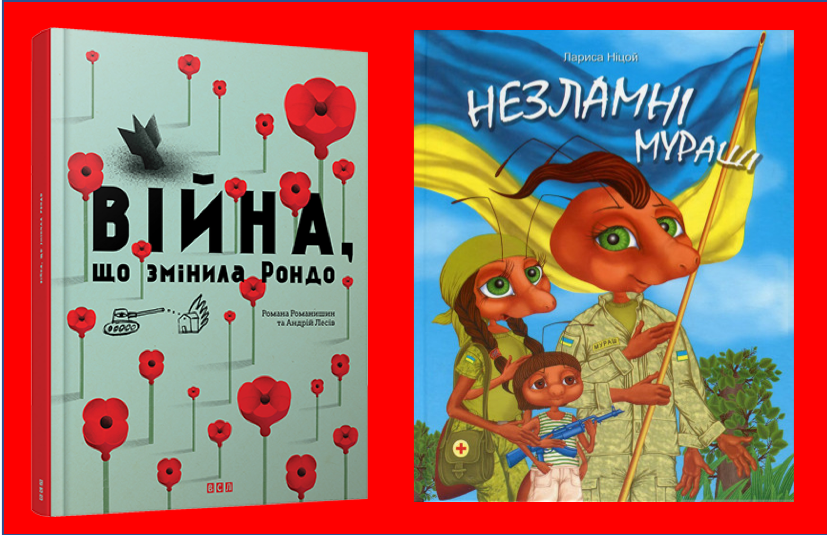
In contrast, the Ukrainian contemporary picturebooks about war are mostly written as tales with animal-like characters. Even though they refer to the current events in Ukraine, the war takes place in the imaginary land. The books show the horrors and the devastating consequences of war; however, they do it in a careful manner. It seems that despite condemning war, the authors attempt to give hope to their young readers and to protect them from the harsh reality (e.g. The War that Changed the Rondo, Adamantine Ants).


                             The War that Changed Rondo                                    Adamantine Ants
                       Andriy Lesiv & Romana Romanyshyn                               Larysa Nicov

In My Mother's Eyes
Mark Wilson

In addition, the Australian and Ukrainian war narratives employ distinct colour palettes to represent war. The sand-like yellow, earthy umbra, brownish sepia and clay orange, less often deep blue, as well as black and white are prevailing colours used to represent war in the Australian picturebooks. The distinction is drawn between Europe (the land of war) and Australia (beautiful homeland). This can be seen prominently in My Mother’s Eyes by Mark Wilson, where the colours used for depicting war are black, red, orange and yellow; and the colours to represent Australia are green and blue colours of the peaceful sky and the bushland.


Whereas, the Ukrainian picturebooks representing war show the contrast not so much in space, but in time: before the war and after war. The vibrant poppy red, bright orange, lemon-like yellow, spring-grass-green, light blue and white are used to depict life before the war. They are contrasted with pitch-dark black, fern-like-green, dark brown, bloody red, deep violet and dark blue for the illustrations representing the wartime and the time after the war. The colours, therefore, emphasise the difference between the peaceful time and the wartime in a war zone. The prominent example is the book The War that Changed Rondo by Andriy Lesiv and Romana Romanyshyn. At the end of the Ukrainian picturebooks, the colours are changed: they are not as vivid and bright as they used to be; however, not as gloomy as during the war. This technique might be used by the authors to give hope to the young Ukrainian readers witnessing the Russo-Ukrainian war which started in 2014.


Adamantine Ants retold in Ukrainian.

Halyna Pavlyshyn
PhD Candidate

This publication is a part of Halyna Pavlyshyn’s PhD research supervised by Dr Angela Thomas, Dr Damon Thomas and Prof Mike Corbett


You can find out more about these titles online.

Links for the Ukrainian picturebooks:


Links for the Australian picturebooks:


Friday, 4 September 2020

Father's Day - It's Reading Time!

Mum’s are invited to put their feet up this Father’s Day and let the Dads share in some of the bedtime rituals – such as reading the bedtime story! This week’s blogger is Felicity Sly, a Teacher Librarian at Don College in Devonport and CBCA Tas Committee Member.


As Father’s Day looms, it seemed like a perfect opportunity to have a look at some titles that feature dads, and to consider the role of dads in reading to children and the effect this has on the future literacy and reading.


“… Research shows that fathers are particularly influential for children’s language and literacy development, which means they are a promising point of intervention for efforts to improve children’s language and literacy” (Fatherhood Research and Practice Network, 2019, para 1). Not only do children benefit from being read to by their fathers, but fathers have also reported that they feel closer to their children through sharing this bedtime activity. It has also been noted that fathers interact differently during the reading session, than do mothers, with conversations generally ranging far beyond the content in the book being read (Schwanenflugel & Knapp, 2019).


Frank Woodley’s video provides 5 tips for reading aloud to children; especially targeting dads in his suggestions.

Tip 1: Be playful

Tip 2: Add sound effects

Tip 3: Add actions

Tip 4: Give life to the pictures

Tip 5: Get into character

Penguin Books Australia. (2020, August 23).
Frank Woodley 5 tips for reading aloud to children.


After watching the Fran Woodley video view other men reading picture books in this video compilation by Penguin (2020).


Dads don’t feature prominently in picture books, so here are some Australian titles to get you started.


The Man Who Loved Boxes (Stephen Michael King):
Dad isn’t great at expressing love in words, but is great at doing things with his son.


I Spy Dad!  (Janeen Brian & Chantal Stewart):
There are lots of dads, but finally the narrator spies her dad.


Harry and Hopper (Margaret Wild & Freya Blackwood):
Dad has to break the news that the beloved dog, Hopper has died, and help his son to cope with loss.


Cheeky Monkey (Andrew Daddo & Emma Quay):

Dad is doing the hands on activities with his son, with mum as the incidental adult in the story.

Grandma's Storytime. (2020, August 25).
Cheeky Monkey read by Grandma's Storytime.

My Dad Thinks He’s Funny (Katrina Germein and Tom Jellett):
Full of dad jokes!

Story Station. (2017, July 10). My dad thinks he's funny.

Kisses for Daddy (Frances Watts & David Legge):

In the only anthropomorphic book in this list Baby Bear doesn’t want to kiss his parents goodnight…but Daddy Bear whilst performing the bath/bedtime routine, manages to give lots of kisses, and finally receives a kiss and a hug.


Chrysalis Montessori. (2019, December 2). Kisses for daddy.

Molly and Her Dad (Jan Ormerod & Carol Thompson):
The only title in this list that is overtly ethnically diverse starts with memories of her Dad, before he arrives from overseas to entertain her friends.

Sydney Kate. (2019, June 10). Molly and her dad.

I can’t create a list without including Bob Graham’s dads. They are kind and involved in their family: Queenie the Bantam, Let’s Get a Pup! and The Trouble with Dogs! are great places to start.


So…Dads, if you’re not already sharing the story reading in your home, it’s a great time to start.


Happy Father’s Day


References


Fatherhood Research and Practice Network. (2016). The benefits of fathers reading to their children: Tips for fatherhood programs and dads. National Responsible Fatherhood Clearinghouse. https://www.frpn.org/asset/the-benefits-fathers-reading-their-children-tips-fatherhood-programs-and-dads>

Penguin Books Australia. (2020, August 5). Read aloud videos by dads. https://www.penguin.com.au/articles/2790-read-aloud-videos-by-dads

Quinn, S. (2009). The depictions of fathers and children in best-selling picture books in the United States: A hybrid semiotic analysis. Fathering: A Journal of Theory, Research, and Practice About Men as Fathers, 7(2), 144-158. https://doi.org/10.3149/fth.0702.140

Schwanenflugel, P. J. & Knapp, N. F. (2019, June 16). A father's role(s) in reading. Psychology Today. https://www.psychologytoday.com/us/blog/reading-minds/201906/fathers-roles-in-reading

Friday, 28 August 2020

Read Local - Buy Local

 We all know what a difficult year it has been for those who work in the arts and CBCA Tasmania has provided a platform for our local children’s authors and illustrators to share their recent creative works via our blog. This week Nella Pickup provides an overview of a number of 2020 of publications, some still to be released. If something resonates, then ‘read local’ but also  ‘buy local’ and show your support for Tasmanian book sellers as a lead up to Love Your Bookshop Day.

 2020 has provided many challenges; one of those has been keeping up to date about local children’s literature creators.   This is my list of 2020 releases with a Tasmanian creator.

Christina Booth Are these Hen’s eggs? (Allen & Unwin) is a multi-layered story about an egg hunt and about friendship, co-operation and celebration of difference. Christina’s 2020 collection includes a paperback release of her Anzac Tree; illustrations for Maureen Jipiyiliya Nampijinpa O’Keefe’ s Mum’s Elephant (Magabala Books) and illustrations for Sally Odgers (see below).


Jennifer Cossins’s The Mummy Animal Book (Hachette) and The Daddy Animal Book (Hachette) are available now and The Ultimate Animal Alphabet Book (a companion to The Ultimate Animal Counting Book) will be out late October.  As usual. her books are filled with fascinating facts and beautiful naturalistic illustrations.


Phillip Gwynne and Tony Flower's Small Town (Puffin) is based on a real-life story of Pyramid Hill in regional Victoria.  Tony Flowers has used watercolours, coloured pencils and ink to bring warmth to this happy refugee story.  Make sure you read the endpapers. 


Kate Gordon’s Juno Jones series continues with Juno Jones Book Sleuth (Yellow Brick Road) in October. The Heartsong of Wonder Quinn (UQP) which will be released in September is already receiving great reviews.  Magpies 35(3) p38 compares it to A. F. Harrold’s The Imaginary and the Afterwards; and you can follow up on Margot Lindgren’s comments on the Momo blog.


Julie Hunt’s Shoestring: The boy who walks on air Allen & Unwin is a companion to the award winning KidGlovz.  Read Julie’s recent blog post.


Carol Ann Martin and Tull Suwannakit’s picture book Heart and Soul (Scholastic) is a touching story about Charlie, a musician, and his dog Louis who are separated by illness and then reunited.  A cross generational story that is perfect for these uncertain times.


Sally Odgers recently wrote about Aussie Kids: Meet Dooley on the Farm Penguin, illustrated by Christina Boot. This book hits the shelves in a few days.


In a recent blog, Lian Tanner wrote about her transition from fantasy to a much more varied repertoire. A Clue for Clara (Allen & Unwin) is a delightfully funny mystery that also deals with bullying, death of a parent, and the struggles of rural policeman dealing with stock thefts. 

If I missed anyone, please let us know by posting a comment here so we spread the word!

Nella Pickup
Grandmother and retired librarian

Friday, 21 August 2020

Not a Zoomer or a Boomer & Not So Silent


Selfie with Owl (Irene Cowell)
Tasmanian writer Irene Cowell tracks her technology development as her writing career developed. Regardless of the tech at your fingertips it is the story that you have tell that is most important.

I knew I wasn’t a “Zoomer”. I’ve only now discovered that my generation is known as the ”Silent Generation”. Strange but true! I have recently started to “Zoom”. This relatively new technology is infinitely more satisfying than its jerky predecessor, “Skype” which I gave up on after a short, confusing tech. information tutorial.

My first computer experiences were with MicroBee, rather than Microsoft or Apple. These computers were Australian designed, began as a hobbyist kit then became so popular that they were assembled in the 80’s on the Central Coast of NSW, near where I lived and worked. They were networkable, with a tiny 16 / 32 KB memory and the first computers we had in many Australian schools. It was fortunate for our school at Bateau Bay, that Assistant Principal, Marlene Davidson, was involved in their development through teaching programs. Both my children “cut their teeth” on these basic machines. Watch Owen Hill, the MicroBee founder to find out more about their history.


Rainbow Island Tapestry of Time


When, after many years, I began to take my writing seriously I typed my manuscript on our family desktop computer. That book was published in 2017 by Forty South as Rainbow Island Tapestry of Time. I graduated to my own laptop. Then towards the middle of 2019 I decided that I needed to brush up on my drawing skills by attempting an online course: “Natural Science Illustration 101” through Newcastle Uni. That tested my ability. It wasn’t just the drawing, although that was rigorous enough; it was more about posting each week’s project online and on time, and being involved in their critique group which exercised all my computer skills and then some.

Towards the tail end of 2019, when I was invited to join a Tasmanian Children’s Writer & Illustrator Group, I thought, “might as well!” and so I did. When CWILLS [pronounced “QUILLS”] went to Zoom in this bushfire-ravaged, storm-damaged, Covid-haunted year, I followed. From that satisfying experience I joined the international writer/illustrator group, SCBWI, and now find I am participating in online tutorials, information sessions and have even progressed to an online critique about my writing. What’s next? After recently participating in a SCWBI TAS Webinar, I have decided to join the associated  “PitchFest”, and will soon be pitching a manuscript to a publisher as well as discussing my illustration portfolio. Wish me luck!

N.B. Must remember to log in early.

Irene Cowell

Author: Rainbow Island Tapestry of Time”, published by Forty South
Instagram @rainbowislandseries

Friday, 14 August 2020

From Brizzlehounds to Chooks

This week, guest blogger Lian Tanner, provides some insights into her writing craft and passions with a special focus on her latest endeavour that has expanded her repertoire. Read on and be introduced to a most amazing chook called Clara.

For the last ten years or so, I’ve seen myself almost exclusively as a writer of fantasy trilogies for children. All my novels have been set in the past or the future, in imaginary worlds populated by brizzlehounds and idle-cats, or mechanical rats and anti-machinist fanatics.

Now, that has changed. I've got a picture book under my belt in the form of Ella and the Ocean (illustrated by Jonathan Bentley), which won the Patricia Wrightson Prize for Children's Literature as part of the 2020 NSW Premier's Awards.

Plus A Clue for Clara, a stand-alone contemporary novel about a chook who wants to be a detective.

The picture book had been cooking in the back of my mind for quite a while. But the stand-alone contemporary novel? That was a surprise – and yet the seeds had been there for the last few years.

I’ve always loved the trilogy format. As a writer, I stumbled into it more or less by accident when I came to the end of Museum of Thieves and realised that I couldn't bear to walk away from Goldie, Toadspit and the museum. Not yet.

Trilogies have allowed me so much space to explore my characters. There’s an emotional arc for each book, but there’s also a wonderfully long arc from the beginning of the first book to the end of the third, and working out how to deal with those two different frameworks has been a challenging and fascinating process.

Then there’s the bonus of not having to invent a whole new world and new characters for the second and third books – instead I could come back to the same characters, and greet them as old friends.

But there were a couple of downsides to writing trilogies. For a start, they took so long. While I was writing The Rogues Trilogy, ideas for new books seemed to come flooding in on a weekly basis, and some of them were so appealing that I wanted to throw everything else aside and get started.

But I was in the middle of writing a trilogy, which meant it was at least two or three years before I could devote myself to anything else.

And then there’s the fact that, while trilogies are wonderful for confident readers who want to immerse themselves in a different world, there are many more kids who are put off by the sheer length of them.

So when The Rogues was done, I set out to write a standalone book. I was looking for a story that was shorter than my usual books, and more accessible. Something contemporary. And funny.

 Like … a detective story starring a small, scruffy chook.

I already knew that I liked writing about chooks. One of my favourite characters in The Rogues was a chook – on the surface at least. (She was really an ancient sorceress who had gotten caught up in one of her own spells.)

And few years ago, I had three chooks living in my back garden. Clara was the smallest of the three, but she was also the smartest and the bravest. She was always the first one to spot a nest of earwigs, or something interesting in the compost heap. And when my cat Harry came too close, she would stare at him until he crept away with his ears flat and his tail twitching.

I'm still not sure where the idea of her desperately wanting to be a detective came from, and to be honest, I wasn't sure if I could pull it off. I knew how to write long form fantasy; what if I couldn't make the switch?

But the idea had lodged inside me, as the best ideas do, and before I knew it this sweet, funny character was keeping a diary and putting her own idiosyncratic interpretations on the human world.

And so, A Clue for Clara was born.

In the end, it turned out to be the most fun I’ve ever had writing. I very much hope that people will have just as much fun reading it.


Lian Tanner, children’s author

Website: http://liantanner.com

Facebook: https://www.facebook.com/liantannerauthor

Instagram: https://www.instagram.com/liantannerbooks/


Editor’s note: One for the diary – A Clue for Clara is being launched at the Hobart Bookshop on Sunday September 20 at 11:00 am. If you are in Hobart, it would be well worth the visit to Salamanca Place.

https://www.hobartbookshop.com.au/upcoming/

Friday, 7 August 2020

Cover Story

After a taste of what was to come last year when Julie Hunt and Dale Newman shared snippets of their current endeavour, it is wonderful to share insights into how the cover for Shoestring, the Boy Who Walks on Air was developed. What an enchanting entry into a world of magic and amazement.

What a joy a cover can be! As a reader and a writer, covers are one of my favourite things and over the years it’s been interesting to see how they come about. 

Sometimes the editor gives a detailed brief to the designer (who may not have read the book) explaining the crux of the story and who or what should be in the image. She might suggest a style and include sample book covers as starting points. The brief can be quite specific: ‘A nine-year-old girl. Red hair, one blue eye and one green. Running as if being pursued. Design could be in the fantasy style, with the figure featured within or around a shape (rather than full bleed illustration), and with the setting or background working as a texture.’

I love reading this sort of thing; it’s a glimpse into another world. The designer then mocks up a cover with text and stock images or a rough drawing done in Photoshop, before passing it to the illustrator.

Other times the brief can be short, informal and wide open. My latest book, Shoestring, the Boy Who Walks on Air, illustrated by Dale Newman, was like that. ‘Perhaps an image of Shoe on his invisible tightrope, something inspired by the beautiful aerial-perspective illustrations in the text. Dale, do you think you could sketch up some thumbnails, and we can go from there?’


 Dale drew an extraordinary thumbnail that seemed to say it all: Shoestring in the sky under a full moon, his life held in the balance by a pair of sinister hands which frame the image. She worked it up and everyone thought the drawing was great – dramatic, theatrical, atmospheric and with plenty of tension. 

There was only one problem – how to place the text? Jo Hunt, the designer (no relation), literally went around in circles trying to make it fit. Then another idea surfaced – a simple image of a boy walking across the face of the moon. Jo did a mock up using Dale’s character, along with stock moon and clouds. She added white dots to indicate stars.

 To tell you the truth at first, I thought it might be a bit too simple, but with Dale’s beautiful rendering, the moon glowed and the clouds behind it became wings or feathers. Shoestring is barefoot, his hands upturned and Metropolis, the self-declared ‘Fabulous Macaw’, is flying triumphantly into the night sky.

Except for the yellow moon, the image is monochromatic, in keeping with the cover of the companion book, KidGlovz – a graphic novel for which Dale was shortlisted for the CBCA Crichton Award for New Illustrators. 


It’s an uplifting image, full of the light fantastic, and it works beautifully with the format of the book – a chunky, heavy, hardback that’s almost square. The moon and Metropolis are gloss laminated (Metropolis wouldn’t have it any other way). And the title—in a typeface reminiscent of 19th century circus posters—fits perfectly.

Thank you so much, Dale, and the team at Allen & Unwin. It’s a delight to hold this book in my hands. 


Take a peak at Shoestring: The Boy Who Walks on Air 


Julie Hunt

W: juliehunt.com.au

Dale Newman

W: https://www.dalenewman.art

Editor’s note: Julie is an occasional contributor to our blog. Last year, Julie and Dale participated in The Travelling Workshop visiting Tasmanian schools, and part of their conversations were around the development of Shoestring. There are also posts about her writing craft and the launch of KidGlovz. Spend some time exploring Julie’s creative efforts in her other posts.