Welcome to the blog of the Tasmanian branch of the Children's Book Council of Australia!
Showing posts with label series. Show all posts

Friday, 18 March 2022

Back to Deltora

Join Lyndon Riggall as he ignites an old passion for a wonderful fantasy series that enchanted young readers as they followed stalwart characters on challenging quests across the dangerous lands of Deltora.  


On my birthday this year there was one present that definitely took me by surprise. Actually, it was two presents, given to me by my friends Georgie and Mitchell, stacked in strange rectangular shapes that looked like two small shoeboxes. When I opened them, I gasped at what they contained: a complete original collection of Emily Rodda’s Deltora Quest 1, 2 and 3, as well as a few supplementary volumes. Something that had long been sleeping inside me was awakened.
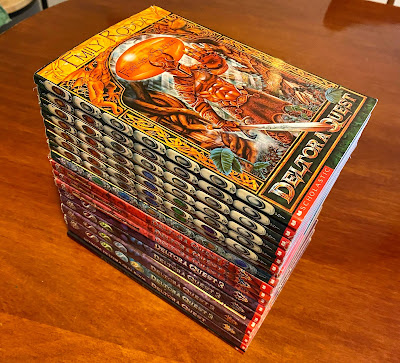

I never owned the Deltora Quest when I was a child, though I remember scouring the school library shelves each week for the volume with the right number of gems or the appropriate sections of pipe to match where I was in Lief’s story. Key among the initial appeal of the books (and the reason that I treasure them so much now), was that they were gorgeous. A few decades on, when every year book covers seem to include less and less detail, the series stands out as being aesthetically astonishing, each part enfolded in a feature illustration by Marc McBride that slyly whispers of the dangers that lie within. As I have been revisiting the novels over the past few weeks, their timelessness is evident. They are complex, fast-paced and short enough that they always leave the reader wanting more. While Rodda has written so many books and stories in and around the world created here (including, of course, Rowan of Rin, the Rondo books and the Three Doors trilogy), I must admit that for me it will always be Deltora Quest that is her masterpiece. The world Deltora has seen enormous global success, from 18 million copies sold worldwide, to an anime series that ran for sixty-five episodes. There have been rumours of Deltora coming to the big or small screen in English for decades, but for me it is sometimes very special to have a work of this quality without a thousand adaptations, variations and merchandising opportunities. Deltora Quest doesn’t need to be brought to the masses with an enormous budget to be one our greatest fantasy series for children. Readers know the secret.
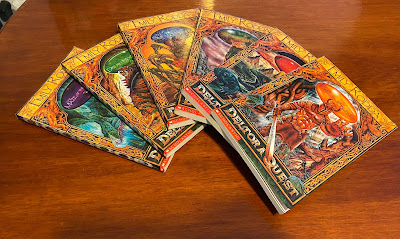
As a young primary school student, I ran to Deltora, and it has been exciting to see the door open once again and to be able to return. At the beginning of my own journey with the series, Deltora Quest was an exercise in simple adventure… I was breathless at the challenges faced by its heroes, trying to crack the puzzles and codes they came across before they solved them, simply enjoying the sheer wild fantasy that Rodda was creating. Now, I see the value of the messages hiding beneath the surface, too: the importance of working together, the fight to save the natural world and the need for leaders to stay in touch with their own humanity. For her part, Rodda seems to be in no way done with her creation. Her latest series set there, Star of Deltora, has only concluded in the last few years, while The Glimme, which was stunningly produced with her Deltora partner-in-crime Marc McBride, picked up an Honour award at the CBCA awards in 2020.


The first volume in the Deltora Quest series, The Forests of Silence, was released at the turn of the millennium, and as such it celebrated its 21st anniversary last year, with a new edition of the collection released in celebration. In the intervening time since my ten-year-old self first got his hands on the series, I am proud to state that Rodda’s work has lost none of its trademark sparkle or shine. It will always feel to me like a place half-forgotten in a dream; a memory lost in some unfathomable depth, like a treasure fallen into a dark lake. Some time before I had the confidence or the stamina to tackle such classics of fantasy as The Hobbit or The Lord of the Rings, when even C.S. Lewis could be daunting, Deltora was waiting for me, its magic begging to be released. I will always be grateful to Rodda for her sharp writing that was never puerile, for the complexity of her ideas and for her love of challenge and adventure. I will always be grateful for my friends, who knew that you could turn thirty-two and still believe in the imagined places that mattered to you when you were a child. 


Once, in a school library, we counted gems on spines and swapped books like secrets. Now, I hold them in my hand once again, and with every turn of the page I am in three places at once. I am here, on my couch; I am there in my school library, lying on a beanbag with my feet in the air…


…And best of all, I am, again, in the land of Deltora, where adventure awaits.


Lyndon Riggall is a writer and senior-secondary English teacher at Launceston College. His latest picture book, Becoming Ellie, was created in collaboration with Graeme Whittle, and he is also co-host, with Annie Warburton, of the Tamar Valley Writers’ Festival podcast. Lyndon can be found at http://www.lyndonriggall.com

Saturday, 21 September 2019

Consistency in a series from an illustrator’s perspective


Alyssa Bermudez, Hobart based illustrator, shares illustrator's insights into the challenges of representing characters that appear over multiple stories. Discover two very different characters in Amelia Chamelia and Lucia the Luchadora.

As an illustrator, it is my job to create the images that help enrich books for children. When I first receive the text for a story, my initial process involves reading it over and over again. I sit, lay, walk and drive with the text in my mind for a period of time to start putting together a visual narrative. This visual narrative is inspired by the text of course, but it also goes beyond that. It is a non verbal language that adds another layer to the story that the text doesn’t explicitly say. This perfect combination of text and additional visual narrative is the great achievement that any children’s illustrator strives for. 

After the initial stage, I start imagining the characters and the world they live in. For the Lucia the Luchadora series, their family heritage was front and centre for me as I began the process of their visual depiction. I set out to find cultural references and colours to inspire their world. For the Amelia Chamelia series, I tried to figure out how to make her stand out yet also be relatable to other eight-year-old Australian girls. Before any pencils hit paper, a lot of research and thought was involved. I feel as though I truly know the characters before I start to draw them.

To provide consistency to these characters across multiple pages and books is also a unique challenge. While they need to look like the same person with the same proportions, their body language and emotional range needs to be as diverse as the readers themselves. Amelia Chamelia faces a huge challenge of public speaking when she is assigned the role of narrator in the school play. Her best friend Willow also faces a fear of heights during the school swimming test. Portraying these very real emotions in visual form can help engage early readers along the journey. 


Creating consistency in style can be an interesting challenge too, especially when illustrating a series. Lucia the Luchadora set the style for the sequel, but I still tried to introduce new colours and characters into the culturally rich world they live in. Amelia Chamelia is simple black and white interior illustrations, so even though the artistic style doesn’t change throughout, the characters and expressions are diverse. 

Each book is an exciting opportunity to explore style, consistency and nuance of character for visual storytelling. An illustrator’s work is never over! Stay tuned for more of my illustrated books coming soon including My Singing Nana! 


Alyssa Bermudez
Children’s and commercial illustrator
W: 
http://www.alyssabermudezart.com/
FB: 
https://www.facebook.com/alyssabermudezart
T: @bermudezbahama 

Sunday, 21 October 2018

The Power of a Good Book

Another wonderful story from the Tamar Valley Writer’s Festival about the increased opportunities for authors and readers to communicate with each other and the enrichment to both that can follow.
When Hobart-based children’s author Lian Tanner received a message on her website from a 16-year-old girl, she was thrilled to read she was a fan of her Keepers trilogy, but what she learned as she read the letter was the impact of her books on this teenage reader.

The young woman had spent most of her life in foster care and the characters in The Keepers resonated with her strongly.

This reader told Tanner that on her worst days she felt as if she were in chains. And when she felt really bad she would lock herself away in her room and read the Keepers books, which would make her feel better.

Tanner told this story at the recent Tamar Valley Writers Festival, held at Grindelwald, and explained how the distance between readers and authors had lessened in the age of social media and heightened online connectivity.

“My Keepers trilogy is about children who are kept in chains. I thought [this story] is the best thing that I have ever heard,” Tanner said.

Readers have more access to authors than ever before and, as a result, have a louder voice. Writers’ festivals, like the one Tanner was speaking at, book launches and social media have all contributed to the level of interaction we now enjoy with authors.

“Children expect to be able to talk to the author,” Tanner said.

“Children could always write to the author, and sometimes youd get an answer and sometimes not, but now they can email or talk to them on Instagram, or talk to them on all sorts of platforms, and that is delightful.

It’s great for the kids, but it is also absolutely delightful for the author,” she said.

Not only does this change in the way we interact with authors create a better relationship for both parties, but it also enhances word of mouth, which is one of the best ways for an author to sell books.

This word of mouth comes from the readers themselves, but also the booksellers, who know their customers so well. A good bookseller will know what to recommend when a customer is uncertain - or wants to try something new.

“What sells books is what the booksellers call hand selling - when you go into a book shop and they know you and say you will love this, or you go into a shop and say what have you got for my 12-year-old child?and they say try this, or one of your friends says,I just read this fantastic book...,” Tanner said.

“There is nothing like word of mouth for selling a book.”

Which book do you continually recommend?

Johanna Baker-Dowdell
Johanna is a journalist and author of the book Business & Baby on Board.

Blog: http://johannabd.com/
Google+: https://plus.google.com/u/0/+JohannaBakerDowdell
Twitter: https://twitter.com/JohannaBD