Welcome to the blog of the Tasmanian branch of the Children's Book Council of Australia!
Showing posts sorted by relevance for query lian tanner. Sort by date Show all posts

Saturday, 17 June 2017

Lian Tanner: What Writers Need

Johanna Baker-Dowdell reports on a writing session conducted by Tasmanian author Lian Tanner as she provided important advice on writing to a spellbound audience of primary students.

I’ve been a storyteller for my whole life: from pulling apart films in great detail to share with those who did not have the experience, to writing Anne of Green Gables fan fiction before I even knew there was such a thing. By the time I left high school I was writing a column for my local newspaper and had dreams of being the next Murphy Brown.

Lian Tanner
As I approach the second year of mentoring grade 5 and 6 students in creative writing for The Write Road, I thought it relevant to reflect on children’s author Lian Tanner’s advice for writers.

Lian spoke at the Writer’s Cafe that concluded The Write Road program last year and shared some salient tips on what writers need with her audience of primary school students, their parents and teachers.

She told the almost 50 aspiring authors they were now part of a “great and honourable tradition of writers who started off as children who loved stories”.

And Lian followed those words with these four tips on what all writers need to do to get the creative juices flowing:
  • to daydream, as daydreaming is one of the most important things a writer can do,
  • take risks, because being creative is all about taking risks,
  • live life deeply and passionately, because we need to notice everything around us – and inside us,
  • go out and have adventures.
And of course Lian is right. Like everything that is worth doing, writing takes time to develop. First there’s the watching what is happening in the playground outside, or how our friends respond when they disagree, or even the different ways people walk. Then comes the kernels of ideas, that just form out of those musings and develop into full-blown ideas if we give them time and attention – and are willing to write them down.

The risk is something more difficult to embrace, but the rewards are worth it. You never know what you’re capable of if you keep doing the same. But, if you take a risk, like Lian advises, you can discover more about yourself and those around you than you thought possible.
A popular, highly successful series that Lian Tanner has written.

While these young writers have not felt the full scope of emotions that present themselves throughout life’s triumphs and challenges, they will soon enough. These students need to take note of how they feel each and every time their hearts swell or break, because it will become something they draw on in their writing time and time again.

And the most important tip of all: have adventures, because to have adventures is to live.

May they all keep writing throughout school and choose careers where stories are important.

Johanna is a journalist and author of the book Business & Baby on Board.


Editors' note: Lian Tanner demonstrates this passion for writing through the extensive range of exciting fiction she has crafted. Read of some of her own inspirational strategies on her website.

Friday, 4 June 2021

On tour with Ella and the Ocean

Author visits have been in hiatus over the last year or so and it is great to read of a successful visit to central NSW by Tasmanian author Lian Tanner and the terrific reception Lian and the award winning  Ella and the Ocean received.

In February this year, the State Library of New South Wales sent me to Dubbo, Forbes and Orange, to talk to preschoolers about my picture book Ella and the Ocean, illustrated by Jonathan Bentley and winner of the 2020 Patricia Wrightson Award for Children's Literature.

© Lian Tanner. At the Forbes library

© Lian Tanner

I had never presented to preschoolers before this. I’d spoken to several K-2 classes about Ella, with the help of some home-made finger puppets, but I wasn't particularly happy with my talk, and I suspected that holding the attention of preschoolers would be quite a bit more challenging. So I set out to do some research.


I watched Playschool for tips. I watched YouTube videos of storytellers and puppeteers. I worked out how to use my finger puppets as if they were asking and answering questions. Then I started looking for songs. Songs about rain. Songs about swimming. I couldn't find any I liked, so I made them up on my morning walks, singing them into my phone so I wouldn't forget them.


The tour itself was wonderful. For a start, it was wildly exciting to leave Tasmania after nearly a year of closed borders. And I love the sort of country towns where people say hello to complete strangers in the street. But these towns were special, having suffered terribly from lack of rain over the last few years. In each place, when my little Ella puppet wanted to know if there had ever been a drought there, all the adults said a heartfelt, 'Yes!' 

© Lian Tanner with the Forbes librarian,
Bronwyn Clar


The hospitality was outstanding, and the librarians in each town made me feel as if I was doing them a favour, rather than the other way round. But the kids were the highlight. I learned that preschoolers have no filter. Me: ‘Would you like to sing this song with me?’ Little boy: ‘No.’  


I learned the signs that meant they had had enough, and I needed to wind up the session. I learned that this age group was much more fun than I had expected. 

And the finger puppets were a winner. Halfway through my talk in Forbes, a little girl called Rosie raised her hand and said, ‘Can I tell Ella a secret?’ ‘Of course,’ I said. She came up to the front, put her face close to my little puppet, and whispered to her. I have no idea what she said. But when she sat down again, beaming with satisfaction, every adult heart in the room melted. 


Lian Tanner is the best-selling author of three fantasy trilogies for children, The Keepers trilogy, The Hidden/Icebreaker series and The Rogues trilogy. Her latest book, A Clue for Clara, is a detective story starring a very determined chook. A companion book, Rita’s Revenge, will be published in July 2022. Lian’s books have been translated into eleven languages and have won two Aurealis Awards for Best Australian Children's Fantasy.


Editor's note: Find out more about Lian and her wonderful books on her website at https://liantanner.com.au/. I am waiting with bated breath for Rita's Revenge - I am sure it will be dastardly! :-)

Sunday, 1 September 2019

Ella and the Ocean by Lian Tanner, illustrated by Jonathan Bentley


Report on launch of Lian Tanner's first picture book at Hobart Bookshop, Sunday 4th August. 

There was an excellent crowd gathered together, excited to celebrate the release of Lian Tanner’s first picture book, Ella and the Ocean, which was launched by Her Excellency, Professor the Honourable Kate Warner, the Governor of Tasmania, AC with a great deal of warmth, humour and obvious enjoyment.
The MC was young English teacher and writer Lyndon Riggall, a regular blogger for the CBCA Tasmanian Branch, and well known for his involvement with Readers Cup competitions. He skillfully interviewed Lian and Kate, bringing out a wonderful amount of interesting detail.
Lian, author of the internationally bestselling The Keepers series, The Rogues and The Hidden, spoke like a first-time author, which she felt herself to be as the author of a first picture book. The average novel is 40 to 60 thousand words, whereas a picture book is closer to 500 words and the author must leave room for the illustrator to ‘speak’ in images to complement the written word. She did not communicate with Jonathan until all the images were finalised, so these represent his ‘voice’ in the story. Unfortunately Jonathan Bentley was unable to be at the launch, but Lian was extremely pleased with his work and hopes very much that she will be able to work with him again. Her idea of an illustrator’s function is to ‘Take your words and make them fly.’

        ‘Ella lived in the red-dirt country where the earth was as dry as old bones and it hadn't rained for years and years and years. One night, Ella dreamt of the ocean...’

The story is set in the Kimberleys, blue ocean contrasting with red country.
For Lian dreams are important, and the ocean is such a great place to play. Ella loves her visit to the ocean, and there is a little boat on almost every page. There was also a great activity for children to hunt in the dark with torches around the bookshop for 20 hidden paper boats in order to win prizes. Lian had an ink stamp with the sailing boat on it which she used when she signed people’s books which added a great touch to her signature.


Christine Donnelly
CBCA Executive member


Jonathan Bentley is the illustrator of many wonderful picture books, including The Second Sky by Patrick Guest (CBCA Shortlist 2018), Tales from a Tall Forest by Shaun Micallef, First Day by Andrew Daddo, Blue Sky Yellow Kite by Janet A. Holmes, and Where is Bear?

Tuesday, 12 November 2013

Lian Tanner's new book

‘The day was so clear that she could see for miles.  There was pack ice everywhere, huge flat slabs of it that the Oyster swept aside with ease.  An albatross hung on the air, its wingspan twice as wide as Petrel’s height, and the wind fiddles sang in time with its swooping and rising.  In the distance a cloud of seabirds was gathering.  The beauty of it all snatched at Petrel’s heart and made her more determined than ever that neither she nor Fin would die today.’ (p. 199, Ice Breaker)

Lian Tanner
Lian Tanner’s new work, The Hidden Series, was initiated recently with the launch of the first in the series, Ice Breaker.  Anyone who had attended the launches of the books in her previous series for young readers, The Keepers, would have been expecting an entertaining hour or so of theatre – and we weren’t disappointed!

The stage is set
The venue this time was the Art Space in Salamanca, and Lian’s imaginative decoration of the space, in my opinion, outdid her earlier work in preparing for an event that would fire the imaginations of her young audience.  Many of these youngsters were dressed to fit the theme, and the décor echoed this.

MC and Reviewers discuss their responses 
Lian works very closely with groups of children in producing her material; this year it was Mt Nelson Primary School students who provided reviews of the book to be launched.  This close contact of author and audience is not only beneficial to Lian and her writing; it must be valuable indeed to the staff and students of the schools with which she works, and I congratulate her on her ability to form these links with local schools.

Petrel and Bratlings 
Members of a local group provided a short but lively dramatization of an early scene in the novel, where the Bratlings pursue and terrorise Petrel, the Nothing Girl.  Anyone who had not yet read the book was itching to get started, by this time!

All of us, on entry, were provided with a numbered ticket – mine indicated that I was an Officer and therefore belonged to Braid territory.  I might have been a Cook or an Engineer, of course, if I’d had a different ticket.  But my ticket, I was very happy to find, provided me with the second luck prize! But my pleasure soon faded when I found that the first prize winner and I were to be tied to the mast by an intimidating Engineer  –  “I’m too old for this!” I thought. ( I’m certainly pleased that no photos of my comeuppance have surfaced as yet!) 

The setting of the novel is grim, with two children who have grown up with hardly any experience of loving and supportive human interaction struggling to form an attachment and find a future for each other and their environment.  But the end is more optimistic, though the sequels no doubt will provide difficulties to be overcome.

Congratulations, Lian!

PATSY JONES


Monday, 3 November 2014

Expect the unexpected: Lian Tanner delivers again…


Before we arrived at the Founders’ Room, Salamanca Place, Hobart this morning for Lian Tanner’s launch of Sunker's Deep, the second book in her Hidden series, we had been warned to expect the unexpected and we were not disappointed!


But what else would you expect from an internationally acclaimed children's author who has also been a playwright, teacher, professional actor, freelance journalist, editor, and tourist bus driver?


Ably assisted by marvellous MC Mel King, puppeteer and actor, the audience was led though games and story teasers that were perfectly pitched to engage and enchant Lian’s besotted fans, little and big!  We were also treated to wonderful reviews by some of Lian’s most impartial critics, including Gus and Max, who rated Sunker’s Deep 10/10! 

And as with the 2013 launch of the first novel in the series, Icebreaker, again the lucky door prize proved to be very less than lucky (for details of last year’s launch http://liantanner.com.au/the-hobart-launch-of-ice-breaker).  But luckily our plucky 2014 prizewinner was eventually returned safely to the bosom of her family, despite being forced to walk the plank by the despicable Chief Engineer Albie.


And who would have thought that this latest title in Hidden series, aimed at middle- and upper-primary readers who love adventure, suspense and strange worlds, was inspired by Lian’s visit to The Museum of Science and Industry in Chicago, where she fell in love with a German submarine known as U-505.  She became besotted with the idea of writing a story set in a submarine after joining a tour which enabled her to experience life aboard this sub in the days leading up to its capture, when it was prowling off the coast of West Africa on a hunt for American and Allied ships, terrorising the Atlantic Ocean as part of a massive U-boat campaign that almost altered the outcome of World War II.

But enough of the background chat!  I’ve got a shiny new copy of Sunker’s Deep waiting to be read… Can the Sunkers and the Ice Breakers put aside their differences and work together? Or will the Devouts finally catch up with them all?

When I’m finished will I agree with Gus and Max’s 10/10?   If you’ve read it, tell me your score and which Lian Tanner book is your favourite.


Jessie Mahjouri

Friday, 5 March 2021

Virtual Author Visits

Author visits in schools provide an exciting conduit to connect the reader, the book and the creator to create a synergy of excitement and enthusiasm. Jennie Bales provides a context for virtual authors visits and Lian Tanner and Julie Hunt, two of Tasmania’s successful and much-loved authors for young people, provide personal insights into the process. The piece ends with some tips to consider when planning your next virtual event – for authors and schools!

The power of students connecting with authors and illustrators should not be underestimated as a means to engage readers with favourite authors, expand their knowledge and interest in new writers and genres, contribute to their own creative spirits and expand and build an interest in reading for personal enjoyment. OECD (2011) research found that “Reading for enjoyment every day is associated with better performance in PISA.” And, “students who are highly engaged in a wide range of reading activities are more likely than other students to be effective learners and to perform well at school.” Teacher librarians and school libraries provide a vibrant literature collection to support a reading culture and have acknowledged the importance of author/illustrator visits for many years. 


As access to technology has increased authors, illustrators, teacher librarians and teachers have looked for ways to connect with their client base – children and teenagers! Chauncey (2017) provides some historical perspectives on the use of Skype in her school library. Virtual meeting software has continued to evolve so that, when COVID 19 closed schools around the world, there were a number of options to continue to inspire young readers by connecting with authors and illustrators. Tapping into visual and audio delivery modes that also supported chat and more relaxed conversations. The ability to share screens allows for images to viewed -  works being discussed and artefacts such as drafts and ideas books - demonstrating a process in action along with the more traditional visuals of the faces of the presenters. 


The CBCA Tasmanian Workshops in Schools Program (supported through a grant from the Department of Education Tasmania) is testimony to the value of connecting readers to the authors and illustrators that feed their imaginations and fuel their love of reading and creating. stalling in 2020 it was exciting to see some local talent step up to the technology challenge to fulfil presentation commitments in a virtual world. Lian Tanner and Julie Hunt provide insights into the process, the joys, and the challenges, of leading a virtual author visit.


Lian Tanner

Lian is a regular contributor to this blog and her action packed adventures are extremely popular.

For me, the lack of connection is the hardest thing about online visits. The inability to make eye contact, or to read the room’s energy. The lack of kids coming up to me afterwards for a signature, or to tell me about their favourite book, or to whisper that they really want to be an author, too.


The screen certainly diminishes distance; over the last few months I’ve spoken to children in Western Australia, regional Tasmania, Melbourne and Indonesia without leaving my house. But by its nature it also creates distance, and I’ve been struggling to find ways around that. I have found that I have to work harder to hold students' attention online – it seems to take more energy than an in-person visit. At the same time, given the close-up nature of the screen, I also have to perform a little smaller. (Think acting for TV rather than acting for stage; a conversation rather than grand gestures.) 


When students are logging on from home, the chat box is invaluable. I can acknowledge individual comments and use children’s names, which helps with the connection issue. We can brainstorm a topic without too much chaos. And I sense that some of the quieter students might actually find it easier than using their voices.


When students are gathered in a group, however, they look so far away that individual attention is almost impossible. I find that it helps to have someone close to the camera acting as a go-between, to repeat questions from the audience, and hold the group together.


As with in-person visits, the most important thing for a successful online visit seems to be an engaged teacher/coordinator – someone who has prepared the children for the session beforehand, knows the technology, and is present and active during the visit. I have had very engaged teachers and barely-there teachers, and the difference is enormous.


Finally, on a purely technical level, I find that the hotspot on my phone is more reliable than my wifi. And that a test of the technology a day or so beforehand, using the same account that we are going to be using for the presentation, is crucial. 


You can find out more about Lian’s virtual visits on her website.


Julie Hunt

Julie has also featured regularly on the blog and writes for a range of audiences and in different formats.

In adapting our face-to-face workshops, illustrator Dale Newman and I began with a sharescreen PowerPoint based around two questions: ‘How do you write a graphic novel?’ and ‘How do you illustrate a graphic novel?’  We introduced the characters in our books, answered questions from the students and, using their suggestions, created a character on the spot, just as we would if we were there in person. 


The teacher-facilitator was the earth wire, holding everything together. She chose who would speak, making sure each student came to the front (it’s hard to see individual faces when a whole group is on one camera and easier to hear if the student is close). Some of the kids drew along with Dale and showed their work at the end of the session.


As far as live drawing goes, the document camera is almost better than the ‘real thing’. The picture is larger than life on the big screen in the classroom and the students can see every mark as the character comes into being. 

© Dale Newman (2020) drawing from home with the document camera


Conclusion

There is no doubt that virtual author visits provide an important alternative with the potential for more regular occurrences to facilitate access to those in remote locations or smaller schools where face to face costs can be prohibitive. All author visits need careful planning and preparation before the event. 


Tips for authors: Maughan (2020) and the Society of Authors (2019) provide suggestions for authors and illustrators and also consider some of the advantages of a virtual, rather than face-to-face visit.


Tips for schools: Planning ahead is vital and should include effective communication with the guest presenter, preparing students and staff, planning for an introduction and conclusion, a structure for involving students in chat or use of audio and a person to manage the chat and questions arising. To get maximum value there should also be a follow up planned in the classroom or library and opportunities to borrow associated books. BookTrust (2019) and Platt (2017) provide suggestions and guidance to ensure that the virtual visit will be highly successful.


Jennie Bales - CBCA Tas social media coordinator, Adjunct Lecturer, School of Information Studies, Charles Sturt University

Lian Tanner – Tasmanian children’s author https://liantanner.com.au/  

Julie Hunt - Tasmanian children’s author http://www.juliehunt.com.au/


References

BookTrust. (2019). Arrange an author or illustrator visit. https://www.booktrust.org.uk/books-and-reading/tips-and-advice/reading-in-schools/how-to-arrange-an-author-visit/   


Chauncey, S. (2017). Virtual author visits in your library or classroom. Skype an Author Network. http://skypeanauthor.wikifoundry.com/   


Maughan (2020, December 11). The virtual author school visit evolves. Publisher Weekly. https://www.publishersweekly.com/pw/by-topic/childrens/childrens-industry-news/article/85114-the-virtual-author-school-visit-evolves.html 


OECD. (2011). PISA in focus: 8. Organisation for Economic Cooperation and Development. https://www.oecd-ilibrary.org/education/do-students-today-read-for-pleasure_5k9h362lhw32-en 


Platt, R. (2017, July 26). Bringing authors into your classroom. Edutopia. https://www.edutopia.org/blog/bringing-authors-classroom-rita-platt 


Society of Authors. (2019). Guide to virtual author visits. https://www.societyofauthors.org/getattachment/Advice/Guides/Guide-to-Virtual-Author-Visits.pdf.aspx 


Friday, 24 November 2017

Jumping Back On to The Write Road

This week Johanna Baker-Dowdell focuses on a creative writing endeavour with primary students undertaken with with the expertise of Tasmanian author, Lian Tanner. It is wonderful that this program has been extended for a further year - if you missed the first post, follow the link provided for some background insights.

For those who have been long-term readers of this blog, you may remember I was a creative writing mentor for a group of grade 5 and 6 students who participated in The Write Road in 2016.

This year the format was slightly different to last in that instead of 10 weekly prompts the groups had five fortnightly prompts, which gave them an extra week to plan, write and edit their pieces. They will soon be seeing the fruits of their labour when their favourite two pieces are published in an anthology.

It was great to see some of the grade 5 students from last year’s cohort joining again this time, as well as some excited new faces (including my 11-year-old son). One of the treats for this year’s Write Road groups was a creative writing session with The Keepers trilogy and the Hidden series author Lian Tanner, who gave these aspiring writers an invaluable insight into her planning process when first presented with an idea, or prompt.

Using the picture of a person on a bike and the question: “What does it mean to escape?” Ms Tanner showed how she would start a story.

To get the eager minds started on the creative road, Ms Tanner handed each a sheet of A2 paper and a handful of coloured markers telling them to write down the first thing that came to mind when thinking of the question above. She explained: “It might be a sentence, it might be a word, it might be a phrase. What’s the first thing that strikes you when it comes to that prompt?”

They had permission to make grammatical and spelling mistakes, and even to write nonsensical things, because order “gets in the way of imagination”. “This is fun. It’s our way of playing,” Ms Tanner said.

Doodling ideas
After an initial flurry of scribbling she asked the students if they came up with anything unexpected or surprising. “I’m encouraging them to explore and do the things I do when I write,” she said.

And explore they did. More than 20 students in that room saw the same prompt and each created a story around it that was completely different. Some were running from something that scared them, others were escaping to a peaceful oasis and others still described the feeling of riding their bike freely, with the wind in their hair and the wind rushing past their ears.

It’s a fascinating process to watch – and do – and it set these eager creative writers on a path that I hope will have them writing their own prose and poetry for years to come.

I know I certainly approach brainstorming in a much less ordered way as a result of Lian’s masterclass.

Johanna is a journalist, author of the book Business & Baby on Board and a PhD candidate.

Johanna Baker-Dowdell
Twitter: JohannaBD

Sunday, 21 October 2018

The Power of a Good Book

Another wonderful story from the Tamar Valley Writer’s Festival about the increased opportunities for authors and readers to communicate with each other and the enrichment to both that can follow.
When Hobart-based children’s author Lian Tanner received a message on her website from a 16-year-old girl, she was thrilled to read she was a fan of her Keepers trilogy, but what she learned as she read the letter was the impact of her books on this teenage reader.

The young woman had spent most of her life in foster care and the characters in The Keepers resonated with her strongly.

This reader told Tanner that on her worst days she felt as if she were in chains. And when she felt really bad she would lock herself away in her room and read the Keepers books, which would make her feel better.

Tanner told this story at the recent Tamar Valley Writers Festival, held at Grindelwald, and explained how the distance between readers and authors had lessened in the age of social media and heightened online connectivity.

“My Keepers trilogy is about children who are kept in chains. I thought [this story] is the best thing that I have ever heard,” Tanner said.

Readers have more access to authors than ever before and, as a result, have a louder voice. Writers’ festivals, like the one Tanner was speaking at, book launches and social media have all contributed to the level of interaction we now enjoy with authors.

“Children expect to be able to talk to the author,” Tanner said.

“Children could always write to the author, and sometimes you’d get an answer and sometimes not, but now they can email or talk to them on Instagram, or talk to them on all sorts of platforms, and that is delightful.

“It’s great for the kids, but it is also absolutely delightful for the author,” she said.

Not only does this change in the way we interact with authors create a better relationship for both parties, but it also enhances word of mouth, which is one of the best ways for an author to sell books.

This word of mouth comes from the readers themselves, but also the booksellers, who know their customers so well. A good bookseller will know what to recommend when a customer is uncertain - or wants to try something new.

“What sells books is what the booksellers call hand selling - when you go into a book shop and they know you and say ‘you will love this’, or you go into a shop and say ‘what have you got for my 12-year-old child?’ and they say ‘try this’, or one of your friends says, ‘I just read this fantastic book...’,” Tanner said.

“There is nothing like word of mouth for selling a book.”

Which book do you continually recommend?

Johanna Baker-Dowdell
Johanna is a journalist and author of the book Business & Baby on Board.

Blog: http://johannabd.com/
Google+: https://plus.google.com/u/0/+JohannaBakerDowdell
Twitter: https://twitter.com/JohannaBD

Sunday, 5 January 2014

The Hidden Series – Ice Breaker, Lian Tanner – an unbiased review!


Petrel never tired of watching ice caves. Some of them were so blue and so beautiful that they made her heart ache....That’s when she saw him. A boy, laid out on the ice like a dead fish, with a scattering of snow almost covering his face. A boy, where there should have been nothing but the memory of winter. A frozen boy.
Not since I read Obernewtyn trapped in a tent in rainy Yamba in 1988, have I been so entranced by a fantasy novel. From the very first page of Ice Breaker, Book One in the Hidden Series, Lian Tanner transports us utterly to a crystalline, arctic environment. We shiver as we read and reach for warming things; including the warm touch of kind and friendly people. Twelve year old Petrel, the outcast, is a sterling hero with a strong moral compass. She is indefatigable in the face of an exhausting sequence of pressing dangers aboard the Oyster, an ancient icebreaker that has been wandering the seas for three hundred years, remaining loyal to her few friends and insightful about her many enemies.
When the boy is rescued from a passing iceberg, the long held secrets of the Oyster begin to reveal themselves. The boy, christened Fin by Petrel, has to make choices – will he fulfil the deadly mission assigned to him by the Devouts, or will he join his new friends and the now-awake Sleeping Captain and embark on a quest that could save the world?
The Big Questions – What does it mean to be human? Do we dare to care for and connect with others? What will the price of betrayal be? What is true and worth fighting for? – provide philosophical depth to a startlingly intelligent novel. But, these layers of politics and philosophy are skilfully interwoven with rich, complex characterisation and a dramatic plot that drives forward with relentless momentum. The crisp, spare, yet poetic prose quite takes our breath away.
Ice Breaker echoes themes of dystopian fiction with its anti-technocratic stance, warring factions, petty enmities and ruthless egocentricity; a canvas against which desperate events are projected as the protagonists struggle for survival.
The child’s face was beaten silver. His mind held the knowledge of ten thousand libraries....So far, every moment of his short life had been spent hiding from the Anti-Machinists.
The age old issues the novel raises are particularly pertinent in a contemporary Australia where compassion seems thin on the ground, philistinism, xenophobia and self-interested scepticism rule the day, and a sense of human decency and care for the planet are at serious risk.
This is a novel I would love to explore with capable readers from 11 -14; a novel I would love to push gently into willing hands. It is a novel perfectly suited to the Australian Curriculum: English, which itself is currently in jeopardy of being dumbed down by reductionist forces.
These views remain those of the blog contributor & do not necessarily reflect those of CBCA.

Jenni Connor

Saturday, 9 July 2022

The Butterfly Effect – social flutterings at the 14th national CBCA Conference

Tasmanian author, Nicole Gill, brings us Snapshot 2 of the recent 2022 CBCA Conference – enjoy these social highlights – don’t you wish you were there?


“A butterfly can flap its wings in Peking, and in Central Park, you get rain instead of sunshine…. The shorthand is ‘the butterfly effect.’”  

Jeff Goldblum man-splains chaos theory to Laura Dern in Jurassic Park.


“Dreaming With Eyes Open” is the Book Week 2022 theme, and the enamel pins minted to mark this event are monarch butterflies.  Monarchs are also known as wanderers and are famed for their long migrations in their native lands.


The social butterflies of the children’s book-loving world migrated to Canberra for the 14th national CBCA conference from 10-12 June 2022.  Needless to say, chaos ensued.


Many CBCA attendees hadn’t been to an in-person conference before The Disease That Dare Not Speak Its Name ruined everything back in early 2020.  Which suited many authors just fine, as they nestled into their writing cocoons to develop their latest manuscripts. 


But after literally years of avoiding going outside, even the most introverted creators were forced to admit that perhaps the conversational gambits of their cats, dogs and chickens were getting a little stale, and that it might be nice to get outside and talk to actual human beings.  As such, once we made it to Canberra, we were as excitable as drunken butterflies, flitting about and banging into things (with frequent breaks spent hiding in our rooms to recharge our batteries).


I was there as a presenter, lucky enough to appear on panels with kidlit nature writing legends Claire Saxby, Dr Stephanie Owen-Reeder, Dr Gina Newton and Sami Bayly, speaking about introducing younger readers to the wonders of the natural world.  But I also enjoyed the opportunity to flit about the conference’s social events like a nectar-addled invertebrate, after the daytime programs had concluded.

Panel: “Dreaming of sharing the Wonders of the Animal Kingdom”
– Dr Stephanie Owen-Reeder, Claire Saxby, Nic Gill, Dr Gina Newton

Friday night was the Welcome Reception, replete with drinks and nibbles. The butterflies flapped their wings.  Authors met teachers, and swapped numbers for visits.  Teacher librarians spilled the beans on what was hot in their school libraries. Publishers eyed potential new talent, and creators gossiped about who was writing what for whom.  Faces were put to names, and Zoom and Twitter friends materialized into IRL actual people.  


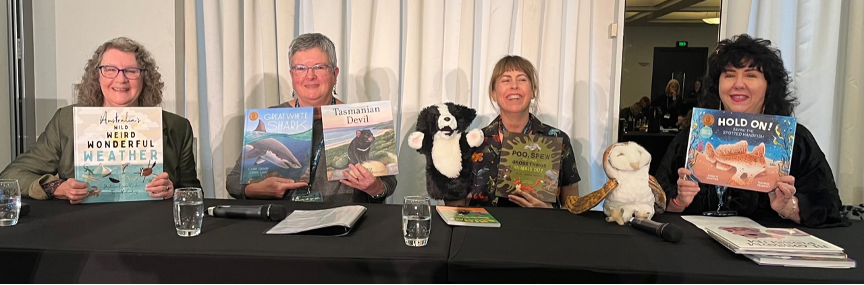
The reception rolled into the SCBWI Friday Night Book Fest, which fellow attendee Lian Tanner recently wrote about here. Each creator had three minutes, and three minutes only, to spruik their latest book to the crowd.  It was an exercise in tightly controlled chaos. Props were encouraged, and theatricality rewarded.


I’d prepared myself to talk about my new book, “Poo, Spew and Other Things Animals Do” by investing in some excellent puppets, one a border collie, the other a masked owl (“Tax deductible!”, I muttered to myself, as I frenziedly ordered one expensive fluffy toy after another from the interwebs, “Tax deductible!”).  Not only did the puppets help me to explain how owls digest their food, and how dogs can be used to find where owls might be hiding, but they also answered questions on my behalf when I was too nervous to speak to people directly.


I wasn’t the only person using fluffy toys to promote their latest creation.  Lian Tanner brought along her friend Rita the Duck to promote “Rita’s Revenge”, and Ali Stegart used a bush-stone curlew puppet to dance the story of “Boogie Woogie Bird”.  There was performance poetry, character cosplay and even the occasional erratically thrown puppet (sorry if I hit any of you).


The following night was the official CBCA conference dinner.  Once inside the venue, the butterflies emerged from their puffer-jacket cocoons, and made a bee-line to the bar, where a selection of delicious nectars had been prepared for their delectation.  There was much flitting about, fluttering of hands, sipping of bubbles and coveting of other people’s shiny dresses. 

Picture of the dinner from Claire Saxby’s table POV (thanks for the photo, Claire!)


Each dinner table was hosted by a creator, and decorated with their books and associated objects.  My lovely publisher, Briana Melideo from CSIRO Publishing, made showbags for our table, full of books and shiny CSIRO swag, and had selflessly stolen her son’s poo emoji soft toy to add to the table’s general scatological vibes.   My table was largely dedicated to my new book, “Poo, Spew and Other Gross Things Animals Do”, which I wrote with koala poo PhD Dr Romane Cristescu, and is illustrated by Rachel Tribout.  I’d previously warned people that conversation at my table was unlikely to be considered polite by conventional standards. Fortunately, my co-diners were more than happy to talk about revolting animal science, owl pellets, and the terrible exploits of their household pets.

CSIRO Publisher Briana Melideo and author Nic Gill flaunt their soft toy collection at the CBCA dinner

After the main course had been scoffed down, special guests fluttered onto the stage. The Australian Mint introducing their new, Diary of a Wombat-themed one dollar coin, with Jackie French making a guest appearance, and Margaret Wild was honored with the CBCA Lifetime Achievement Award.


After the final day of the conference, a dozen or so SCBWI members got together at the Civic Hotel – a great chance for us interstate interlopers to chat to the locals, and to congratulate them on the great work they’d done pulling together some really fun conference events.


The morning after the conference, we bunched together in dribs and drabs in the hotel lobby, preparing to fly back to our respective territories.  I looked down at my shirt – a rather loud number covered in a chaotic print – and noticed a flock of monarch butterflies flitting across the busy patterns.  Perhaps there was some order in the chaos after all.


And in keeping with the theme... Here are some fun butterfly facts!

  • Although native to the Americas, monarch butterflies can now be found all over the world.  They were first recorded in Australia in the 1870’s, where they are considered to be an invasive species, albeit a relatively benign one.
  • The world’s largest butterfly is the Queen Alexandra birdwing – with a wingspan of up to 30cm, this giant flapper can easily fly off with a small chihuahua*
  • Butterflies can actually be quite disgusting.  More than one species has been observed gorging on animal poo!  
  • For more information on the monarch butterfly in Australia, try this great article from Ann Jones, which also contains a link to an Off Track episode on these beautiful invaders. 

* Actually, no one has ever seen them do this.  But pretty sure they could take down a chihuahua if they wanted to.


Nicole Gill

Author