Local author and illustrator, Shanli Perkins, introduces us to a delightful story about a much loved family member – Bobbie Rotten – a mischievous Australian Terrier. Share her journey into self-publishing on a topic close to her heart.
I am a creative soul who loves to design, create and share laughter. I live near the beach on the North West Coast of Tasmania. With Covid-19 locking down our region earlier this year I needed to escape the woes of the world and decided to finish the children’s book I had planned in my head for more than three years.
I teach teenagers and an ex-student of mine, Krystal Clancy, was chosen to help me start the illustrations for my story. She showed me how to draw our furry, frantic pet. When my children were little, we adopted an Australian Terrier who filled our lives with so much love and trickery! He loved tormenting us with his antics and long after he died the stories remained. I thought the world now, more than ever, needs a laugh and a hug, so I sat for two weeks illustrating and writing a children’s book. It is a true story written in rhyme about our family pet named Bobbie Rotten.
I purposely kept the book black and white so children could imagine the colours, but to my surprise adults love the book too. The book Bobbie Rotten has visited local schools and the response has been wonderful. As we cannot hug each other easily at the moment, I have also helped create Bobbie Rotten cuddle cushions for children to use when they need a hug. Children have started making their own cuddle cushions with drawings of their own pet or with Bobbie Rotten. I have had a wonderful time sharing my story and creative ideas.
The responses and smiles I have received back from this project, have made my first-time attempt at story writing truly joyful. It has lifted my spirits and I think it has lifted the spirits of my readers too.
Bobbie Rotten is on its second print edition with limited numbers remaining. If you would like to purchase a copy of Bobbie Rotten and/or a cuddle cushion please message Shanli Perkins on Facebook. 😊
This week’s blog presents a wonderful array of books about ‘fitting in’ that are sure to tantalise readers of all ages. Thank you, Maureen for this great selection of title exploring those awkward and difficult momenta and events that life throws at all of us.
Andrew Plant’s dedication in his book Jump(2020) says “For everyone who has ever felt they don’t fit in – we make the world interesting!” This fun book is about a small Quig living in an alien city who questions his skills because he can’t jump like the rest of his group. Eventually, he does better than they do when he takes a leap of faith and discovers that he can fly.
Many of us feel we don’t fit in. For some, it’s constant because they are so different to everyone around them. For most of us, it’s usually only some of the time, in certain situations. We wonder why we can’t do something, no matter how much we try and practise. Or we wonder why things are different for us.
Authors over the years have taken this emotion and written about it because it’s such a great starting point. Here are some I have enjoyed –not in any order, but as I thought of them.
Wonder by R.J. Palacio (2012).
Auggie’s facial deformity prevents him from fitting in, when all he wants is to be the same as everyone else. Starting with Auggie’s narrative, the reader soon has other points of view of what and who Auggie is. This is a book about kindness and accepting people for who they are, not how they look. Middle school age
Elephant Me by Giles Andreae and Guy Parker-Rees (2020). All the young elephants show their skills to Elephant Almighty and are given their special name, but all Num-Num wants is to be himself, without emphasising his talents. He finally convinces the king that he is special and can become Elephant Me. Picture book
Giraffes Can’t Dance by Giles Andreae and Guy Parker-Rees (2001). All the animals show their skills when the music is right, but Gerald’s long legs won’t match the rhythms of the music and he’s teased by everyone. Suddenly he finds his own song and succeeds. This book works really well despite my dislike of anthropomorphism. Picture book
Eleanor Oliphant is Completely Fineby Gail Honeyman (2017). Eleanor is completely happy with her life until she realises that speaking her mind, saying exactly what she thinks as she thinks it, is not acceptable to many people. She is self-sufficient until she finds her great love and realises she needs to accept other people. Older readers/adult
Star Girl by Jerry Spinelli (2002). Stargirl is the non-conformist new student who does everything differently to everyone else and things no one else would consider. She is kind and considerate (too kind and considerate as a teenager perhaps?) and indirectly encourages others to break from their own moulds. Older readers
The Silence Between Us by Alison Gervais (2020). Maya, profoundly deaf, has to adapt to a hearing school after years of attending a school for the deaf. She learns that her deafness is part of her personality and that she is comfortable with that and doesn’t need to become part of the hearing world which a cochlear implant might achieve for her. Older readers
Spork by Kyo Maclear (2010). Spork’s mum is a spoon and his dad is a fork and he doesn’t fit into the world of the cutlery drawer. He wants to be wanted, and that comes when a baby arrives in the household and Spork is the perfect utensil for him. Picture book
Chrysanthemum by Kevin Henkes (1991). This book, its title shortened to THUG, is about systemic racism and the damaged US criminal system, that Black Lives Matter (becoming prominent again in 2020). Starr from a strong family unit witnesses the death of her unarmed friend Khalil at the hands of the police. She at first thought that her voice wouldn’t make a difference and finally realises she needs to speak out, which she does. Older reader/adult.
The 57 Bus: A true story of two teenagers and the crime that changed their lives by Dashka Slater (2017). While travelling on the 57 bus in California, Sasha, a white agender teen, had their dress set on fire by Richard, a black boy from the poor areas of town. This challenging story is the result of their regular 8 minute ride together. Richard has to overcome police stereotyping of him as a person and his perceives hate crime while Sasha has to convince everyone that they are not bitter or wanting to be avenged. A great story of compassion, about restorative justice and non-binary gender identity. Older older readers
Twig by Aura Parker (2016). No one notices Heidi the twig insect on her first day at school, none of the other students, nor the teacher, because she blends in so well. She has to learn to stand out and become an individual in her own right. Lots of counting and visual searching activities throughout. Picture book.
Which important titles do you think I have missed out? What would you like to add to the list?
And most importantly, before I finish… I hope you have seen the announcement of the 2020 Book of the Year winners and honour books. As always a great choice from the judges. Please check out the results if you haven’t already done so. https://cbca.org.au/winners-2020
Maureen Mann Retired teacher librarian and avid reader
This week, Emma Nuttal draws on personal and professional experience and the family’s reading preferences to consider the differences between print and digital reading. What do you think?
My children devour books. The school holiday treat is always a new book and a milkshake. These holidays, the book was done nearly as quickly as the milkshake.
Now, I’m not complaining. I love that my kids love books. It was a parenting goal of mine, and I’m proud that we’ve knocked that goal out of the park… and over the road… and into the next park. Truly, I am. It’s just that I can’t keep up!
The bookshelves in our house are overflowing – and there’s a huge range of reading material on them. I think it’s healthy, a bit like a balanced nutritional diet; a balance of reading material is good for you. It must be. There are mountain bike magazines stacked up next to the collection of Asterix comics, which cause the hefty science books to constantly tumble over. On the shelf above, we’ve put the ‘collections’ –the Roald Dahl collection, the Lord of the Rings set and literally ALL of the Percy Jackson books. We’ve recently added the David Walliams collections and the Emily Conolan books too. It’s our own little family library. In the busy-mess of family life, the local public library isn’t always an option. And the habit has to be fed…
One day, I was given an e-reader. I was hesitant at first. I had resisted for years. Actively avoided them. But, this was a gift and I’m not one to offend. So I used it. Only a little at first. But convenience crept in. A few long holidays and the deal was done - no more lugging big books around on long haul flights, I packed my whole holiday reading onto one device. But there’s a ‘but’. Well, actually a few.
I can’t see the cover every time I read. I can’t really tell how big it is or how far through it I am. I can’t gauge how much time I get to spend in the story, with the characters I’ve grown to love. I can’t even easily read the blurb or accidentally flick a chapter or 2 ahead (I only do it occasionally, and only ever very briefly!). I can’t easily borrow and lend with friends and family. I can’t smell the pages. I can’t feel the literal weight of the story. There is research that suggests that we can’t comprehend as well when we read on a screen, “The strong appeal of digital-based assessment and learning environments has led many educational systems to adopt them. As findings from the current work reveal, however, digital environments may not always be best suited to fostering deep comprehension and learning” (Delgado et al. 2018).
But there’s another ‘but’, what about that balanced reading diet? Screen reading is here to stay. Perhaps, as educators, we have the responsibility to teach students the comprehension skills required to effectively access digital AND paper texts. I’ve made the decision to balance my personal reading diet and as a parent, I’ve done the same. I provide a balance of digital, paper and audio reading material to my children. And they continue to devour books. Digital or otherwise. They don’t have the same hang-ups about screen reading as I do.
Some other reading diet decisions will torment them as parents.
Reference
Delgado, P; Vargas, C; Ackermon, R & Salmerón, L. (2018). Don't throw away your printed books: A meta-analysis on the effects of reading media on reading comprehension. Educational Research Review, 25, 23-38.
Emma Nuttall Teacher, Literacy Coach, avid reader and parent of readers
Editor's note: If you are looking to explore digital reading, a good place to start is through your local library. If you live in Tasmania, visit Libraries Tasmania and discover ebooks and magazines, audio books and audio storytelling.
An ongoing project to involve children in creative writing and self-publication now has a place for others to share and read these ‘stories in the impressive Kids’ Own Cubby at the Hobart Library. Find out more about Victoria Ryle’s work with children and how this is informing a doctoral study.
Kids' Own Cubby - with books to read!
“That was fun!” “That was better than I thought it would be!” Overheard
reactions as the class of 4/5s filed out of the children’s area of Hobart
library recently. They had just deposited their ‘published books’ in the
Library’s newly acquired
Kids’ Own Book Cubby
(Built by the
Clarence Plains Men’s Shed).
These cheerful children had each succeeded in publishing what I term a
micropublication in the space of two hours! A challenging task for the children,
and a valuable opportunity for me to observe with my researcher’s hat on. Based
on many years’ experience, I have noticed that the nature of this challenge is a
slippery beast depending on the age, expectations and abilities of the young
authors in question.
Creations from the Hobart Hotdogs
First, these bright and sparky 10 year-olds and their
teacher have to overcome a common misconception that the publishing process
centres on a writing task. This particular experience of publishing is about
creating a book on 8 pages that fit on a single side of a piece of A3 paper – so
little room for stories in chapters or other extended narratives! Rather it is a
multimodal and artifactual task (Pahl & Rowsell, 2012), that demands a
multi-layered weaving together of visual and written ideas and materials that
typically do not include graphite pencils, erasers or colouring pencils.
Children bring with them a wide variety of learning styles, individual
self-expression and understanding of the audience and purpose to this
time-limited task. While we had discussed the theme of ‘little joys’, as
individual authors they had control of the decision making process and were free
to deviate.
Many children dive into writing with confidence, but some children
need to chat while they rehearse, curate and bounce their ideas around. Some
children think visually, and some demonstrate a natural spatial awareness of the
layout and design of the eight pages including front and back cover.
An
open-ended approach makes for a good assessment opportunity for teachers,
revealing as it does the procrastinators, the collaborators, the perfectionists
and the dashers. Teachers are often surprised to notice that different children
than usual shine in this rich arts-based context.
Through my research journey to
date, I have deepened my understanding of this particular process of publishing
as constructed through relationships, and practice that is emergent, intuitive,
material, and embeds intra-action with the book as artefact. In short it is
embedded in the Deleuzian concept of affect (Deleuze & Guattari, 1987) providing
an encounter that delves beneath the surface features of a typical literacy
activity (Boldt & Leander, 2020; Sherbine, 2018).
The three classes who
participated in these September workshops, have been given the brief of
producing a collective narrative that they will illustrate, inspired by the work
of Tasmanian illustrator Daniel Gray-Burnett.
The book that will eventuate will be the inaugural publication to mark the
launch of Hobart Library’s Book Cubby.
In the meantime the Book Cubby is in
residence in the Hobart Library where the librarians report it has proved
popular during this school holidays. It is not fully complete, and currently
houses a small collection of books by children for children, including the Bee Book by children of Goodwood, All Emotions Allowed Here and
In the Tree Castle by young children from Goodstart Claremont. The Book Cubby
awaits many more books by young Tasmanian authors, and an official launch to
come.
Victoria Ryle
Victoria Ryle is a PhD candidate researching publishing
books with children as authors at the University of Tasmania. You can follow Victoria's researchhttps://www.publishingbookswithchildren.com/
She is also the
co-founder of Kids’ Own Publishing and
designed the prototype Kids’ Own Book Cubby in 2007. There are now 20 Book
Cubbies spread across Australia and New Zealand.
Boldt, G., & Leander, K. M.
(2020). Affect theory in reading research: Imagining the radical difference.
Reading Psychology, 41(6), 515-532. https://doi.org/10.1080/0270711.2020.1783137
Deleuze,
G., & Guattari, F. (1987). A thousand plateaus: Capitalism and schizophrenia. University of Minnesota Press.
Pahl, K., & Rowsell, J. (2012). Literacy and
education. SAGE Publications.
Sherbine, K. (2018, June). Track Star+ thing power: Be
(com) ing in the literacy workshop. Journal of Early Childhood Literacy.https://doi.org/10.1177/1468798418777847
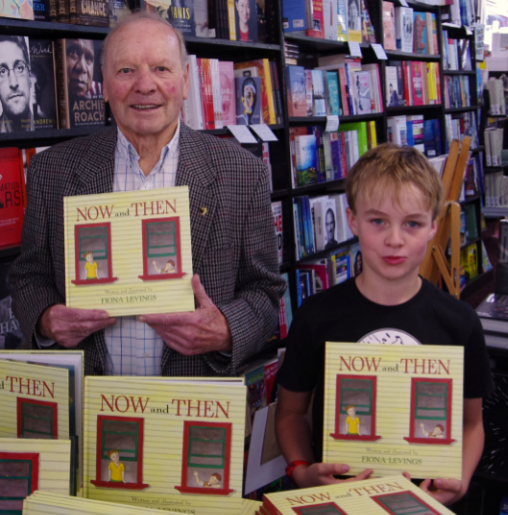
Fiona Levings reflects on the inspiration and historical perspectives inspired by her own home and captured so evocatively in her recent picture book, Now and Then. A fascinating examination of the history of a home, set in Margate, Tasmania.
I never expected to write a picture book about my house.
Cover of Now and Then by Fiona Levings.
We moved to Margate about ten years ago. The little house, sitting in the bush by a creek, had won us over instantly. We knew from the construction that it was built in the early 20th century but that was about it. Its history was a mystery - and with a new baby and busy lives, it was fixing to stay that way.
But the house had other ideas.
Four years ago a car parked in our drive and an older gentleman came to the door. A stranger; he introduced himself as Doug and told me that he used to live in my house. He had dropped by to visit the place where he grew up. Could he take a look around?
Doug grew up in the 1940’s and he had many memories of life at that time. Standing on the front verandah of the house he pointed at the window to the right of the front door, smiled, and said “that was my room.”Turning to look I spied my son Jem’s room through the window to the left and in that instant I saw the spread of a picture book: a room occupied by a modern child on the left and one belonging to a child eighty years ago, on the right. It was now and it was then.
The page spread that started it all.
I think most creative people would be familiar with that particular species of idea that won’t go away. Now and Then insisted on existence. With Doug’s permission, and having picked his mind further, the parallels and contrasts between his Margate life eighty years ago and that of Jem’s modern world had to be captured. Two boys, who live in the same house, go to the same school and play in the same creek in a little town near the end of the earth. It is one the smallest pieces of history I can imagine and yet, it works. Taking it into the classroom has been a joy as kids explore the illustrations to discover for themselves the ways our world has changed over time – and the ways that people have stayed the same.
Generations of kids have lived in our house and played in its creek. The world may have changed a lot over that time but some things can still be relied on.
And, you know, a few weeks after the book came out another car appeared in my driveway and another stranger, this time a lady, got out. Her name was Lynne and it turns out that she, too, grew up in this house, about fifty years ago. And what did she ask about first?
“Is the creek still there?”
Doug and Jem at the launch of Now and Then at Petrarch's, Launceston (December, 2019).
......................
Fiona Levings is a Tasmanian-based author and illustrator of children’s picture books. Now and Then, published by Forty South Publishing, was listed as a notable book in the 2020 CBCA Book Awards. Copies are available in bookstores or online at www.fortysouth.com.au.
The weekly grocery shop provides access to books – this week Lyndon Riggall considers the merits of a recent commercial promotion.
It’s a fascinating thing, the use of children’s merchandise as a means of encouraging commercial loyalty. Newspapers have been trying it for years to boost circulation (with there being no more sure sign of a struggling rag than a “one-a-day” DVD collecting promotion), and now it seems as if a trip to the supermarket without some kind of Ooshie, Little Shop or Discovery Garden product is a trip wasted—though where many of these objects end up for the long haul can only be a topic for grim speculation. You can imagine my surprise, then, when Coles announced that their latest venture was to hand out Little Treehouse books by Andy Griffiths and Terry Denton with every purchase.
The works of Griffiths and Denton are, in my mind, a curious example of the disparity between the CBCA’s consistent judgment and the nature of children’s reading on the ground level. Kids go to the Just… series and the Treehouse books in droves, but questions of their literary merit mean that they typically miss out on recognition of the kind offered by the Children’s Book of the Year awards. The concerns that might be directed towards Griffiths and Denton in times past continue with this mass-market publication, including the usual accusations that they produce texts that are “potty humour,” “promote violence” or are “disgusting” (the claims of which, I have no doubt, serve often to increase rather than diminish their readership). Griffiths has always said that his work is a subversive riff on such old-fashioned improvement literature as Hilaire Belloc’s Cautionary Tales, but whether the books are harmless fun in a world with no boundaries or encouragement of reckless misbehaviour is nevertheless up for debate. My weighing in on the issue: are the Little Treehouse books really inappropriate for children’s reading? No. Do kids love them? You bet they do.
Research conducted by Coles itself found that 88% of parents said that they encouraged their children to read. What percentage of parents regularly purchased books for their children? 22%. We know that access to books make a huge difference in the literacy of children, and even if the Little Treehouse campaign was not supplemented with links to the Indigenous Literacy Foundation and a creative writing competition, it would be hard to argue that the charming, mischievous Treehouse books aren’t a huge step in the right direction from a company whose previous best efforts included mass production of inedible miniature plastic versions of groceries.
As educators, parents, and members of the community, we know that the solution to illiteracy is found in a number of places… it is found in libraries, in schools, in bookshops and in the corners of every loungeroom and bedroom in the country. Nevertheless, we need gateways. We need books that enchant, inspire, and give children a rush of glee and dissident delight. We need books that fall into hands unbidden; that bring reading into everyday life, dragging it kicking and screaming into places we never saw it before; challenging the notions of who readers are, and what being a reader is.
Should we need a major supermarket chain to shell out free books just to get kids reading? I wish we didn’t. Nevertheless, somewhere in Australia, a child is holding a tiny book from one of the most successful teams in our country’s legacy of children’s literature, and they only have it because they got it for free at a supermarket. They are reading and laughing. Tomorrow, they are going to want more.
I hope that we will, eventually, have a plan for tomorrow. Today, I’m just glad that they can find Andy and Terry in the treehouse.
Lyndon Riggall is a writer and teacher from Launceston. You can find him at http://lyndonriggall.com and @lyndonriggall on Twitter.
This week’s post presents a snapshot of doctoral research undertaken by Halyna Pavlyshyn. Her insights and discussion have a strong focus on visual literacy as Halyna compares and contrasts the techniques employed by illustrators in these selected titles.
The comparison of Australian and Ukrainian picturebooks representing war reveals a number of tendencies. While the war is condemned in both cultures - it is represented as a gory, horrific and destructive experience - the message is conveyed differently. In Australia, war narratives usually focus on the First World War, the legend of Anzacs and the lives of ordinary people who either went to war or who stayed in Australia hoping that their family members would return home safe. The war mostly takes place in Europe. The Australian picturebooks representing war often explore such themes as death, orphanhood, separation, military service, national identity, mateship, and the impact of war on its survivors (e.g. My Mother’s Eyes; Ride, Ricardo, Ride; Dreaming Soldiers).
Ride Ricardo, Ride! Dreaming Soldiers
Phil Cummings & Shane Devries Catherine Bauer & Shane McGrath
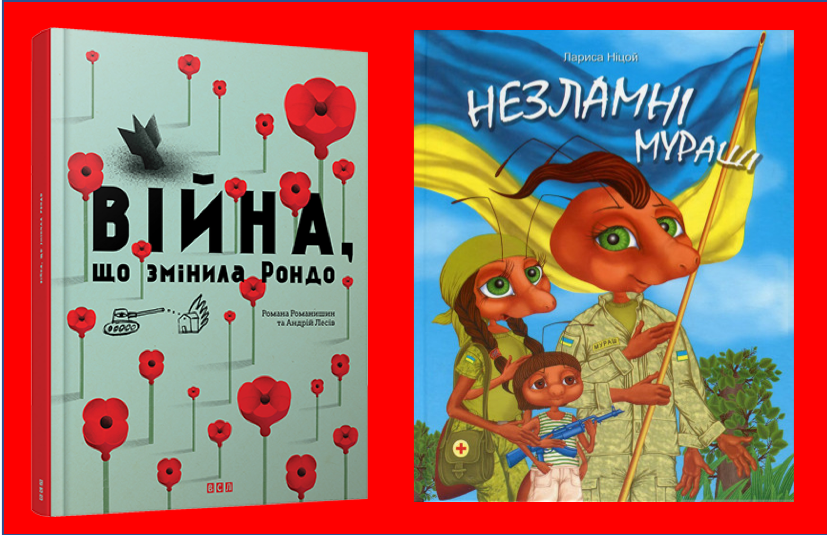
In contrast, the Ukrainian contemporary picturebooks about war are mostly written as tales with animal-like characters. Even though they refer to the current events in Ukraine, the war takes place in the imaginary land. The books show the horrors and the devastating consequences of war; however, they do it in a careful manner. It seems that despite condemning war, the authors attempt to give hope to their young readers and to protect them from the harsh reality (e.g. The War that Changed the Rondo, Adamantine Ants).
The War that Changed Rondo Adamantine Ants
Andriy Lesiv & Romana Romanyshyn Larysa Nicov
In My Mother's Eyes Mark Wilson
In addition, the Australian and Ukrainian war narratives employ distinct colour palettes to represent war. The sand-like yellow, earthy umbra, brownish sepia and clay orange, less often deep blue, as well as black and white are prevailing colours used to represent war in the Australian picturebooks. The distinction is drawn between Europe (the land of war) and Australia (beautiful homeland). This can be seen prominently in My Mother’s Eyes by Mark Wilson, where the colours used for depicting war are black, red, orange and yellow; and the colours to represent Australia are green and blue colours of the peaceful sky and the bushland.
Whereas, the Ukrainian picturebooks representing war show the contrast not so much in space, but in time: before the war and after war. The vibrant poppy red, bright orange, lemon-like yellow, spring-grass-green, light blue and white are used to depict life before the war. They are contrasted with pitch-dark black, fern-like-green, dark brown, bloody red, deep violet and dark blue for the illustrations representing the wartime and the time after the war. The colours, therefore, emphasise the difference between the peaceful time and the wartime in a war zone. The prominent example is the book The War that Changed Rondo by Andriy Lesiv and Romana Romanyshyn. At the end of the Ukrainian picturebooks, the colours are changed: they are not as vivid and bright as they used to be; however, not as gloomy as during the war. This technique might be used by the authors to give hope to the young Ukrainian readers witnessing the Russo-Ukrainian war which started in 2014.
Adamantine Ants retold in Ukrainian.
Halyna Pavlyshyn PhD Candidate
This publication is a part of Halyna Pavlyshyn’s PhD research supervised by Dr Angela Thomas, Dr Damon Thomas and Prof Mike Corbett
You can find out more about these titles online.
Links for the Ukrainian picturebooks:
The picturebook preview on the official publisher’s website for Війна, що змінила Рондо (2015) [Viyna shcho Zminyla Rondo] or The War that Changed Rondo by Andriy Lesiv and Romana Romanyshyn: https://starylev.com.ua/viyna-shcho-zminyla-rondo
Mum’s are invited to put their feet up this Father’s Day and let the Dads share in some of the bedtime rituals – such as reading the bedtime story! This week’s blogger is Felicity Sly, a Teacher Librarian at Don College in Devonport and CBCA Tas Committee Member.
As Father’s Day looms, it seemed like a perfect opportunity to have a look at some titles that feature dads, and to consider the role of dads in reading to children and the effect this has on the future literacy and reading.
“… Research shows that fathers are particularly influential for children’s language and literacy development, which means they are a promising point of intervention for efforts to improve children’s language and literacy”(Fatherhood Research and Practice Network, 2019, para 1).Not only do children benefit from being read to by their fathers, but fathers have also reported that they feel closer to their children through sharing this bedtime activity. It has also been noted that fathers interact differently during the reading session, than do mothers, with conversations generally ranging far beyond the content in the book being read (Schwanenflugel & Knapp, 2019).
Frank Woodley’s video provides 5 tips for reading aloud to children; especially targeting dads in his suggestions.
Tip 1: Be playful
Tip 2: Add sound effects
Tip 3: Add actions
Tip 4: Give life to the pictures
Tip 5: Get into character
Penguin Books Australia. (2020, August 23). Frank Woodley 5 tips for reading aloud to children.
After watching the Fran Woodley video view other men reading picture books in this video compilation by Penguin (2020).
Dads don’t feature prominently in picture books, so here are some Australian titles to get you started.
The Man Who Loved Boxes (Stephen Michael King): Dad isn’t great at expressing love in words, but is great at doing things with his son.
I Spy Dad! (Janeen Brian & Chantal Stewart): There are lots of dads, but finally the narrator spies her dad.
Harry and Hopper (Margaret Wild & Freya Blackwood): Dad has to break the news that the beloved dog, Hopper has died, and help his son to cope with loss.
Cheeky Monkey (Andrew Daddo & Emma Quay): Dad is doing the hands on activities with his son, with mum as the incidental adult in the story.
Grandma's Storytime. (2020, August 25). Cheeky Monkey read by Grandma's Storytime.
My Dad Thinks He’s Funny (Katrina Germein and Tom Jellett): Full of dad jokes!
Story Station. (2017, July 10). My dad thinks he's funny.
Kisses for Daddy (Frances Watts & David Legge):
In the only anthropomorphic book in this list Baby Bear doesn’t want to kiss his parents goodnight…but Daddy Bear whilst performing the bath/bedtime routine, manages to give lots of kisses, and finally receives a kiss and a hug.
Chrysalis Montessori. (2019, December 2). Kisses for daddy.
Molly and Her Dad (Jan Ormerod & Carol Thompson): The only title in this list that is overtly ethnically diverse starts with memories of her Dad, before he arrives from overseas to entertain her friends.
Sydney Kate. (2019, June 10). Molly and her dad.
I can’t create a list without including Bob Graham’s dads. They are kind and involved in their family: Queenie the Bantam, Let’s Get a Pup! and The Trouble with Dogs!are great places to start.
So…Dads, if you’re not already sharing the story reading in your home, it’s a great time to start.
Happy Father’s Day
References
Fatherhood Research and Practice Network. (2016). The benefits of fathers reading to their children: Tips for fatherhood programs and dads. National Responsible Fatherhood Clearinghouse. https://www.frpn.org/asset/the-benefits-fathers-reading-their-children-tips-fatherhood-programs-and-dads>
Quinn, S. (2009). The depictions of fathers and children in best-selling picture books in the United States: A hybrid semiotic analysis. Fathering: A Journal of Theory, Research, and Practice About Men as Fathers, 7(2), 144-158. https://doi.org/10.3149/fth.0702.140
Schwanenflugel, P. J. & Knapp, N. F. (2019, June 16). A father's role(s) in reading. Psychology Today. https://www.psychologytoday.com/us/blog/reading-minds/201906/fathers-roles-in-reading