Welcome to the blog of the Tasmanian branch of the Children's Book Council of Australia!

Friday, 16 June 2023

Tassie Rhymes for Little tigers – Read aloud to babies every day!

This week Narelda Joy, Tasmanian author and illustrator, provides behind the scenes insights into her publication of a nursery rhyme  book for young Tasmanians and an accompanying braille edition.


In 2020 I was thrilled to be chosen to create a book for the Help Babies Learn project, an initiative of Toast for Kids Charity Inc. Having had first hand experience of the low literacy rate in Tasmanian schools, I knew the idea behind the project was important - to encourage parents to read aloud to babies and young children by providing a *free book to the parents of Tasmanian newborns, and to create a braille and low vision companion version of the same book, so that parents with print disabilities would have the same opportunity.


Reading aloud to a newborn baby, toddler, or preschooler every day is important because it provides them with the building blocks of language, and introduces them to words and phrases that aren’t used in everyday talk. Stronger connections are formed in their brains from the repetition of words and sentences, and this helps them process language faster, and be ahead when they start school. If they don’t have these strong brain connections by kindergarten, it is much harder for them to learn. 


Spending time reading aloud to a child also develops a special bond that makes them feel loved and secure, exercises their concentration and imagination, and creates a fun, positive experience of reading. Kids that read succeed! Interestingly it doesn’t matter what you read aloud to a newborn baby, as it’s the sound of the words, the cadence of your voice, and your expressions that they absorb. It could be the Financial Times, Australian Dairyfarmer, a brochure on a steam train ride, or even Shakespeare! 


A book with a Tasmanian theme, as defined by my brief, was far more fun and appealing to me! I decide that I wanted the book to feature the quirks and uniqueness of Tasmanian animals, as well as the different environments in which they live. I wanted the book to have multigenerational appeal, to encourage older siblings to read aloud to younger, and to hopefully peak the interest of adults into learning more about the animals with their children. The book also includes a counting game in which the reader looks for animals hidden in each illustration, and the palawa kani names of the animals in the book.


After many hours of research into Tasmanian animals, writing and refining the sixteen rhymes, illustrating the animals and the landscapes, designing the layout, typesetting, editing and proofreading, Tassie Rhymes for Little Tigers was sent to the printer, and then officially published in August 2022.
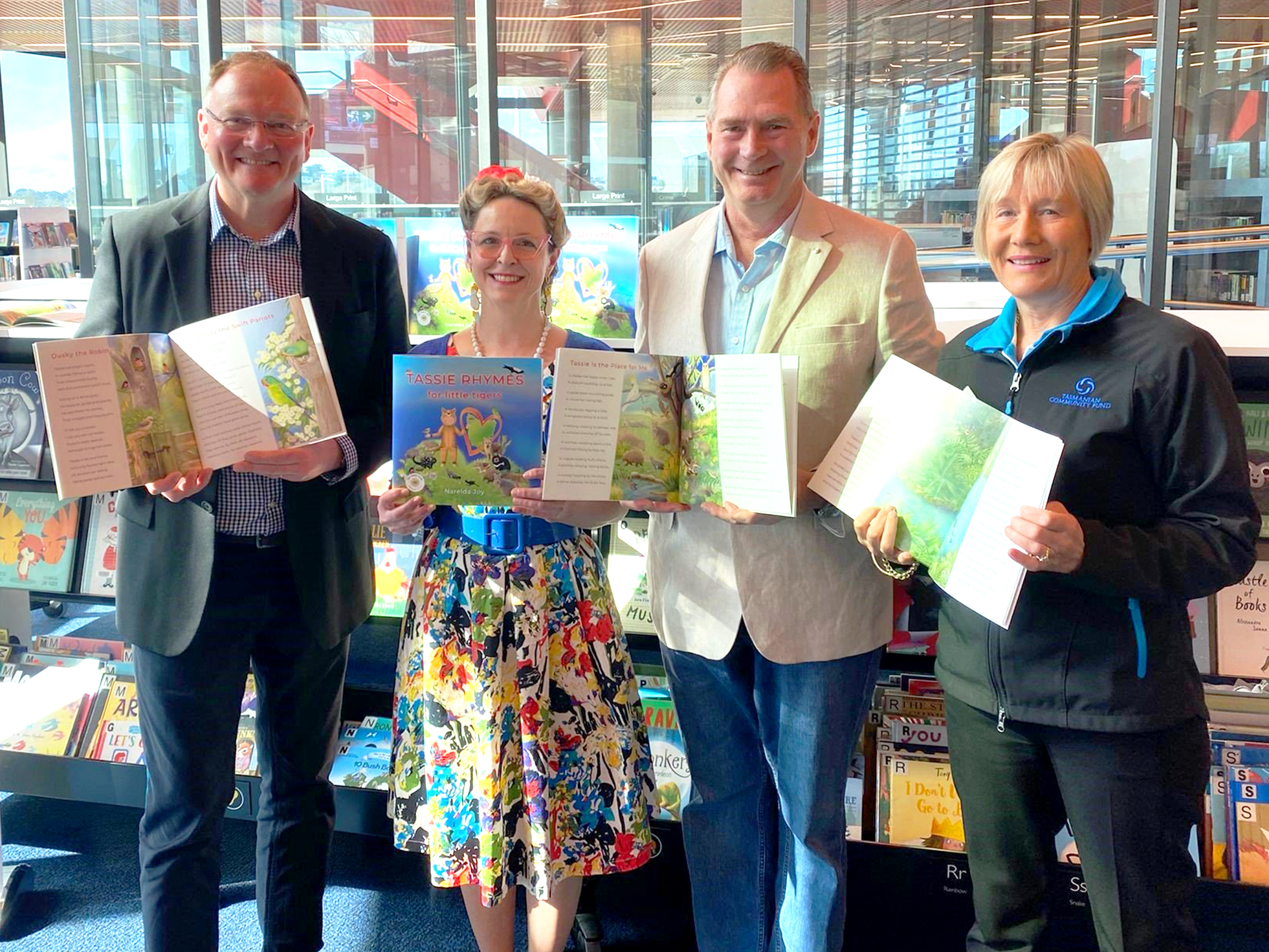
Print book launched by Roger Jaensch (Tasmanian Minister for Education, Children and Youth)

L to R: Roger Jaensch, Narelda Joy, Steve Martin (President Toast for Kids Charity Inc, 
Sally Darke, (TAS Community Fund)


I then set to work on the braille and low vision companion version. It was such an honour to work in collaboration with the team at Next Sense (previously known as the Royal Institute for Deaf and Blind Children) to make this happen. This institute has been supporting those with print disabilities since 1860, and believes that “everyone should have the power to reach their potential”… I also believe this!


I quickly discovered that the illustrations needed to be completely different to my usual detailed textural style, in order for them to be viewed by someone with low vision. I started from scratch and simplified each animal into groups of shapes, and used thick black or white lines around each shape to define them. I then chose the colours for the shapes specifically to provide a high contrast between each of the elements on the page.

A comparison of the Tasmanian devil illustration by Narelda Joy

 - showing a high contrast image for low vision on the left. © Narelda Joy


The sixteen rhymes from the original book, which feature Tasmanian animals, remained unchanged, as did the translations of the animal names into palawa kani, (and I’d like to thank the Tasmanian Aboriginal Centre for providing those). However other incidental text within the book needed abridging, for as I have learnt, the amount of braille that will fit on a single page is 40 characters across and 20 lines down. It was important that the words in braille on the left side of a double page spread were replicated exactly, in a large size font suitable for a person with low vision, on the right side of the spread, to enable a parent with low vision and a child without any vision, to read along together (or vice versa). 


The illustrations were sized to fit any available space that remained on the low vision (right-hand side) pages. The book became quite thick, as each page is actually an A3 sized paper folded in half, so that the dot impressions of the braille do not impact the low vision text on the reverse.


Her Excellency, the Honourable Barbara Baker AC, Governor of Tasmania launched this braille and low vision version at Government House. That night, a mother of three vision-impaired young children contacted me, after the launch was reported on the TV news, and we were able to personally deliver her a copy of the book the next morning!

Braille and Low Vision companion version book launched by

Her Excellency, the Honourable Barbara Baker AC, Governor of Tasmania.

L to R: Sonali Marathe (Manager, Accessibility and Inclusion, Next Sense),

Steve Martin (President Toast for Kids Charity Inc), the Honourable Barbara Baker AC,
Narelda Joy


I was genuinely shocked when I heard that there were very few books for young children with visual impairment, and that most were home-made by parents. Hopefully this book will be a step in the right direction to rectify this. There are so many exciting possibilities available, for example Next Sense have the ability to produce a braille outline of an illustrated character so that a child can trace it with their fingers, or a 3D model of an animal that a child can hold and feel while the book is being read, to get a sense of its shape.


I’d like to thank Steve Martin and the Toast for Kids Committee, for their enthusiasm and determination to create these two books, our generous sponsors, and especially the CBCA Tasmanian Branch for their support.


My hope is that both versions of Tassie Rhymes for Little Tigers will foster and encourage a love of reading that spreads throughout Tasmania, and continues for generations of Tasmanians to come.


Narelda Joy

Award winning children’s book illustrator, author and designer.


*If you are the parent of a newborn, please refer to the Toast for Kids Charity Inc. Facebook page for the terms and conditions of receiving a “free” book, or contact T4K directly. https://www.facebook.com/toastforkids/


Book signing in a Hobart bookstore
© Narelda Joy


If you are a member of the general public, the original book is available for purchase in Tasmanian bookshops, or through T4K, for $20. The braille and low vision version has a high production cost as each is individually printed, and as such will be printed on demand. Please contact T4K directly for pricing and details of how to obtain this version. 


www.nareldajoy.com.au
https://nareldajoy.wordpress.com
https://www.facebook.com/NareldaJoyAuthorIllustrator/


Saturday, 27 May 2023

So many words…so why can’t I find the one I need?

A post that celebrates the sharing of favourite authors and provoking reciprocal responses. Felicity has captured that special relationship and magic moment of shared pleasure – I too can’t find the perfect word!


A Google search (#ididtheresearch) tells me that there are somewhere between 750 thousand and one million words in the English language. Susie Dent (if you haven’t already, check our 8 out of 10 Cats Does Countdown) suggests we know forty thousand words, but only use about twenty thousand of them. With so many words, why can’t I find the one word that expresses the thrill and enjoyment I get when someone loves the same author I do? 


The two words Google gave me are compersion, the positive thoughts derived from knowing of another person’s gratifying experience; and freudenfreude (the opposite of schadenfreude) - the bliss we feel when someone else succeeds. But they aren’t the right words to describe my feeling.


Daughter of the Forest
by Juliet Marillier

I love books by New Zealand born and resident West Australian author, Juliet Marillier. This love started when my mother purchased the second book in the Sevenwaters series for my birthday many years ago…I read the first chapter and realised that a love affair was born, and that I needed to stop reading and buy the first book before I could continue reading my birthday present. My mum gave me the gift that keeps on giving.


Sevenwaters series by Juliet Marillier

I purchased some of Juliet Marillier’s books for my workplace. They were not borrowed, so they have been withdrawn - based on our weeding policy - despite recommending them to many readers. I have mentioned them, ad nauseum, on any social media book related post. I may have even blogged about them in the past…and now, finally, I have two work colleagues hooked, and I am supplying their reading from my own library. And now I need a word to describe how happy this makes me feel. To have someone in my immediate sphere, other than my three children, love these books is a joy. As one book is returned, I pull another from the shelf and position it on my desk, ready to hand it over when the staff member walks past. This can go on giving me joy for months, as I have 25 Marillier titles on my bookshelf.


So, dear reader (#bridgerton) please come up with the word I need to describe my joy…we can’t all have the same forty thousand words in our lexicon…and I need that word. Surely it is sitting somewhere in the other 710 thousand words I don’t know! 


Please also post in the comments the name of your favourite author, so you too have the chance of experiencing this un-named feeling. I’m also happy for you to invent the word I need!


Felicity Sly is Teacher Librarian at Don College, Devonport and on the committee of CBCA Tasmania Branch.


Editor’s note: Thank you Felicity – you have provided the spark for me to return to one of my favourite authors who I have not visited for some time. I have series to complete – The Warrior’s Bard – here I come! Evidence that reciprocity is at work.

Warrior Bards trilogy by Juliet Marillier


Saturday, 20 May 2023

Fiction, Non Fiction or Both?

Booksellers have their finger on the pulse (or is that eye on the page) when it comes to observing trends in the industry. This week Bronwyn, from Hobart Bookshop, shares her thoughts on publishing in the field of children’s non-fiction. This post is sure to resonate when we consider the range of books appearing on recent award lists and on the shelves. 


There are many trends a bookseller gets to watch come and go. These can include particular themes - such as the time we were receiving more books about llamas than could ever be reasonably necessary - or choices in fonts and cover illustration styles.  


Tasmanian Devil, by Claire Saxby (2023)
Walker Books
Look inside

A notable trend that appears to be on the increase is the morphing of fiction and non-fiction books for children. A beautiful example of where this works is in Tasmanian Devil by Claire Saxby. The book is both a story and a non-fiction information source, with the two elements clearly differentiated: displayed separately and in different fonts. This allows for the book to be read in two ways, doubling its purpose and enjoyment. (There are other examples which are not as successful and generally where they seem to go wrong is that you can’t really tell which side of the fence the book is trying to sit on.)


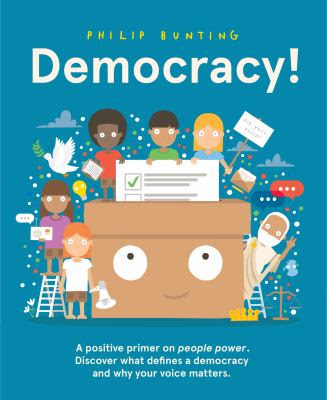
Democracy, by Philip Bunting (2023)
Hardie Grant
Look inside


Another aspect of this trend is the decrease in the amount of photography that is being used in non-fiction books.  Books produced using illustrations are now more common – some in cartoon-like styles with successful examples including many of the recent books by Philip Bunting including his new release Democracy. Others use beautiful art which would be quite at home in any picture book. 


Earth, Knowledge, Genius! (2022)
Dorling Kindersley (DK)
Look inside to see a combination
of both techniques.

It’s interesting to ponder the reasons for the more common use of illustrations. Using a single illustrator can give a book a more consistent tone, which photography obtained from different sources can struggle to create. Some subject matters are easier to draw than photograph (e.g. atoms and microbes) and others are more palatable to look at in illustration form (e.g. inside the human body).  However, I think there are two main underlying reasons for the bulk shift in these types of books.  The first is the legal and accounting processes that are involved in the production of the book with increasing complexity of licensing photos - and the second is the rise of the internet as a reference source (although this second factor has more influence with older readers). Generally, it is some of the biggest children’s book publishers such as National Geographic or DK (and some others directly targeted at school markets) that are still using photography consistently.


Feedback from several librarians who have noticed this change suggests that children are less likely to believe facts they read in illustrated books rather than those with photos whose realistic nature backs up the content. This may also hark back to our own childhoods where an encyclopedia with photos included (if you were lucky) was the common source of information for researching school projects.  Potentially the use of the internet as the source of all knowledge for older students means that non-fiction books are needing to become more enjoyable to read – in other words less like an encyclopedia. 


If the trend continues (and I expect that it will), then younger children will be growing up with non-fiction books that are mostly illustrated, and the expectation that non-fiction books should have photographs will decrease, as they will simply not be as common. From my point of view as an independent bookseller, I am trying to continue to support non-fiction books that are produced using photographs so that both options are available to our readers; however to ignore all the beautifully illustrated non-fiction books would be to miss out on many wonderful resources. Being aware of these changes is likely to be the first step in ensuring that the value of non-fiction books is not diminished at a time when online information sources are so easy to access.


Bronwyn Chalke 

The Hobart Bookshop 

W: https://www.hobartbookshop.com.au/

FB: https://www.facebook.com/HobartBookshop/ 

T: https://twitter.com/HobartBookshop 

Saturday, 13 May 2023

Reading Routines – How do we design routines that form effective reading habits?

When children see an adult engrossed in a book it conveys a positive message about the act of reading. This week, Emma identifies this as one influencer in establishing effective reading habits in children. 


I was talking recently with a friend about the habits (quirky and otherwise) that we form over time. We found we had some similar habits, and some that were amusing to the other! I did some reading about forming habits, and, as you would expect, habits form when you repeat a routine over and over. And for this to happen, one needs some sort of motivator to get the ball rolling. 


This also suggests habits can be intentionally formed. And unintentionally formed. 


For me, improving habits associated with good sleep and exercise have been a high priority of late. Amongst other factors, choosing the right music or podcast has been key to building, and maintaining, enthusiasm towards exercise. The same can be said for reading and sleep. A really engaging book, and a solid routine around that, has led to improved quality of sleep. The associated routines to further support this, can also promote wonderful new habits. A fitting example is to always carry a book (or a kindle in my case) for those times when you are out, and lucky enough to find yourself with 5 minutes to spare.


Frederick Backman’s plot lines and character development have contributed to my renewed routines, thus rejuvenating my own reading habits. Would less engaging texts achieve the same level of commitment to a new routine? I very much doubt it!


Schools are highly structured places – an ordinary school day is based on a series of routines. If we know that these routines can be habit-forming, we have a responsibility as parents and as educators to ensure that the good ones (habits that is!) are lasting.


Group mentality cannot be overlooked as a tool to support the formation of lasting habits. A ‘goodreads’ approach to classroom reading programs, where children are recommending texts to each other, can also be incredibly powerful. As can role modelling good habits ourselves, reading and otherwise. I would go as far as to say that role modelling is one of the most powerful teaching tools available. 

To build strong and lasting reading habits, we can support young readers by:

- Creating engaging reading environments; 

- Ensuring access to high quality reading material readily; 

- Providing a variety of daily reading opportunities and structures; 

- Empowering the broader group as motivators and supporters of each other as readers; and 

- Role modelling our reading habits to create lasting, positive reading habits.


Maybe as educators we just need to make a habit out of making habits?


Emma Nuttall
Deputy Head of Junior School - Wellbeing | Teacher


Saturday, 6 May 2023

Ready Set Go – National Simultaneous Storytime is nearly here.

Are you ready to enjoy National Simultaneous Storytime at your local public or school library or other venue where kids gather? Find out what's happening in your area on Wednesday 24 May, dust off those running shoes and register to help celebrate this wonderful event. Get ready, get set, then go!


The National Simultaneous Storytime (NSS) is an Australia-wide group reading event run by the Australian Library and Information Association (ALIA), where schools, libraries and other institutions bring  children together to read the same picture book at the same time –across the country! Registering for the event has great benefits, providing access to a range of electronic resources, including digital presentations of the book. The digital version PDF version of the book allows for sharing on electronic screens for easier viewing and still allows for the reader to add sound effects and voice animations as part of the reading. The ALIA NSS page includes links to Register (for free), Buy Merchandise and Buy the Book (though I suggest you check your local book store or library as your first option).


However, registering is not just about accessing resources, it is about being counted. Participation numbers provide data on just how many people were involved in the event and helps measure its success and relevance. ALIA and its supporters invest considerable time and effort to organise and promote this event and libraries and literacy organisations leverage this at the local level to make this an event to savour, celebrate and enjoy by targeting key stakeholders - teachers, parents and children. In a time when support for libraries is under the microscope getting counted…counts!  


For inspiration; in 2018 over 1,062,230 participants at over 8,255 locations across Australia took part in National Simultaneous Storytime. In 2020 there were over 1,297,000 participants at over 14,469 locations, including participants from New Zealand. In 2022 there were almost 2 million participants  simultaneously reading Family Tree by Josh Pyke in around 33,000 locations. Such figures are testimony to the way we value reading and reading aloud to children.

The Speedy Sloth (2022). Scholastic.

This year the book to read and share is The Speedy Sloth written by Rebecca Young and illustrated by Heath McKenzie. This is a delightful and funny story with some positive messages as Spike learns a lot about determination and perseverance as she takes on the faster animals in the jungle. Most importantly, Spike learns to be proud of her own achievements.


Each year, the chosen text specifically targets younger children but the shared reading experience is such fun that older students can also enjoy being part of the event. Here are some ideas to get you started:

  • Run a “Crazy Running Shoes” competition – encourage teacher and other adults to participate.
  • A school assembly – involve teachers to act out the different characters – sloths and the race participants – and transform the ‘book’ into a ‘performance’. Alternatively, older students could perform the book. Invite parents to participate.
  • Have children make and decorate and sloth mask to wear to the book reading.
  • Sloth mask template from ALIA's NSS page
  • Plan a “Buddy” activity, with older children sharing the book with younger children, or completing an activity together as a follow up. 
  • Secondary drama or arts students visit a nearby primary school to lead a simultaneous story time activity.
  • Readers’ Theatre type activities are a great way to encourage read aloud skills in older children. 
  • Investigate sloths, jungles, jungle animals and the Urban Sloth Project.
  • There are loads of other great ideas to support this year’s NSS on the ALIA NSS page including free downloadable graphics – a great way to promote the event to your community and a number of other activities including a template for making a sloth mask.
  • Search for other resources such as those available via Scholastic, a partner in this event and Learn from Play (a NSS supporter).

Find out what is happening in your local area – ask at your school library or day care centre and Tasmanian readers can visit Libraries Tasmania to register for a visit at your local library.

Speedy Sloth trailer from Scholastic Australia

We all know that reading aloud is vitally important and having fun with books is a great way to hook children into reading. With this post as a starting point you can easily get ready, get set and then GO on the 24 May 2023.  Don’t be a sloth – register today!


Jennie Bales

CBCA Tasmania Social Media Coordinator, read and retired teacher librarian and adjunct lecturer.

Friday, 28 April 2023

My Favourite Author is a Robot!

Children’s Publishing and Artificial Intelligence


by Lyndon Riggall


You could be forgiven for thinking that we were living in an episode of Charlie Brooker’s Black Mirror or a Ray Bradbury short story. The product is called Oscar, a mobile application in which, with a few button presses (selecting characters, story details, and even a moral message), a bespoke bedtime story is generated by an artificial intelligence, tailored to your requests and/or your child’s specific interests. It’ll even throw in the illustrations. You can paint me surprised that when the AI revolution came, it came for the creatives just as quickly as it came for everyone else. I can remember at school being comforted by my careers counsellors that my ambition to be a writer put me in a field that was lovingly cocooned from threats of automation. I suspect now that some of those flow charts have had to be updated. Goodnight sweet princes and princesses, may flights of coding sing you to your rest.


Alice and Sparkle, 2022,
created by Ammaar Reshi

It didn’t take long to bring us here. Within weeks of widespread access to artificial intelligence tools like ChatGPT and art creator MidJourney, the designer Ammaar Reshi published the first AI-generated picture book, called Alice and Sparkle (fittingly, about a girl who becomes friends with a robot), which was created entirely by prompts fed into online tools. The work had understandable and predictable flaws (pedestrian sentences, clichés, odd illustrations with claw-like hands, inconsistency of lighting and shadow and weird objects floating the background) but it was also, inarguably, a children’s book of comparable quality to many that get published. What does it mean that a picture book can now be created with almost no human input whatsoever? 


The first quagmire we find ourselves traversing is that of copyright. For the time being, perhaps, the most useful precedent is that of the “monkey selfie,” in which British wildlife photographer David Slater had his camera operated by a curious Celebes-crested macaque, which then took several photos of itself. While hotly contested to this day, it has been the general legal understanding that no-one owns these photos. They were taken with Slater’s equipment, but he is not the photographer, and a non-human cannot be said to hold copyright for an artistic work. Artificial Intelligence outputs are usually considered to follow the same logic, but it’s also more complicated than that. The San Francisco Ballet’s Instagram page became a hot-bed of anger late last year when the company used generated images to produce promotional pictures for their performance of The Nutcracker. Many in the comments argued that these (admittedly captivating) outputs could only be generated because of the hard work of other artists who provided the models for them without recompense or permission, meaning that while nothing may be recognisable from their own work and style, those who generate them could be argued to be exploiting the artworks of the past while simultaneously robbing artists of future work.

Images of a female crested black macaque monkey are central to a copyright quagmire between UK wildlife photographer David Slater and
Wikimedia Commons over its copyright status
(photo: © David Slater / Wildlife Personalities Ltd).

From a teaching and writing perspective, my own relationship with artificial intelligence can be summed-up in two words: cautious and curious. I use Artificial Intelligence almost daily, for all sorts of things, not the least of which are myriad simple tasks for which basic, bland documentation needs to be filled in, or for my own pleasure and fascination in seeing what the technology’s strengths, flaws and limits are. When it comes to creative writing, my personal ethos is very similar to the one that I espouse in the classroom. I talk to my students about the idea of “entitlement,” and the concept that so many people these days think you should be able to have something without working for it. A writer who uses Artificial Intelligence to produce their work will create, at the very least, a story or essay that is often of comparable quality to others, and sometimes better (most of what I see coming out of ChatGPT from my own experiments I would assess at a “B” standard in Years 11 and 12). But what does it mean to have that assessed? What does it mean to get good marks? To be proud of it? Legally, an output by an AI is said to have been created by no-one at all. Artistically, I think I would argue the same. Artificial Intelligence can delight, inspire and challenge. It can create, and to a degree even collaborate. Yet I would argue that its outputs are not, in any way, the work of the human author who inputted them. I guess the real question here is whether you want to write a book, or whether you are happy simply to have written one. Does the process mean something in and of itself?


While it is fascinating to be able to insert details of your child into a machine to create a tailor-made bedtime story for them, or to whip up a complete picture book in a weekend, I doubt we’ll be finding anything like the outputs of Oscar or Alice and Sparkle on the CBCA shortlist any time soon. The tech is inarguably impressive, but the vast majority of what it does comes down to predicting the next word in a sequence based on all of the words and requests that have come before it. AI can create pretty much anything, just as long as what you are looking for is the prototypical example of it.


We live in exciting, changing times. Nevertheless, I hope that tonight, if you are lucky enough to tuck in a little person and to read them a story, you will keep your iPad well away. Artificial Intelligences can give us what we ask for. For now, I think it is still with other humans where we find what we need.


Lyndon Riggall is an English teacher at Launceston College, the author of the children’s picture books Becoming Ellie and Tamar the Thief, and Co-President of the Tamar Valley Writers Festival. You can find him online @lyndonriggall and at www.lyndonriggall.com.


Editor's Note: Food for thought! You can delve deeper into coverage on Ammaar Reshi and his AI publishing in this article (Popli, N., 2022, December 14, Time.) and the Monkey selfie copyright dispute. (Wikipedia contributors. (2023, March 30). Monkey selfie copyright dispute. In Wikipedia, The Free Encyclopedia. Retrieved April 29, 2023)

Saturday, 1 April 2023

International Children’s Book Day and Eudaimonic Happiness

April the 2nd is a special day – International Children’s Book Day (ICBD) organised by the International Board on Books for Young People (IBBY). Nella Pickup encourages us all to revel in the long term happiness that reading to children can engenderÉ.Start reading!


New Scientist published a feature about the different types of happiness (Flood, 2023) informed by research undertaken by Robert Waldinger. The example given for eudaimonic happiness was a parent reading and rereading (and rereading) a favoured book to a child. Did the parent experience hedonic happiness (short term pleasure) at the moment of rereading? Probably not. But they would achieve eudaimonic happiness described as a long-term flourishing.  


Since 1967, on 2 April, Hans Christian Andersen's birthday, IBBY has celebrated International Children's Book Day (ICBD), a day designated to inspire a love of reading and to call attention to children's books. In 2023, IBBY Greece has created a beautiful poster, flyer and poem with the theme 'I am a book, read me'. Scroll down https://www.ibby.org/awards-activities/activities/international-childrens-book-day to see the poster and read the poem on the poster or flyer.

Last week, my husband and I experienced our own eudaimonic happiness when our son, visiting from Brisbane, read books to our 2.5 year old grandson and quoted books that we had read to him three decades ago.


Experience happiness - both hedonic and eudaimonic. On April 2, celebrate ICBD – buy a children’s book (maybe even by an international author) and share it with someone special. 


Want to find out more about the international children’s book world? Join  IBBY Australia Inc. Australian members can view Katrina Nannestad as she celebrates this year's theme:

I am a book, read me


Reference

Flood, A. (2023, January 9). How to be happy, according to the longest-running study of happiness. New Scientist. [requires subscription for full access]


Nella Pickup

Happy parent/grandparent, retired librarian, reader, member of IBBY Australia Inc, and Children's Book Council of Australia, Tasmanian Branch