Welcome to the blog of the Tasmanian branch of the Children's Book Council of Australia!

Saturday, 6 April 2013

How many have we got right? Guessing the Short List Part 2 by Nella and Maureen

Just before the Caldecott short list was announced in January – and sadly we in Australia often miss celebrating these wonderful books – Phil and Erin Stead (authors & illustrators themselves) created a list of their own favourites, much as Nella and Maureen are doing for the CBCA shortlists. Their blog is often thoughtful and thought-provoking so you might like to have a browse. In the same way as it was last week, you’ll find the link at the bottom of this current blog.
To paraphrase part of Phil’s blog, Nella and Maureen are trying to share some of the 2012 Australian books for children and young adults which had an impact on them. Not all of them will appeal to all people, and so we expect some disagreement from our readers. In the same way, we are likely to disagree with the CBCA judges’ decisions. But it won’t take away our confidence in the process the judges go through. It won’t diminish the power of the books we have included or the ones the judges choose.

So now to our choices this week, starting with Younger Readers. This is the category which always has the largest number of entries – 170 YR entries for books published in 2012 – so there was lots of competition.
Younger Readers
Anna Branford & Sarah Davis
Violet Mackerel’s Personal Space (Walker)
This is the 4th in the series about Violet Mackerel. The story and themes are a little more complex than previous titles, in that they deal with the emotions of other people. There’s also the unsettling feelings brought on by Mum’s new marriage and moving house. Violet’s voice will appeal to young girls as will her quirky and enthusiastic character.
Elizabeth Fensham
Matty and Bill for Keeps (UQP)
The adventures of Matty and Bill continue – helping a visiting English boy escape Isabelle Farquay-Jones, ensuring Bill’s dad Troy isn’t caught up in illegal activities and learning secret cultural practices. A warm story about friendship and growing up.
Anna Fienberg & Stephen King
Figaro and Rumba and the Crocodile Cafe (Allen & Unwin)
A fun picture book in six chapters. Figaro the dog, prone to hypochondria & dramatics, and Rumba, the dancing singing cat from Cuba, become caught up in a cat-napping adventure when they ride the Very Fast Train.
Anna Fienberg
Louis beside himself (Allen & Unwin)
13 year old Louis and his sister Rosie are being brought up by their loving Dad. Mum has died.  Louis’s sports mad dad is not sympathetic to his son’s love of reading and his passionate interest in words.  Louis supports his friends who are having difficulties. Fast paced and humorous.
Jackie French
Pennies for Hitler (Harper Collins)
Georg(e) is smuggled out from Nazi Germany via England, and eventually reaches Australia. On the way he has to cope with enormous changes in his speech, location and family. French’s story is slow paced but well-researched.
Morris Gleitzman
After (Penguin)
Continues Felix's adventures in World War Two, where he faces perhaps his greatest challenge - to reconcile hatred and healing and to find hope when he's lost almost everything.

Sonya Hartnett
The Children of the King (Penguin)
Hartnett, with her trademark beautiful writing, combines children evacuated from World War 2 London with the history of Richard III and the princes in the tower.  There are great insights into the psychology of young people and strong characterisation. Readers may need to be encouraged to see beyond the hardback presentation and bland cover.
Glenda Millard & Stephen Michael King
Tender Moments of Saffron Silk (HarperCollins)
I know many people find the Silk family saccharine sweet but I wished I’d had this when my child first started experiencing migraines.


Emily Rodda

The Silver Door & The Third Door (Omnibus)
Further adventures of Rye and Sonia in the world beyond the Wall of Weld.

Lian Tanner
The Keepers : Book 3 : Path of the Beasts (Allen & Unwin)
A stunning finish to this wonderful trilogy.

Things a Map Won’t Show You
edited by Susan la Marca and Pam Macintyre. (Penguin)
It’s good to see a great collection of diverse poems and short stories from old and new authors who were given free range in choosing their subject matter. We’ve wondered whether it should be put into Older Readers but it’s one of those titles where some parts fit into either category.
Our Notables:
Catherine Bateson Star (Omnibus)
Pamela Freeman & Tamsin Ainslie Princess Betony and the Unicorn (Walker)
Roland Harvey On the Farm (Allen & Unwin)
Petra James & Roy Chen Arkie Sparkle series (Pan Macmillan)
Stephen Dando-Collins Caesar the war dog (Random House)
Sofie Laguna and Anna Pignataro The Forever House (Penguin)
Steven Lochran Vanguard Prime (Penguin)
Fiona McIntosh Rumpelgeist (Penguin)
Marianne Musgrove Beginners’ Guide to Revenge (Woolshed)
Katrina Nannestad Red Dirt Diary 2 : Blue about Love (Harper Collins)
Jan Ormerod & Carol Thompson Looking for Rex (Little Hare)


Picture Book:
This is Maureen’s favourite category so she found it hard to choose just a few titles, and because of that has probably whittled it down further than it needs to be! There is a change of rules this year for the BOTY Awards. No title can be listed in more than one fiction category, so there are books here which the judges may consider in Early Childhood.
Suzanne Gervay and Anna Pignataro

Ships in the Field (Ford Street)
This is a deceptively multi-layered book which deserves repeated readings. The family is making a new home after the devastation of escaping from the war, though the memories continue to haunt them all. Their hope for the future are the fields where the ‘ships’ graze, and the place that brings them new life.

Gus Gordon
Herman & Rosie (Penguin)
A lonely alligator and a deer are brought together by music. Inside the enticing cover are detailed illustrations, wonderfully quirky characters, and imaginative use of the broad range of different media used. A celebration of music and friendship.


Julie Hunt & Ron Brooks
The Coat (Allen & Unwin)
A magic coat transforms a downtrodden man.  At first, there is no colour, reflecting the dejection of both man and coat; colour seeps in, becoming a deep rich wash of colour as the man finds friendship and self assuredness. 
Meg McKinlay & Kyle Hughes-Odgers
Ten Tiny Things
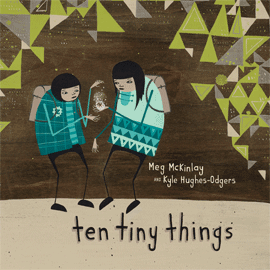
As two children are forced to walk to school, they become aware of the wonder of the world.  The stylised and other-worldly illustrations are earthy tones of browns, greens and blues –cool despite the hot weather the children are experiencing. 


Madeleine Meyer
Carpet (Windy Hollow)
Meyer presents a biography of a carpet from its creation, through its life stages to its eventual recycling.  A beautiful book about the cycles of life.
Tohby Riddle
Unforgotten (Allen & Unwin)
The illustrations, on black paper, are a mixture of full page photographic collages and comic strips reminiscent of film stills.  The location is anywhere and everywhere. The people, some with statue heads, others hand drawn, are from differing times and places.  New buildings reflect older ones. This is a picture book for the older reader, dark and gritty yet haunting and thought-provoking.
Alison Reynolds and Heath McKenzie
A Year With Marmalade (Five Mile Press)
When Maddy has to go away for a year, she leaves her cat with Ella. The progress of the year is shown through the changing seasons, in the pen, ink and watercolour drawings but the reader also sees old and new friendships and comes to understand that change can be a good thing.
 Anna Walker
Peggy (Scholastic)
A brave hen sets off from her snug roost on an unexpected big adventure into the big city.  The muted illustrations, in a variety of media, make great use of the page though often allow for a light-hearted giggle.
Oscar Wilde & Ritva Voutila
The Selfish Giant (Allen & Unwin)
The rules allow for a retelling, so long as the changes are obvious. This richly illustrated book should be on everyone’s long list. The stunning double-page oil paintings are richly detailed –perfect for this allegorical story. The text reflects the style and punctuation of the original.
Notables:
Sean E Avery All Monkeys Love Bananas  (Fremantle Press)
Nick Bland and Stephen Michael King The Magnificent Tree (Scholastic)
Gary Crew & Ross Watkins The Boy Who Grew into a Tree  (Penguin)
Libby Hathorn & Bruce Whatley A Boy Like Me  (HarperCollins)
Andrew King and Benjamin Johnston Engibear’s Dream (Little Steps)
Stephen Michael King A Bear and a Tree  (Penguin)
Danny Parker & Matt Ottley Tree: A little Story About Big Things (Hardie Grant)
Judy Paulson Baby Tawnies  (Random House)
Judith Rossell Oliver (Harper Collin)
Colin Thompson and Sarah Davis Fearless in Love (Harper Collin)

So, what did you think of our lists? Which of your favourites have we missed? And I wonder what the judges will have chosen. We now only have to wait till tomorrow, April 9th, to find out. The Short Lists will be announced in Canberra at midday. The lists will be available online from www.cbca.org.au but don’t be too precipitate, so that the site doesn’t crash from overuse.  

Phil and Erin Stead’s blog about their Caldecott choices can be found at http://philipstead.com/2013/01/22/announcing-the-4th-annual-phildecott-and-steadbery-awards/
It’s interesting to compare their list with the official result.


Monday, 1 April 2013

Maureen and Nella Try to Predict the Short List Part 1.

Yay! It’s nearly time for our CBCA Short Lists to be announced. That will happen Tuesday 9th April and it’s always a day lots of people look forward to. The announcement will be made in Canberra and the results will be posted on the CBCA website – www.cbca.org.au -- at midday. Don’t be too impatient though otherwise the site might crash because of demand. It’s always an exciting time – to see what has been included or what hasn’t captured the judges’ minds.
There have been a couple of recent articles reflecting on the strengths and weaknesses of creating a short list, as many book Awards do. We all think about what has been included or not – and celebrate inclusions or mourn omissions.   Michael Cart says that this is one of the strengths of the short list system, whether it is created behind closed doors (as we do with CBCA short list) or more openly. If you’d like to read his most interesting article the link is at the bottom of this blog.
Many CBCA branches hold a Clayton’s short list night or similar event where prominent community members or avid readers predict what this year’s judges might choose. These contributors don’t have the advantage of having read every entry. And though this makes for an enormous work load for each judge, it is one of the great strengths of our CBCA system. It also makes it hard to find committed judges.
But, over the next 2 blogs, Nella and Maureen are going to suggest what the short lists might contain. Sadly, we haven’t always been able to reduce our lists to just 6 titles! At least, we have the freedom to do this. The judges don’t!
The Eve Pownall Award for Information Books
Christopher Cheng & Lindsay Knight Australia’s Greatest Inventions & Innovations Random House
Each invention from the Powerhouse Museum shows the original problem e.g. how to replace a body part lost through an accident or to attach a new one if it is missing at birth.  The reader learns who was involved as well as easy to read information about the invention/innovation.  
Martin Flanagan & Ainsley Walters Archie’s letter One Hill Publisher

This is the story of an ordinary man, his experience during World War II and his life afterwards.   It includes his memories of mates who didn’t return. We all need stories like this to remind us what is important. A major drawback is the density of text on the page.

Jackie French & Mark Wilson A Day to remember Angus & Robertson
Through a mixture of fact and story this book traces the Anzac legend and the development of the day which now serves to remember all the men and women who served in war, and all who have been affected by war.
Maggie Hamilton Secret Girls’ Business Viking
Craft, stories, fashion tips, recipes and helpful advice about being happy with yourself, and finding your 'style'.  It includes stories about women who volunteer or have interesting jobs.  An antidote to the rampant commercialism young women face daily.
Catriona Hoy & Andrew Plant The Little Dinosaur Working Title Press
Recreates a truthful and poignant story of a dinosaur that lived and died millions of years ago in Gondwanaland and explains how the resulting fossil has helped scientists learn more about the dinosaur.
Jackie Kerin & Peter Gouldthorpe Lyrebird Museum Victoria
Set in the 1930s, this retells a story of the friendship between a gardener and an unusual bird in its native habitat, and explains the fascinating characteristics of the lyrebird.
Kristin Weidenbach & Timothy Ide Tom The Outback Mailman Lothian
Tom Kruse drove a seven-day one-way journey from Marree to Birdsville each fortnight to deliver the mail from 1936 until 1957. It’s a fascinating story which needs more editorial input. The book includes a map, and biographical information. 
Early Childhood. These are books written for children aged 2-6, who are at the pre-reading stage, or the early stage of reading. 
Emma Allen & Freya Blackwood The Terrible Suitcase Omnibus
A delightful story about starting school, friendship and the power of imagination beautifully illustrated in typical Freya Blackwood mode. The reader learns that sometimes we can benefit from not getting exactly what we want.
Ursula Dubosarsky & Andrew Joyner Too Many Elephants in This House Puffin

Eric just loves elephants and his mum finally tires of them all cluttering up each room in the house, even though they help to entertain her son. They have to go! Eric’s solution is a joy.  My 5 year old grandson loves sharing this one on Skype. 
 

Jane Godwin & Anna Walker Today We Have No Plans Puffin

Showcasing days of the week and the many activities that families have over the working week, this book will have meaning for many readers. But unlike most, this family manages to have a recovery day on Sundays when they can slow down and notice the small things. Words and pictures complement each other beautifully. Great endpapers.

Christine Harris & Ann James It’s a Mirocool Little Hare
When she has to leave home for a short time, a young girl worries whether the tooth fairy can find her and creates a path to help. Ann James’ muted illustrations perfectly portray the Australian bush.
Doug McLeod & Craig Smith Heather Fell into the Water Allen & Unwin
Heather is attracted to water even when she is not supposed to be swimming. She even wears water wings to bed! She develops a fear of water but her worry (and the reader’s) is reduced through McLeod’s subtle turn of phrase and Smith’s ability to show humour in pictures.

Amanda Niland & Christina Booth I Wish There Were Dinosaurs Windy Hollow

A young boy wants the zoo to replace its current animals with dinosaurs but then has second thoughts.  The story’s drama and humour are enriched by Christina Booth’s illustrations – just look at the suitcase animals.
Sally Odgers & Lisa Stewart Bushland Lullaby Scholastic
A well-crafted story written in rhyming couplets about familiar and less common Australian animals exquisitely supported with delicate pastel illustrations. The animals are preparing to sleep, but are not anthropomorphised. 
Briony Stewart The Red Wheelbarrow UQP
This wordless picture book has two alternating stories - the right-hand pages depict two little girls’ discovery of a red wheelbarrow (and the rivalry over a bag of lollies) while on the left-hand pages, big chicken and little chicken fight it out over a worm.
Our Notables.  Don’t miss these either – they are some great books for sharing, but they are just not our very most favourite!
Karen Blair Baby Animal Farm Walker Books
Tania Cox & David Miller Millie’s Special Something Working Title Press
Sue De Gennaro The Pros & Cons of Being a Frog Scholastic
Corinne Fenton Hey Baby Black Dog Books
Jackie French & Bruce Whatley Queen Victoria’s Christmas HarperCollins
Phillip Gwynne & Bruce Whatley The Queen with the Wobbly Bottom Hardie Grant
Catriona Hoy & Annie White Isla Lu Where Are You?  Windy Hollow
Kim Kane & Sara Acton The Unexpected Crocodile Allen & Unwin
Penny Matthews & Martin McKenna The Gift Omnibus
Penny Matthews & Andrew McLean Show Day Scholastic
Jane Tanner Lily and the Fairy House Penguin
Michelle Worthington and Sophie Norsa Yellow Dress Day New Frontier

Older Readers. These books are for mature readers, up to 18 years old, and may contain confronting themes and language. Some of the titles we have chosen are for the upper limits of the age range.
Isobelle Carmody Metro Winds Allen & Unwin
6 short stories that redefine the meaning of fairy tale for young adult and adult readers. However some of the writing is variable which may make it Notable rather than Short list.

Pip Harry I’ll tell you mine UQP
Fifteen-year-old Kate Elliot has done something so terrible that her family has banished her to the local boarding school so they don't have to deal with her. Realistic contemporary multi-layered Australian teenagers. A brilliant debut.


Margo Lanagan Sea Hearts Allen & Unwin

This atmospheric selkie tale is a story of human weakness, rejection, revenge, love and courage which may challenge some readers’ conceptions.  Excellent crossover literary fiction for those looking for a dark yet captivating read.

Julia Lawrinson Losing It Penguin
Four girls in Year 12 make a bet: to lose it before schoolies week – and preferably in a romantic, sober way that they won't regret. Graphic, embarrassing and hilarious, it’s a serious story about choices and relationships.
Neil Grant Ink Bridge Allen & Unwin
Omed and Hec are two people on the edges of society for very different reasons, and their turbulent lives collide briefly but with impact. This multi-themed novel has three structural sections, one devoted to each of the boys with the final part showing Hec’s search, as an adult, for closure of his boyhood traumas.
James Roy City UQP
These are linked short stories, with a few characters reappearing with new friendships and incidents. It’s a companion book to his prize-winning Town, but doesn’t maintain consistency throughout.
Jaclyn Moriarty A Corner of white Pan Macmillan
Two separate worlds and stories come together, via the rare event of a crack, through the correspondence between Madeleine in Cambridge, England and Elliot in the Kingdom of Cello. There are mysteries to solve, science to understand and colours to absorb, combined with lots of world history. The cover, with its lightning-like crack, is great.
Vikki Wakefield Friday Brown Text
Friday Brown tries to escape the death of her mother and the family curse but life on the streets makes her quickly discovers her own strengths and weakness through her interactions with a broad range of (often troubled) characters and some nail-bitingly scary situations.
Notables:
Myke Bartlett Fire in the Sea Text --The ending is a little weak, but this is an author to watch.
Judith Clarke Three Summers Allen & Unwin
Rose Foster Industry HarperCollins (1st in series)
Jackie French Girl from Snowy River HarperCollins
Maureen McCarthy Convent Allen & Unwin
Shirley Marr Preloved Black Dog Books
James Moloney Silvermay HarperCollins (2nd in series)
Garth Nix Confusion of Princes Allen & Unwin
Karen Tayleur Love Notes from Vinegar House Black Dog Books
Kirsty Eagar Night Beach Penguin -- scary Australian Gothic romance
Andrew McGahan Voyage of the Unquiet Ice Allen & Unwin

So what would be on your list? What have we missed? Please let us know. And come back next week to see what we choose for the last two categories: Younger Readers and Picture Books.


Monday, 25 March 2013

Kids' books in China - what are the challenges?

When the grandchildren of Tasmanian CBCA member Kim Boyer went (with their parents!) to live in Beijing 2 years  ago, access to quality children’s books was one of Kim’s key concerns.
She needn’t have worried! Lucy (now 6) and Jack (4) have remained avid readers and listeners, strongly supported by parents Daniel and Amy and their international school.
The family is two-thirds of the way into a three-year posting, based at the Australian Embassy in Beijing, and is enjoying, to the utmost, living in this vibrant and exciting city.
Books and language opportunities are plentiful. Amy is now capable in Mandarin, and Lucy is already displaying some of her mother’s aptitude for languages.
Lucy and Jack both attend the international British School at Beijing, where Lucy in now reading fluently in English, with her favourites including the Billie B Brown books and the Go Girl books. Jack’s reading is accelerating fast, and he is seriously into any books relating to Ninjas, the Gruffalo, Uno’s Garden, Pinkalicious, Dr Seuss books, and The Beach. Stories at bedtime at this stage (read by parents) are the Roald Dahl classics, which both the kids and parents are enjoying! As well, their Chinese babysitter reads Chinese stories in Mandarin as an extra challenge!

While school texts and the school library focus on English texts, the Australian Embassy also has an honours-system library, which is well stocked with favourite Aussie titles. There is a good bookshop in nearby Sanlitun called the Bookworm, which is actually running a literary festival next month featuring a number of Australian children’s writers and illustrators, including Alison Lester, Anna Spudvilas (a CBCA Picture Book of the Year winner), Meredith Badger, Robert Newton, Ann James  and Ambelin Kwaymullina.
When special titles are needed there is always the online Book Depository or fond grandparents in Tasmania!
Interestingly, where the gap really exists is access to good children’s DVDs and TV. DVDs are nearly all Disney-related, and TV is much the same.  Chinese-language DVDs are much better, and also great at helping the kids with their Mandarin speaking and reading. So ABC Children’s DVDs like the Octonauts, Angelina Ballerina and the various Playschool series have also made their way from Hobart into this multicultural melting pot.

Kim Boyer

Monday, 18 March 2013

Crossing the Divide ... or, Writing for young people and adults

The release of J K Rowling's The Casual Vacancy marks a dramatic change from young people's fantasy to adult fiction and it started me thinking about just how many authors have managed to cross the divide between young people's and adult books, and vice versa.

Most of us would know that Mark Twain (Samuel Clemens) wrote Adventures of Huckleberry Finn, as well as A Connecticut Yankee in King Arthur's Court. A A Milne, famous for Winnie-the-Pooh also wrote detective novels and short stories for adults as well as war poetry. And Ian Fleming, who of course immortalised James Bond on paper, also wrote the children's classic, Chitty Chitty Bang Bang.

Adult authors who write/wrote for young people include Salman Rushdie (Haroun and the Sea of Stories), Oscar Wilde (The Happy Prince and Other Tales), T S Eliot (Old Possum's Book of Practical Cats), Margaret Atwood (Up in a Tree) and James Patterson (the Maximum Ride series).

And young people's authors who write/wrote for adults include Anthony Horowitz (the thriller William S, a string of screen plays for television and a series of graphic novel horror stories called Edge), Roald Dahl (My Uncle Oswald in addition to short stories, one of the more successful being The Man from the South), Dr. Seuss (The Seven Lady Godivas: The True Facts Concerning History's Barest Family), R L Stine (the horror novel Red Rain) and C S Lewis (The Discarded Image, and a revision of John Bunyan's Pilgrim's Progress called The Pilgrim's Regress).
 
David Galef, a writer and English Professor in the US, researched this topic. And in Crossing Over: Authors Who Write Both Children's and Adults' Fiction, which he wrote for the Children's Literature Association Quarterly, he placed such authors into three main categories.

1. Writers of adult fiction who 'take up children's literature in mid-career’. Galef says that some even manage the transition with grace, Roald Dahl for example;
2. Those who start out writing for children and then only later write for adults. He says, 'those who achieve sufficient fame in children's literature ... will attract adult readers for anything they have written'. Maurice Sendak is an example; and
3. Those authors 'who can balance an array of diverse projects and have done so since the start of their careers.' Louisa May Alcott and C S Lewis.

I guess this tells us that some authors can/could be flexible in their thinking, their imagination and their writing. But the real question is - did they cross the divide successfully?

What do you think?

Penny Garnsworthy


Monday, 11 March 2013

A BEGINNER'S GUIDE TO CROWD FUNDING

There was a time when publishing a book was all about agents, contracts and the negotiation of advances. Then, as now, publishing was an expensive enterprise that required an investment, and that investment was found at a publisher. Of course now the shifting emphasis from paper to electronic publishing has opened up a new way of thinking about how a book might be made, but there is another equally interesting form of publishing underway, that often brings us traditional ink-and-paper books, but through new-world means: crowd funding.

Anyone interested in modern art should be keeping an eye on websites like Kickstarter, Pozible and Indiegogo. In the last few years these websites have become absolutely central to a new kind of creation model in which the artist is king, and as such artists from all tiers of fame have been giving it a try. I have been delighted by the results of the projects I have crowd funded. Although I've given my money across multiple mediums, the publishing offerings have been notably beautiful - on the shelf they are indistinguishable from books I've been sent by mainstream publishers.

So how does it work? Crowd funding has a very simple premise: the creator makes an argument for the product that they wish to create, explaining the time-frame that they plan to make it in, and offering a comprehensive levelling system through which patrons might "opt-in." These start at the very simple, such as a small-change contribution getting you a tweet of thanks, through to copies of the product signed, and then at a much higher tier, dinner with the author when they next visit your area. If a minimum amount of "pledges" are gained, the product is created, and many offer "stretch goals," so that as the product makes more money, its quality increases. One of the nice aspects of this system is that the artist is more connected to his/her audience. Many projects I have funded have offered the patrons the opportunity to comment upon designs and aspects of the finished product, with regular email updates explaining how things are going.

Eventually, the product is sent out to all of the people who have supported it, and then it often enters the traditional market as well. The advantage of attaching yourself to it early is that you get opportunities the general public won't have; signed copies or additional trinkets that are sent out with the product. Occasionally I have pledged at a level that allowed me to be listed in the acknowledgements section of a book; you can imagine what this might mean as a gift… though you do need to be careful and make sure you know how far away the product is. It will likely take months to make.

I don't necessarily recommend that writers approach crowd funding in preference to traditional publishing houses. In many cases, to allow funding to reach its goal, a level of public support is required prior to beginning a project. That said, as a book collector and a person who enjoys supporting artists (and being more involved in the process of them creating their art), I think crowd funding represents a remarkable opportunity to engage with writers, illustrators and creators of all kinds.

In fact, it may not even be that new. Mozart, after all, was visiting subscribers in the 18th Century and offering them services in exchange for an outlay of funds: concert tickets and copies of concertos now replaced by ebooks and dedicated YouTube videos. An old art has been digitised and globalised. The world is calling out with great ideas. If we listen, we can be a part of them.

Where to start:


Lyndon Riggall

Monday, 4 March 2013

BINGO! I have found another great book for older teens and young adults

‘The Convent’ by Maureen McCarthy
When I hit upon a book that :
a)      Is a good story that keeps you interested and eagerly awaiting developments
b)      deals with social issues relevant and close to your own heart
c)       is set in a familiar location where you have spent time and is therefore recognizable
d)       has an historical bent
then as far as I’m concerned I am onto a winner.
I was handed such a book just last week.  ‘The Convent’ by Maureen McCarthy is a young adult novel published last year by Allen and Unwin.
Recently I have come to the conclusion that some of the best writing is actually produced for younger people.  For some reason in YA novels the issues are clearer and more realistic or perhaps I have become lazy and need my literature to be easily accessible. On the other hand perhaps I haven’t yet left teen age.  But seriously, I would strongly recommend adult readers to browse through the YA section in your library; it’s not all about vampires and werewolves.  Or better still go to the CBCA website (www.cbca.org ) and look up the past few years of notables and shortlisted books for older readers. This is a fail-safe guide and you won’t be disappointed.  Take ‘Kill the Possum’ by James Maloney or ‘Jasper Jones’ by Craig Silvey to name just two.
But back to ‘The Convent’.  The action and the several stories intertwined in ‘The Convent’ take place at the Abbotsford Convent which is situated next door to the Collingswood Children’s Garden in Melbourne. I know this place, having visited the garden one afternoon on a family outing ending with afternoon tea at a very trendy coffee shop, probably the actual one described in the book.  Today the elegant but still  faintly daunting buildings are a far cry from the sad and tortured past enclosed within its wall and for many visitors completely unknown or just forgotten.
Based to a degree on McCarthy’s own family history and involving the issues which led to the recent political apologies to women whose illegitimate or ‘fatherless’ children were forcibly removed from them, the stories of Sadie, Ellen, Cecelia and Peach emerge stark and poignant.
Issues of women’s rights are prominent but the patronizing, sometimes inhumane, attitudes adopted by society and especially the Catholic Church come into play as well, as do the intriguing issues of faith, belief in a God and religious dedication. 
McCarthy deftly maneuvers between her central characters, the different eras in which they live and the vastly differing social climates in which each lives, but she still manages to keep all the different components related and connected.
This is definitely a book for girls, but in 2013 when statistics are showing that women’s rights and equality are actually declining this is a book which is a timely and important reminder of what went on before and startlingly not so long ago.
And since I happen to be in Melbourne as I write this, I will be revisiting Abbotsford convent again at the weekend but this time with a lot more understanding and a more profound appreciation of, and more appropriate anguish about, the history of the building and its former occupants.
Carol Fuller