With climate disasters at home and abroad and media reporting on global warming, children can’t help but be affected and concerned. This week, Jennie presents some recent, and some not quite so new, publications dealing with sustainable issues that can help parents and teachers navigate this challenging topic.
Environmental problems permeate our daily lives – through political debate, news reporting and social media bombardment but also in the lived experiences of many of us as extreme weather and natural disasters affect our own lives and TV screens and computer monitors stream images of loss and destruction. Such exposure must impact young people – it can lead to despair and anxiety (ecophobia) or become a call for positive action. Arteaga (2020) states “Our students will be the ones to protect the future of our planet, so how do we give them hope and help them take action? How do we equip them with the tools they’ll need to take on this challenge while also maintaining optimism?” Children’s literature can provide the stimulus to not only inform young people about global issues to but to also inspire them to consider solutions.
Haq (2018) argues that children’s books must do more than explain climate change and highlight issues of concern. “Stories not only develop children’s literacy but convey beliefs, attitudes and social norms which, in turn, shape children’s perceptions of reality. They allow children to move from a position of powerlessness to a position of possibility. Through fiction, children are able to explore different perspectives and actions beyond what they know by living in the story world of characters for whom they care. ”(Haq, 2018, para. 7).
The following titles have been chosen because they provide stimulus for discussion and positive environmental action to different degrees. Their selection intends to counteract feelings of helplessness to nurture resilience and mindfulness to not only imagine, but contribute to, a better world (Ljanta, 2019, para. 4). All of them help readers build knowledge about the health of the planet and some go further to engender a sense of collective responsibility and purposefulness to make a change – at a personal level and also as activists and a starting point to make a stand for the good of the planet.
~~~~~~~~~~~~~~~~~~~~~~~~
Marine pollution is a connecting theme across most of these titles with the effects of plastic on marine life the major issue presented.

Barroux tells the story of young boy who loves the sea and sailing upon it, and in particular, the whale that inhabits the water. When the whale does not appear he searches the water and finds a very sick whale. He enters the whale and discovers a belly full of plastic bags which he removes, and the whale recovers. Although the story is implausible the message is cleverly illustrated with the boy’s diagram comparing a floating plastic bag with a jellyfish. Barroux provides factual information and practical advice to encourage children to protect whales and other sea life.

Allen vividly demonstrates the almost tragic effect of a plastic bag picked up by the wind and dropped in the sea where an ibis becomes entangled. The environmental messages are implied rather than stated providing a subtext to be explored between adult and child rather than make clear statements about the overuse of plastics. The boy’s careful placement of the offending bag in the bin provides a starting point for a discussion. Five years on, I would expect many youngsters to indicate that they should have packed the lunches in reusable containers rather than ones that need to be disposed.
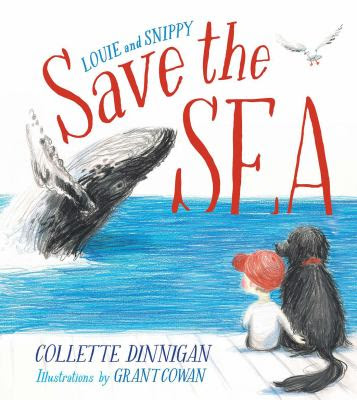
The creators present a strong message on the effects of pollution – particularly plastics – in the ocean, on sea life. Louie and his dog are on the beach, and the boy dreams of travelling underwater, but the dream is nightmarish as he meets many sea creatures in life threatening situations due to the many forms of plastic in the ocean. Once awake, Louie and Sniffy set out to educate others on the beach with an action plan to make a difference. The characters taking up the cause, rather than advice at the end by the author, presents a more powerful message of taking responsibility through positive actions. The book is gloriously illustrated by Grant Cowan in pencil to portray a series of distressed but relatable creatures. Although a little didactic in tone, there a many teachable moments between its covers – on the ocean, sea creatures, pollution and looking after our Earth.

Walk of the Whales (2021) by Nick Bland. Hardie Grant
Bland sends a very strong message about human responsibility for the state of our oceans when the whales leave the polluted ocean and move onto the land. At first a curiosity, this becomes a disaster as shopkeepers go out of business, farms are flooded with water and salt, and people shout horrible, anti-whale words. The message is saved to the final pages, and the reader is mesmerised by the various antics of an array of different whale species as the leave the ocean to inhabit the land. Tongue in cheek humour, wonderful perspectives to indicate scale and simple straightforward language recount the exodus from the sea, the impact on human lives and then puts forward a solution.
It is interesting to note that it is only when human lives are seriously disrupted that they start to take some responsibility rather than just blaming the whales. Although marketed as a book for young readers Bland sends a powerful message that will stimulate debate with older readers.
~~~~~~~~~~~~~~~~~~~~~~~~
On the theme of being responsible for our actions the following three recent publications are worth investigating.

Targetting younger readers, Sophia is visited by and listens to the stories of misplaced animals that turn up on her doorstep. She learns that this is her fight, too…and discovers the power of collective action, the strength of her own voice, and how all of us are stronger together. The second part is particularly useful to adults sharing this book as it provides information on climate change and the final section introduces positive action for building a better world together.

Ilustrjo has created a stunning allegorical tale that speaks to sophisticated readers and adults alike. Visualised through the perspective of a marmoset, and told from an outside observer stance, the city gradually floods. Ignoring the prompting of the marmoset seeking help, the animal inhabitants adjust to the worsening predicament. First with gumboots, then oxygen tanks and helmets as the waters rise and treasures are lost or destroyed. The giraffes, as the tallest animals, can’t see what the problem is until they too are immersed. As the numbers of affected animals increases, they finally start to band together to complain. It is the marmoset, who has been waiting for this moment, that finally gets the animals to cooperate and work together to solve the problem – evocatively portrayed via a fold out page to present all the animals across a triple page spread. The underlying message is a wake call to humanity – that we can’t ignore the suffering of others until it affects us – like the ostrich with his head in the sand – and the power of working together to find and enact solutions. The intriguing illustrations, in muted greys and watery blues, effectively extend the text to convey the intended message. Some examples of the art work can be viewed on Ilustrio’s website. Older readers will be able to make many connections to current global issues in this allegorical tale. The Western world’s (as the superior giraffes) response to COVID, or dealing with climate change – the point is that it needs to be a united and cohesive response. A sophisticated book that

Endorsed by HRH The Prince of Wales and designed in partnership with the Prince’s Foundation the book presents the road map to sustainability that has be created by the Prince and his Sustainable Markets initiative and included at the end of the book. The book aims to promote the importance of re-establishing harmony between Nature, the People and the Planet. The forward by HRH The Prince of Wales highlights the connection children have to Nature and his intent is for this literary non-fiction book to inspire young people to discover, celebrate, support and care for our Planet. The book is divided into four sections with the first three reflecting nature, people and the planet in both celebration and in concern showing how the balance between these elements has been lost. Part 4, the Terra Carta, presents ways we can bring Nature back into balance. As well as presenting the Terra Carta, the end pages also provide images and brief biographies and locations of the 33 illustrators, information on the Prince’s Foundation, a glossary, information on the carbon footprint of the book and an explanation of the Fibonacci spiral. Visit the What on Earth Books website for a downloadable poster to start mapping your action plan now.
The book sends a clear and pressing message for communities to work together to ensure a sustainable future and to bring Nature back into balance. This section explains and illustrates key elements in the Terra Carta road map. The final message, as a poster brandished by a diverse group of children states (p. 49):
We CAN do this.
We MUST do this.
And we have to do it NOW.
Because…
IT’S
UP
TO US!
References
Arteaga, A. (2020, February 28). Thinking bigger solutions. Climate Interpreter. https://climateinterpreter.org/content/thinking-bigger-solutions
Haq, G. (2018, June 4). Children’s books can do more to inspire the new generation of Earth warriors. The Conversation.
Ljanta, A. (2019, July 1). Book list: Kids with climate change anxiety. The Sapling
Jennie Bales
Adjunct Lecturer, Charles Sturt University
CBCA Tasmania Social Media Coordinator


