Welcome to the blog of the Tasmanian branch of the Children's Book Council of Australia!
Showing posts with label multicultural. Show all posts

Friday, 4 March 2022

Cultural diversity celebrated through stories

This week’s post works in tandem with the previous coverage of the NCACL Cultural Diversity database. Maureen Mann has risen to the challenge to explore the database and seek out titles that she discovered. She shares her thoughts and reactions here.

I have enjoyed exploring the NCACL Cultural Diversity database following on from Dr Belle Alderman’s blog last week. For me, the format is not as user friendly as the Indigenous one is. Each book is listed with the information about it in columns across the screen. The last column is Annotation and of course it is much longer than the other levels of information. For me, this makes it much clumsier to read and there’s lots of scrolling down the page to get to the next title listed. But, having made that relatively small criticism, the database is full of wonderful titles. It’s easy to browse by image, and there are search tools too, though these would benefit from a little bit more finessing. I look forward to further explorations, and new additions as they happen.


Having made some criticisms, it’s a fantastic resource. I also must remember that it’s all built by volunteers, under the umbrella of the National Centre for Australian Children’s Literature, and it will continue to evolve as time and funding allows. Maybe if you’d like to help you could contact the NCACL. They’d love sponsorship, donations to special projects or more volunteers, even if you don’t live in Canberra.


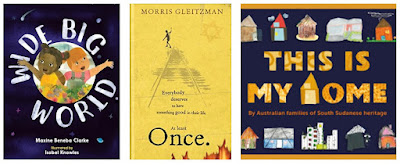
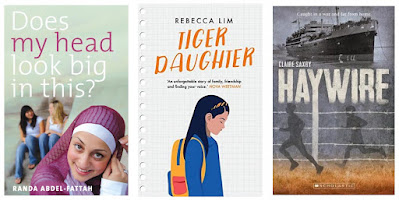
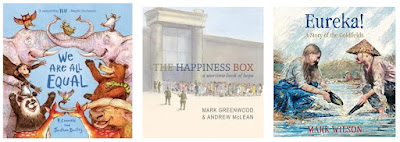
Did you check out the covers which were included last week?

Here are some of the titles that I have explored over recently. 


What Do You Call Your Grandma? and What Do You Call Your Grandpa? by Ashleigh Barton and Martina Heiduczek, 2021 and 2020. Harper Collins.

Each books has a similar format, but the cultures included differ. Each grandparent gets a double page spread showing the child and grandparent, who is rarely stereotyped, doing their favourite things. The accompanying verse helps with pronunciation of a traditional name from that culture. The book demonstrates that all children across the world have a special relationship with their grandparents. A glossary at the end of the book includes the meaning of the names and their locations


Under the Southern Cross
by Frane Lessac, 2018. Walker Books.

Bright primary-coloured illustrations support this night-time tour across Australia. Each page introduces the location, the activity described and the phrase under the Southern Cross (found in each illustration), along with some relevant factual information. Though there is a map at the end of the book showing all the locations, a small map on each page would have satisfied this reader, especially as the locations jump around our huge country. 


The Katha Chest by Radhiah Chowdhury and Lavanya Naidu, 2021. Allen & Unwin.

When Asiya visits Nanu’s house her favourite activity is exploring the chest containing the katha quilts, made from worn out saris. The rich detail, inspired by Bengali Pattachitra folk art, in the illustrations show both the quilt and the family’s activity where the reader sees a part of the original sari owner’s life.


When We Say Black Lives Matter
by Maxine Beneba Clarke, 2020. Hachette.

Rich dark colours make up the illustrations of this oversize book. Clarke wanted to explain to the multi-cultural children in her extended family why recent protests were so important but she doesn’t sensationalise it.  There’s lots to discuss and it’s not just a picture book for the very young.

Little Nic’s Big World by Nic Naitanui and Fatima Anaya, 2019. Allen & Unwin.

This, the second of Naitanui’s titles, features a school fete, titled “The World Comes To Us” where all the families bring their favourite foods and there are a lot of cultural activities. Nic has lost his bag containing his favourite cassava cake. Readers have to search for Nic’s lost bag as well as 16 other items.


The Happiness Box: A Wartime Book of Hope by Mark Greenwood & Andrew McLean, 2018. Walker Books.

This is the true story, in picture book format, of some of the POWs in Changi Prison in 1942 who created Christmas presents for the children interned with and near them. One of these gifts was a book called The Happiness Box. All the presents were confiscated because the Japanese commander thought the book contained war secrets. A soldier offered to destroy the book but instead buried it and it was dug up in 1945, becoming a National Treasure. Though there are subtle references to the hardships the men suffered but the book also shows their resilience. 


If You Come to Earth by Sophie Blackall, 2020. Chronicle Books.

Blackall offers a microscopic perspective on many aspects of the world, both natural and man-made. It’s a guide to our world and a call for us all to look after and celebrates cultural and environmental diversity across the globe. The illustrations encourage the reader to pore through the detail as well as encouraging discussion of the differences and similarities. A picture book for all ages.


Little Lon by Andrew Kelly, Heather Potter and Mark Jackson, 2020. Wild Dog Books.

This is based on the recollections of Marie Hayes who lived in the Lonsdale St area of Melbourne in the 1920s and 1930s. The reader meets some of the many others from all over the world who also lived there. It’s a wonderful celebration of a historical period, complete with descriptions of housing, food and lifestyle shown both in visual and verbal text. The endpapers add to the information given.  Though it’s picture book format, it’s not only for the very young. 


Always by Maurice Gleitzman, 2021. Penguin.

The last in the series which started with Once, combines the story of Felix, now 87, and Wassim 10 years old as was Felix in the first story. Set in Poland, it describes the racism and persecution which is eventually overcome. Felix and Wassim journey is to win the race to the WW2 ‘treasure’ which the Iron Weasels desperately want. An excellent, very readable story (as has the whole series been) which celebrates the power of love, friendship and hope.


Red Day by Sandy Fussell, 2020. Walker Books.

A story that combines historical fiction, based on the WW2 Cowra NSW prisoner of war camp, with magic realism reaches a satisfying conclusion. Charlie has synaesthesia, where everything has colours and into her life comes Kenichi, a Japanese exchange student whose family have tasked him with finding his grandfather’s grave. The book is full of complex characters, with many tensions surfacing. 


I hope you will also have fun searching through this, and the indigenous, databases.


Maureen Mann
Retired teacher librarian and avid reader


Friday, 25 February 2022

Step into the lives of others: A database of Australian children’s literature reflecting our diverse culture

Following on from posts over the previous fortnight celebrating Aboriginal literature and how to discover a wealth of titles via the NCACL Aboriginal and Torres Strait Islander Resource, this week introduces another excellent resource: The NCACL Cultural Diversity Database.


Here is the story behind the decision of the National Centre for Australian Children’s Literature to create a database of children’s books featuring cultural diversity. 


You may have heard the oft-quoted analogy—children’s books are ‘windows, sliding doors and mirrors’ explored here in this article. ‘A window is a resource that offers you a view into someone else’s experience. A sliding door allows the reader to enter the story and become a part of the world. A mirror is a story that reflects your own culture and helps you build your identity’ (We Are Teachers Staff, 2018, para. 4). Children’s books are the perfect medium to do all three.  

We all know that the Australian population is culturally diverse. The facts are available from the Australian Human Rights Commission website which states: ‘One in four of Australia’s 28 million people were born overseas; 46 per cent have at least one parent who was born overseas; and nearly 20 per cent of Australians speak a language other than English at home’(2014, para 5). These statistics and the windows, sliding doors and mirrors analogy motivated us to create a database featuring cultural diversity in Australian children’s books. 


We found other such databases in Canada and the United States. We studied these, chose their best features and decided what would work for Australia. We asked teachers, public librarians, teacher librarians, home schooling groups, researchers, specialists in children’s literature, literacy, English as an Additional Language/Dialect (EALD) and staff at the ACT Directorate of Education what would be useful? 

As our perspective on this topic developed, we needed to choose which books to include. The Centre is very fortunate to receive donations from publishers, authors and illustrators so we see the majority of Australian children’s books. We also extensively researched existing sources to discover others’ views on culturally diverse children’s books. Here are just a few that we examined: 

  • The Canadian Children’s Book Centre —Social Justice & Diversity Book Bank
  • United States non-profit organisation —We Need Diverse Books
  • AustLit: the Resource for Australian Literature 
  • Australian Multicultural Children’s Literature Award (1991-1995)
  • CBCA’s Notable Books (1990-)
  • International Board on Books for Young People Australia Honour Books
  • The White Ravens: A Selection of International Children’s and Youth Literature
  • Source Online: Subject Guide to Children’s Books 
  • Kerry White’s Australian Children’s Fiction: The Subject Guide (1993 and 1996)
  • Prime Minister’s Awards for Children and Young Adult Books and all State Premier’s awards

These, other bibliographies and databases, plus a wide range of people with expertise in this field, helped us determine what and how we would capture and deliver books featuring cultural diversity. We read hundreds of books, discussed, annotated and assigned key concepts then we added Australian Curriculum Links and the Early Years Learning Frameworks. We sought out database expertise and design at 372 Digital in Canberra. It was a big learning curve. We learned a new ‘language’ about databases and realised undreamed of possibilities. A year later, our Cultural Diversity database said ‘Hello!’ to the world.  People told us what they thought of the Cultural Diversity Database, and we added comments to our website.


“The database is accessible and interesting.  It seems to me that kids need to be hearing their own stories and more than ever the stories of others too and access to libraries and such information as you are putting together will go some way to help that along.”
Bob Graham | Author and Illustrator | April 25 2019


“This is an amazing initiative by the National Centre for Australian Children’s Literature – a database that can be searched for titles that showcase or promote diversity, be it cultural, linguistic, familial, political, geographical, historical. Explanations and background here, dive right in here.”
Australia School Library Association | Newsletter, 30 April 2019


Pictures in this blog are jacket covers for just some of my favourites! Why not search for them on the database for publication information, curriculum links and plot summary.


Dr Belle Alderman AM, Emeritus Professor of Children's Literature 

Director, National Centre for Australian Children’s Literature Inc


References

We Are Teachers Staff (2018, July 12). What are windows, mirrors, and sliding glass doors? We Are Teachers. https://www.weareteachers.com/mirrors-and-windows/ 


Australian Human Rights Commission. (2014). Face the facts: Cultural diversity. https://humanrights.gov.au/our-work/education/face-facts-cultural-diversity