Welcome to the blog of the Tasmanian branch of the Children's Book Council of Australia!
Showing posts with label Author & Illustrator School Program. Show all posts

Friday, 25 August 2023

Celebrating Book Week – Engaging with Books and Humans

Hutchins School engaged in a range of exciting activities in the lead up to, and then ongoing throughout Book Week. It is wonderful to see such a strong reading culture celebrated across the school. 

Critical Evaluation of Shortlisted Titles (our version of Shadow Judging)

Our Book Week celebrations begin mid-Term 2 with the introduction of our Critical Evaluation unit, which begins with exploring the question, ‘what makes a good book?’ Our younger students focus on the Early Childhood shortlist, while older students build on their knowledge of different kinds of non-fiction to hone their evaluative skills by examining the Eve Pownall shortlist.


Students explore this inquiry question through the examination of previous shortlisted books and current notable books.  Through this exploration, students design their own criteria; generally they come up with something along these lines:


Criteria for ‘what makes a good picture book?’

  • Story – a problem, a solution, a sizzling start and end, makes you feel something (happy, sad, excited)
  • Language – descriptive, interesting
  • Illustrations – detailed, interesting, help tell the story

Criteria for ‘what makes a good information book?’

  • Information – detailed information, sources are listed
  • Layout – book is presented in an interesting, creative and attractive manner
  • Visuals – book includes clear, detailed and attractive visuals to support the text

These criteria then underpin our exploration of the shortlisted books and students vote in the Hutchins Choice Awards shortly before Book Week.


Book Week Celebrations

Our Book Week celebrations take place across the week and are centred on children engaging with quality books and engaging with one another in book sharing, discussions and celebrations. 

Some examples of this year’s offerings included:


Pop Up Readers – During Book Week, we had over 25 guest readers, including staff from all areas of the school and Senior School students, ‘pop up’ in classrooms to read stories.  This is super simple to set up; send out an editable timetable of the week for readers to nominate their available times and class teachers snap up a match.

Senior student reading to a younger class ©


Story Walks with Fahan – Our younger students were lucky enough to visit a local school, Fahan, for the morning, where they listened to stories read by older students and participated in challenges as they walked through the gardens to listen to other stories.

Hutchins and Fahan students enjoy an outside storytelling session ©


Drop Everything and Read – At designated times throughout the week, students and staff were encourage to ‘drop everything and read.’


Buddy Reading – Across the week, there were several times for students to meet with their buddies to share stories together.


The Great Book Swap – This event is always a hit in schools and there are plenty of winners; families can declutter their bookshelves, children can buy ‘new-to-them’ books and we are able to raise money for the Indigenous Literacy Foundation.

The Great Book Swap raises funds to support the Indigenous Literacy Foundation ©


Book Buying Excursion – A highlight of our Tasmania Reads celebrations was taking a small group of students to a local bookshop to select new books to purchase for the library.  This event was such a success that we decided to repeat it for Book Week.  Choosing to spend part of our library budget in this way provides incredible ownership by students over the collection.


Exciting purchases made for the library ©


Creator Presentations and Workshops – Thanks to the CBCA Tasmania’s Creator Workshop program, we were fortunate enough to have Daniel Gray-Barnett visit us for a day during Book Week.  Students loved hearing Dan’s yet-to-be-released story and learning about his illustration process.  Keen writers and illustrators were invited to participate in small group workshops with Dan where they were guided through several writing and illustrating exercises.

Daniel Gray-Barnett engages students in the writing process ©


Staff Book Club – Earlier this year, as part of our Tasmania Reads celebrations, we launched a staff book club.  A couple of times a term, we meet and share books about a particular theme.  For our Book Week catch up, we all shared books related to the 2023 Book Week theme, Read. Grow. Inspire.


Announcement of Hutchins Choice Awards – This happens in an assembly and there is great excitement when students hear the books that were favourites in each year levels.


Book Week Quiz – On the first day of Book Week, each class received a 25-question quiz that students worked on across the week, drawing on their knowledge of the 2023 shortlisted books and other well-known books.  On the final day of Book Week, teachers were emailed a final bonus question, before students raced their completed quizzes to the library.  This was the first time I’ve run an activity like this and it certainly created a spark amongst the community (bribes may or may not have been offered in students’ quest to find the answers!)


You’ll notice that dress-ups were not mentioned in the list of celebrations.  Yes, we did have a dress-up day, but this was certainly not the focus of our Book Week celebrations.  Moving forwards, we will move to a model of having a dress-up day every second year, with a different book-focused creative celebration for families to get involved in on the alternate years.


During regular library lessons, our focus was on engaging with the 2023 Book Week theme, Read. Grow. Inspire., and providing time for students to simply enjoy the power of a good book.  


Anna Davidson
Junior Teacher Librarian, Hutchins School
Twitter - @davidsonteach
(avid reader (mad for Middle Grade Fiction), dog lover, yogi, nature lover, tea drinker)

Friday, 28 January 2022

Creators in Schools Workshops

The CBCA Tasmania and the Tasmanian Government partnered Creators in Schools Workshops program enters its final year in 2022. The initial grant, allocated in 2019, is to be fully expended by November 30 2022.


Participating schools reported that the students were enthused by participating in the workshops. The opportunity to meet the creators in person and develop a greater understanding of the creative process increased students’ engagement with literacy; as both consumers and producers. Some schools added to the experience by engaging the creator for additional workshops at their own expense.


If you are an educator in non-government and government schools in Tasmania, you are able to access this program via an institutional membership (visit our website for further information). The cost of a creator workshop is covered by the cost of your membership.


If you are a Creator resident anywhere in Tasmania, you can let CBCA Tasmania know of your availability to provide workshops. Australian Society of Authors (ASA) rates are paid and CBCA Tasmania will advertise your availability on our website and list you on our database for our schools. We connect the school to you!


2021 Feedback:

“Exposure to Tasmanian creators have been invaluable. Being able to engage with a creator and then view/read their books is such a great experience.”

“Inspired…students to learn more about writing and illustrating.” 

“Our students have benefited greatly from this opportunity. As…funding is quite limited in schools, it is often out of the reach of schools to pay for an author workshop. This program gives all schools an opportunity to participate. Our students have really enjoyed the workshops and have incorporated much of what they have learnt into their own writing. It is also wonderful for students to meet authors in person and be able to speak to them directly.”

“[The creator] was engaging and had easy, creative and achievable strategies for story writing. [They were] versatile and well-suited to any age level, definitely an invaluable creative Tasmanian.”


Read about two successful author visits conducted in in 2021:

Schooling the Creator - Fiona Levings

Creating Worlds - Narelda Joy - Artist in Residence


For further information about the Creators in Schools Workshop program please email tas@cbca.org.au or visit our website cbcatas.org. Check out our Creators.

CBCA Tasmania Committee, led by President Steve Martin, will be advocating with state and federal governments to continue to support this programme beyond 2022.


Felicity Sly

CBCA Treasurer and North West Creators in Schools Workshops Co-ordinator


Friday, 8 October 2021

Schooling the Creator

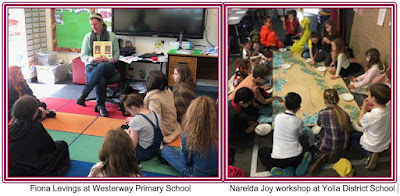
Fiona Levings shares her experiences as a visiting children’s book creator in two Tasmanian primary schools; sharing her work and inspiration in the development and publication of Now and Then, a fascinating historical fiction picture book title set in Margate. Fiona’s school visits were supported by the Workshops in Schools Program, a CBCA Tasmania initiative in partnership with the Department of Education Tasmania.


When I create a picture book I tend to think that I know it quite well.  How could I not?  I’ve spent countless hours ruminating on the words, working the character sketches, painstakingly composing each page.  By the time it’s printed I’ve read it, proofed it, checked it, re-checked it, read it backwards, forwards, out loud and probably upside down.  Then I take it into a classroom … and what I think I know about it suddenly becomes a minor part of a much greater whole.  When I share my book with kids they show me what I’ve really made.  

© Fiona Levings - sharing Now and Then with students

Bringing Now and Then into schools with the CBCA Creator-in-Schools Program has been an exceptional experience.  Being able to interact with kids, to see their eyes light up because I talked to them and took them seriously is a gift.  Watching them engage with my book, be inspired by it, recognise the parallels with their own lives, press their noses to the page to examine the detail of the illustration or triumphantly spot the easter eggs I hid for them is a joy.  A book that has less than 300 words can take up to an hour to read, such is the level of engagement, dissection and discussion.


In June I visited St Aloysious Primary in Blackmans Bay and worked with three separate Year 2 classes.  We had nice long session times and I thought I was safe but I still blew out because we were talking too much.  Fortunately, we had enough time in the schedule to start some drawing work together.  It never ceases to amaze me what 7- and 8-year-olds can come up with when you ask them to imagine how their future homes might look. Underground houses, offshore sea farms, moon bases and flying houses with robot dogs are just the beginning.


In Book Week I was honoured to be invited out to Westerway Primary, a school even smaller than the one attended by Doug in 1940 in Now and Then.  Westerway is a town that has seen many changes over the years and it was fascinating to talk to the kids, to hear their perspectives and tease out their vision for how they think their home town might continue to change in times to come.  Once again, they saw things in my book that I did not realise were there; in return Now and Then gave them a fresh perspective on the everyday history present in their world.   

© Fiona Levings - talking to students about book creation

The synergy of author and audience at a school visit is very special.  Both parties giving, both receiving; I love every minute of it. And I am so grateful, as a creator, to the CBCA Tasmania for the opportunity to learn about my book from these wonderful young muses.   

Now and Then, by Fiona Levings
Forty South


Fiona Levings
Fiona Levings is a Tasmanian-based author and illustrator of children’s picture books. Now and Then, published by Forty South Publishing, was listed as a notable book in the 2020 CBCA Book Awards. Copies are available in bookstores or online at www.fortysouth.com.au.


W: http://fionalevings.blogspot.com/

FB:  https://www.facebook.com/themoonbowmaker 

IG:  https://www.instagram.com/themoonbowmaker/ 


Editor's note- find out more on the inspiration and historical research behind the book in an earlier post by Fiona: Now and Then...And Then Again.


Saturday, 19 June 2021

Thank you!

This week Emma applauds and celebrates the authors and illustrators who contribute a wealth of literature that explores such diverse and relevant matters for the lives, interests and learning of children and teens – and pure magic for teachers to engage their students.

No matter which subject area I am planning for; no matter which aspect of literacy I am trying to model - I firstly seek out a text. I start with a text because I know that I will find something that fits the bill. Something that will provide the ultimate provocation. That will spark joy and wonder. Something that will be a springboard for rich and powerful learning. Something that will tell the story I need to tell. 


And often in these searches (which incidentally I happily get completely lost in), I stumble upon a story or two that I didn’t even know I needed! And whenever this happens, I tuck it away for that perfect moment. Because it will come. 


I’ve recently been reflecting on this reliance, that we as educators have on texts to support our classroom programs. This reflection first began to bubble when the ‘Reading Wars’ were reignited in the media, as the Australian Curriculum review commenced; and as various jurisdictions around the country came out in support of phonics-based principles and practices. It got me thinking though, that regardless of what the media tout about a raging reading war – schools continue to rely on the rich array of texts available to us, as we strive towards confident, happy and successful readers. How lucky are we? The range of texts available, the content, the quality. The breadth of themes. The endless examples of authorial techniques. The vast vocabulary. The mystery and intrigue. The inspirational life stories of authors themselves. The sheer entertainment and the questions posed.


And for this, this rich array of classroom resources, I thank the authors. The magic and the inspiration, and not to mention the learning, that you bring to each, and every, classroom, every day, is most appreciated. Without it, I know for certain that my classroom would not be the place it is today. 

From all of us in schools - thank you!


Emma Nuttall

Teacher, reader and passionate advocate for children’s literature


Editor’s note: To discover some local Tasmanian children’s book creators represented in the images above, visit the CBCA Tasmania Creators page on the website and investigate how you can bring a creator into the classroom through CBCA Tas Workshops in Schools Program, supported by the Department of Education, Tasmania.

Friday, 5 March 2021

Virtual Author Visits

Author visits in schools provide an exciting conduit to connect the reader, the book and the creator to create a synergy of excitement and enthusiasm. Jennie Bales provides a context for virtual authors visits and Lian Tanner and Julie Hunt, two of Tasmania’s successful and much-loved authors for young people, provide personal insights into the process. The piece ends with some tips to consider when planning your next virtual event – for authors and schools!

The power of students connecting with authors and illustrators should not be underestimated as a means to engage readers with favourite authors, expand their knowledge and interest in new writers and genres, contribute to their own creative spirits and expand and build an interest in reading for personal enjoyment. OECD (2011) research found that “Reading for enjoyment every day is associated with better performance in PISA.” And, “students who are highly engaged in a wide range of reading activities are more likely than other students to be effective learners and to perform well at school.” Teacher librarians and school libraries provide a vibrant literature collection to support a reading culture and have acknowledged the importance of author/illustrator visits for many years. 


As access to technology has increased authors, illustrators, teacher librarians and teachers have looked for ways to connect with their client base – children and teenagers! Chauncey (2017) provides some historical perspectives on the use of Skype in her school library. Virtual meeting software has continued to evolve so that, when COVID 19 closed schools around the world, there were a number of options to continue to inspire young readers by connecting with authors and illustrators. Tapping into visual and audio delivery modes that also supported chat and more relaxed conversations. The ability to share screens allows for images to viewed -  works being discussed and artefacts such as drafts and ideas books - demonstrating a process in action along with the more traditional visuals of the faces of the presenters. 


The CBCA Tasmanian Workshops in Schools Program (supported through a grant from the Department of Education Tasmania) is testimony to the value of connecting readers to the authors and illustrators that feed their imaginations and fuel their love of reading and creating. stalling in 2020 it was exciting to see some local talent step up to the technology challenge to fulfil presentation commitments in a virtual world. Lian Tanner and Julie Hunt provide insights into the process, the joys, and the challenges, of leading a virtual author visit.


Lian Tanner

Lian is a regular contributor to this blog and her action packed adventures are extremely popular.

For me, the lack of connection is the hardest thing about online visits. The inability to make eye contact, or to read the room’s energy. The lack of kids coming up to me afterwards for a signature, or to tell me about their favourite book, or to whisper that they really want to be an author, too.


The screen certainly diminishes distance; over the last few months I’ve spoken to children in Western Australia, regional Tasmania, Melbourne and Indonesia without leaving my house. But by its nature it also creates distance, and I’ve been struggling to find ways around that. I have found that I have to work harder to hold students' attention online – it seems to take more energy than an in-person visit. At the same time, given the close-up nature of the screen, I also have to perform a little smaller. (Think acting for TV rather than acting for stage; a conversation rather than grand gestures.) 


When students are logging on from home, the chat box is invaluable. I can acknowledge individual comments and use children’s names, which helps with the connection issue. We can brainstorm a topic without too much chaos. And I sense that some of the quieter students might actually find it easier than using their voices.


When students are gathered in a group, however, they look so far away that individual attention is almost impossible. I find that it helps to have someone close to the camera acting as a go-between, to repeat questions from the audience, and hold the group together.


As with in-person visits, the most important thing for a successful online visit seems to be an engaged teacher/coordinator – someone who has prepared the children for the session beforehand, knows the technology, and is present and active during the visit. I have had very engaged teachers and barely-there teachers, and the difference is enormous.


Finally, on a purely technical level, I find that the hotspot on my phone is more reliable than my wifi. And that a test of the technology a day or so beforehand, using the same account that we are going to be using for the presentation, is crucial. 


You can find out more about Lian’s virtual visits on her website.


Julie Hunt

Julie has also featured regularly on the blog and writes for a range of audiences and in different formats.

In adapting our face-to-face workshops, illustrator Dale Newman and I began with a sharescreen PowerPoint based around two questions: ‘How do you write a graphic novel?’ and ‘How do you illustrate a graphic novel?’  We introduced the characters in our books, answered questions from the students and, using their suggestions, created a character on the spot, just as we would if we were there in person. 


The teacher-facilitator was the earth wire, holding everything together. She chose who would speak, making sure each student came to the front (it’s hard to see individual faces when a whole group is on one camera and easier to hear if the student is close). Some of the kids drew along with Dale and showed their work at the end of the session.


As far as live drawing goes, the document camera is almost better than the ‘real thing’. The picture is larger than life on the big screen in the classroom and the students can see every mark as the character comes into being. 

© Dale Newman (2020) drawing from home with the document camera


Conclusion

There is no doubt that virtual author visits provide an important alternative with the potential for more regular occurrences to facilitate access to those in remote locations or smaller schools where face to face costs can be prohibitive. All author visits need careful planning and preparation before the event. 


Tips for authors: Maughan (2020) and the Society of Authors (2019) provide suggestions for authors and illustrators and also consider some of the advantages of a virtual, rather than face-to-face visit.


Tips for schools: Planning ahead is vital and should include effective communication with the guest presenter, preparing students and staff, planning for an introduction and conclusion, a structure for involving students in chat or use of audio and a person to manage the chat and questions arising. To get maximum value there should also be a follow up planned in the classroom or library and opportunities to borrow associated books. BookTrust (2019) and Platt (2017) provide suggestions and guidance to ensure that the virtual visit will be highly successful.


Jennie Bales - CBCA Tas social media coordinator, Adjunct Lecturer, School of Information Studies, Charles Sturt University

Lian Tanner – Tasmanian children’s author https://liantanner.com.au/  

Julie Hunt - Tasmanian children’s author http://www.juliehunt.com.au/


References

BookTrust. (2019). Arrange an author or illustrator visit. https://www.booktrust.org.uk/books-and-reading/tips-and-advice/reading-in-schools/how-to-arrange-an-author-visit/   


Chauncey, S. (2017). Virtual author visits in your library or classroom. Skype an Author Network. http://skypeanauthor.wikifoundry.com/   


Maughan (2020, December 11). The virtual author school visit evolves. Publisher Weekly. https://www.publishersweekly.com/pw/by-topic/childrens/childrens-industry-news/article/85114-the-virtual-author-school-visit-evolves.html 


OECD. (2011). PISA in focus: 8. Organisation for Economic Cooperation and Development. https://www.oecd-ilibrary.org/education/do-students-today-read-for-pleasure_5k9h362lhw32-en 


Platt, R. (2017, July 26). Bringing authors into your classroom. Edutopia. https://www.edutopia.org/blog/bringing-authors-classroom-rita-platt 


Society of Authors. (2019). Guide to virtual author visits. https://www.societyofauthors.org/getattachment/Advice/Guides/Guide-to-Virtual-Author-Visits.pdf.aspx 


Friday, 29 January 2021

Inspiring literacy through Workshops facilitated by Tasmanian Authors and Illustrators

In 2019 CBCA Tasmania in partnership with the Department of Education Tasmania, received a federal grant to improve the literacy of students by participating in CBCA Book Week activities and promoting educational learning experiences. 2021 will be the third year of the grant implementation which will continue until December 2022.  


One of the programs developed is the Workshops in Schools. The program is available to all Tasmanian schools including Government, Independent & Catholic schools. The popularity of the workshops is indicated by the increasing number of school memberships which were 60 in 2019 when the program was initiated, and 73 in 2020. This is remarkable considering the pandemic challenges schools faced in 2020 and highlights the impact of interactive workshops on students and teachers around the state.


Student Comments

  • I loved the workshop with Emily (Conolan) My favourite part was when we went off and wrote our own “choose your own” stories. 
  • It was a great experience to have! I can’t wait to write some more stories! 
  • I learnt that “Person, Plot and Problem” are the keys to creating a good story. 

Teacher Comments

  • Lian Tanner is simply great at getting the students upping the quality of their writing, she has a real gift for connecting with kids 
  • Thank you for sharing your wonderful ideas, Daniel, your openness inspired us. We now have many authors/artists-in-the-making. We can’t wait to see if any of our suggestions make it to Grandma Z: the sequel.   

Creator Comments

  • I am excited to have been one of the many authors visiting schools. I gain greatly from these visits too. Being a cave dwelling creator, it is always good for the creative soul to get out into the daylight and be replenished by meeting your audience and sharing and inspiring writers and readers of all ages. One of the things I love is hearing stories from others and discussing the stories I have created. (Christina Booth)
  • To be able to visit schools within our own state has a certain beauty, a real attachment for our creative place. The CBCA Tasmania grant enables small schools to benefit from interacting with creators to develop ideas to inspire written and visual narratives which is often not financially viable. (Coral Tulloch)

How can l organise for a Tasmanian creator to facilitate a workshop in my school?

An annual membership of $70 entitles your school to a half day workshop consisting of two 60-minute sessions or one 90-minute session. To augment the interactive literacy experience for your students, class size groups are recommended. Regional Coordinators are available to assist you with the organisational procedures.


Coral Tulloch and
reading fans

These workshops provide an opportunity to introduce your students to our talented local creators. Your school can select an author or illustrator and view their biographies on the Creators page of the CBCA Tasmanian Branch website at: https://www.cbcatas.org/


If you are interested in participating in the 2021 Workshops in School program, please read the membership information on the website.


Leanne Rands                                                                                                                    

Past President CBCA Tasmania                                                                Past Regional Coordinator of the Workshops in Schools Program


Editor’s note: It would be wonderful to hear from schools after they have had a visiting author or illustrator in their school. Consider writing a post and sharing your experiences with the community. This is also a great way to provide evidence of the value of such programs to support future grant submissions.