Welcome to the blog of the Tasmanian branch of the Children's Book Council of Australia!

Tuesday, 29 January 2013

Some comments on YA Historical fiction

Ask a bunch of teenage students who Julius Caesar was and they will answer “Who is she?” You need not blame the inadequacy of the history curriculum -  it is simply that they do not read much.
An understanding of history for most people probably comes from stories. I did not “do” history of ancient Rome much less Genghis Khan or the Vikings at school. (I think my early school history stalled on Blaxland, Wentworth, and Lawson).  Yet, however imperfect our knowledge, we usually know something about them. I DO at least recognise where John Flanagan gets his inspiration for the exciting Rangers Apprentice series.
If one reviewer in Reading Time is correct, that young readers have been on a diet of futuristic and Celtic fantasy for many years, it is no wonder historical understanding may be missing.
I have always been fond of historical fiction. Probably the earliest and still one of my favourite reads was Robert Louis Stevenson’s Black Arrow won as a Sunday school prize and read that afternoon.
I remember borrowing Geoffrey Trease and homophonic Henry Treece from Stanley Lady Clark Memorial Library, may it rest in peace. Enthralled with the adventures in historic times, I did not know I was learning about history, I was just reading stories. Merely writing about it reawakens my interest to read them again as an adult.
Coincidentally I recently picked up Rosemary Sutcliff’s Shield Ring while I was reading Robert Ferguson The Hammer and the Cross: a new history of the Vikings London, Penguin, 2010. Sutcliff’s fiction made me much more aware of Viking history.  In Sutcliff’s story of the resistance to the Norman invasion by the Lake District descendants of the Vikings, the history supports the story.  The story is not a device for teaching.
This has opened my eyes, though I admit not necessarily my mind/heart, to some contemporary YA historical fiction.
A story should need no explanations; it should explain itself. My adult science-trained brain bridles at the paradoxes of the popular time travel device which interferes with my enjoyment of these stories.
However, Maureen McCarthy in her The Convent really hits the spot.  It is never didactic and uses the stratagem of telling the story from four generations of “Catholic” women’s points of view with nary a Tardis in sight. 

Like Bernard Shaw, my education was interrupted by schooling. I hope that the Australian curriculum does not spawn historic fiction in which the story is the device to “teach” history rather than history being  a device to tell a story. 
My appetite however has been whetted (not wetted) for more YA historical fiction.  Go to http://www.theatlanticwire.com/entertainment/2013/01/literary-tour-through-historical-y/60731/ and see for yourself.

Richard Pickup (President, Children's Book Council of Australia (Tas. Branch) Inc.

Monday, 14 January 2013

Velazquez and Tycho Brahe – an unusual juxtaposition?


Having recently been in Brisbane and had the opportunity to visit the exhibition ‘Portrait of Spain : Masterpieces from the Prado’, at the Queensland Art Gallery, my attention was captured when I read a review of a new YA novel, Jepp, who defied the Stars (Katherine Marsh, published 2012).  So I ordered and read my own copy (of course).

The Prado exhibition displayed, among many others, several works by Spanish court painter, Velazquez (1599 – 1660), depicting the Habsburg court of his time.  Notable among the Velazquez portraits were several featuring the dwarves employed as entertainers and curiosities at the court. Jepp, the hero of the novel, is a dwarf, not employed in the Spanish court, but in the court of the Infanta (Princess) Isabella Clara Eugenia, ruler of the Spanish Netherlands from 1598 to 1621.


Tycho Brahe

At this period in history, astrology and star charts provided a structure through which a person could understand his or her personality and possible future – believers in this structure considered they had little or no capacity to set a direction for themselves, or influence their lives. (If you read your stars each day in the newspaper, do you still have vestiges of this belief?)  Jepp, however, is portrayed as a strong personality with a capacity to resent his life as the ‘buffoon’ whose function is to be a mere toy at the court, always subject to the vagaries of the powerful courtiers.


Court Dwarf - Velazquez

His sudden removal from the court at Coudenberg and exile to Uraniborg (the home and astronomical observatory of Tycho Brahe, who developed his own model of the universe without the use of a telescope) was initially very disturbing for Jepp but his intellectual capacity and strength of character enabled him to make a home and future for himself – he ‘defied the stars’ and controlled his own destiny.

The novel is engaging in its focus on a community with a very different outlook on so many aspects of life – it seems that Jepp and other dwarves at the royal court were really owned, not employed, and the undoubted luxury of their lives did not make up for their lack of self-determination.  The contrast between the rigid court at Coudenberg and the more open community at Uraniborg is well drawn.  It’s not a simple read – many aspects of the story will need research and discussion to develop appreciation in the reader, but older teenagers and their teachers and families will be glad if they make the effort.

And here’s a question for you – when you read this book (I hope I’ve piqued your interest in it!), why did I get annoyed EVERY TIME I saw the word ‘auger’ (and I saw it and its derivatives quite often…)?

Patsy Jones

Sunday, 6 January 2013

New Year's Resolution?

With 2013 well and truly underway, it was time to put into practice one of my new year’s resolutions – reading more YA books. And as serendipity would have it, a good friend had gifted me a copy of a YA novel entitled Between the Lines, written by Jodi Picoult with her teenage daughter Samantha van Leer.
When I first saw this book in a bookstore several weeks ago I just knew I had to have it – and it wasn’t only the title that made me think this way; it was the fact that the ‘grab’ on the front cover refers to a fairy-tale prince.
Why, you might ask, would teenagers be interested in reading a fairytale? And perhaps even more perplexing is why an adult would want to. Well, the story is about a fifteen-year-old, and hey, I’m a sucker for fairytales.
I read Between the Lines in less than two days which is pretty remarkable for me. Usually I have at least two books on the go and I find I read mostly at night, in bed, and usually fall asleep after a couple of chapters. But yesterday was a scorcher, temperature-wise, and today is much the same so reclining somewhere cool with a good book seemed the most logical thing to do. And this book certainly didn’t disappoint.
Between the Lines is a wonderful story, written from three different points of view in alternating chapters. First there’s the fairytale story about Prince Oliver’s search for a missing girl; then there’s Oliver’s own story in his own words. And finally we hear from Delilah, the fifteen-year-old who is actually reading the story. What a fascinating premise.
On top of this, each of the three points of view appears in a different coloured font, and scattered throughout the pages of the book are numerous black and white silhouette drawings. But the biggest surprise of all is the collection of wonderful full colour, full page illustrations, each beginning a new section.
Between the Lines is not just a good read, it’s an absolute delight for the eyes as well. Why not lose yourself in it, like I did, or better still, thrill a teenager with a read worthy of their attention.
Happy reading everyone!

Tuesday, 1 January 2013

Reading in 2012


I have spent some time over the past few days, knowing that my turn to write the blog was fast approaching, mentally reviewing my year’s reading. Do I think there any books which stood way out from the others? Am I happy with what I had achieved? Do I need to expand the sources of my reading? I have also been mentally reviewing the processes I use for finding books to read: reviews (online and hard copy), lists from my local library and online, newspapers and of course word of mouth as well as bookshops. And I get lots of wonderful suggestions from other writers of the CBCA Tas blog, of course. I am sure that I have previously said several times that I am no longer buying books in the same way as I used to do. With this in mind, now I must either borrow from other people or use my local library and this also restricts the titles available.  Fortunately the library service is still reasonably well resourced, though it’s not as good as it has been in the past.
Most of my questions, for this blog, are going to remain rhetorical, and I am not going to spend time discussing my own responses. But they are relevant for all of us to consider now that it’s at the end of a calendar year and at the beginning of the summer holiday season when we might have the opportunity to read different titles from the ones which we usually choose.
My recent choices have been YA titles published in 2012 in the US, titles suggested by one of my lesser-used sources. There hasn’t been anything outstanding, but several have been ‘good reads’ which have been ideal for this time of the year.
The False Prince by Jennifer A Nielsen. This is the first of a fantasy series and I look forward to seeing where Nielsen travels when she develops the story of King Jaron. In this first part, we have the story of four boys, only one of whom will be chosen to impersonate the kingdom of Carthya’s missing prince. The chosen one is predictable, but not the processes which the boys have to go through.
The Statistical Probability of Love at First Sight by Jennifer E Smith is a delightful light love story set in New York and London. Though it is not deep and meaningful, those who enjoy chick lit will end the book with smile on their faces.
Out of Sight Out of Time by Ally Carter is part of The Gallagher Girls series. Cameron has returned with amnesia and has to find out what happened during the summer when she found herself pitted against the Circle of Cavan. I enjoyed this one – despite my initial misgivings.
I have also re-discovered some of David Wiesner’s picture books (for readers of all ages) and had a delightful time exploring them again. He has won the Caldecott medal three times (with Tuesday, The Three Pigs and Flotsam) and has also had two honour books (Free Fall and Sector 7). His multi-layered stories, several of which are wordless, show the ordinary in a fantastical way, with a frequent focus on clouds and the sky. If you don’t know these books, search them out. 
Have a wonderful 2013, with peace and prosperity for yourself and your family. May you have lots of time for reading and may a superb selection of titles be available. 

Maureen Mann

Friday, 21 December 2012

A Christmas List


As a teacher I have often been asked by parents and my students, “What books should/ ought/ must my child/I read?”  Usually I have answered this from a literacy point of view and replied, “What the individual finds interesting, since boredom or lack of interest is the biggest turn off for a beginning, developing, young, or even established reader”.  Alternatively my response has been to provide the latest list of CBCA shortlisted or notable titles, since keeping up with the latest trends is important.  Children especially dislike stories, characters and language that are outdated. Have you been watching the first James Bond films on TV?  How clichéd and outmoded in fashions of all types these relics seem.  The humour is wet, the clothes are most notably different, the action is tamer and dare I say it, Sean Connery doesn’t seem quite so suave. And talk about sexist!  Quite unobtrusively and without us noticing, our culture and society morph over the years, diminishing the vibrancy, relevance and appeal of many previously acclaimed books, stories, music and films.  This is of course one of the tests of a classic. If a work retains its application to current life and values, then it has that ‘je ne sais pas’ that makes it a literary work.  But even classic literature has its draw backs.  Usually one has to be a very dedicated reader to plow through some of the classics in their original form, hence the many adaptations and rehashes of these important reflection and representations of humanity, some good and some bad!  
As a child my first introduction to ‘the classics’ was through the monthly comic I was allowed. While my brother opted for ‘The Eagle’, a boys’ comic about spaceships and intergalactic adventure, I read my way through “A Tale of Two Cities”, “Jane Eyre”, “Macbeth”, and many more.  I wish I had kept them because only now in my mature years do I realize they probably formed the basis of my future as a reader and, I like to think, a person fairly well -versed in English literature.   Now such publications are called graphic novels and are easily accessible via the net but I must confess I’m not au fait with the quality of these more recent publications.
As I prepare my Christmas list for this year I have been thinking about how important it is for children to at least know but preferably read certain stories. Irrespective of any personal religious beliefs, how important is it for each of us to know the story behind Christmas or indeed many of the Bible stories?  How much does a person miss out on if they don’t understand about their Achilles’ heel or about ‘being a Scrooge’ or perhaps ‘ a Romeo’?  Reading is not just about sounding out the letters or knowing the meaning of each word. That is the literacy.  It’s also about access to that deeper understanding of the ideas, inferences, implications and allusions; in other words the literature.
So perhaps over the next few years, in my grandson’s Christmas stocking will be the best adaptation of Bible stories for children I can find; at least Dickens’  “A Christmas Carol”; definitely some myths and legends; some traditional nursery rhymes; some updated Peter Rabbit; “Wind in the Willows”; “House at Pooh Corner”; a series of graphic novels of the classics; Aesop’s’ Fables; Kipling’s “Just So Stories” and “Grimm’s Fairy Tales” at least, as well as the latest CBCA Book of the Year winners.  That should keep him well read and reasonably informed.  And what I have missed out, I’m sure others will add to my list.
Carol Fuller
PS  There is a little book called “Don’t Leave Childhood Without…” published by Specialist Children’s Booksellers that provides an excellent guide to the essential reading  to which I am alluding.

Wednesday, 19 December 2012

The truth about ‘Peggy’ (or: Choosing picture books for Christmas)


When talking with some early childhood teachers recently we began musing about what gives a book ‘kid appeal’ in this electronic age?
We used Peggy, by Anna Walker (Scholastic Books, 2012) as a test case. Now, Peggy is a black chook whom we first meet peering out the window of her ‘small house in a quiet street’. With gentle pastel tones and varied image framing, the author/illustrator engages us with Peggy’s daily routines – until, one blustery day, Peggy is swept up over the rooftops, into a bewildering city environment. She does ‘see things she’d never seen before’, but is greatly relieved to find her way back home – although, later, she ‘sometimes caught the train to the city’.
So, why does Peggy work so well with children and adults alike?
·         Peggy is an endearing character
·         She goes on adventures that engage readers and listeners emotionally in her journey
·         There is quirkiness in having a chook as the star of the story
·         The changing visual perspectives keep our eye curious and connected to the story
·         The picture text tells a tale way beyond the sparse word text, requiring viewers to unpack the humorous visual asides
·         &, it’s good fun!
I guess, the message is, when choosing picture books for children, whether for the classroom or under the tree, keep in mind the need for:
·         Humour and action
·         A story with enough tension to make us want to find out what happens
·         A word and picture story that’s worth re-visiting.
Works of great literary merit deserve accolades, but they won’t all necessarily win a chuckle of delight from a receiving child.
While every child is different and ‘age rules’ are somewhat risky, here is a rough guide:
Infants and toddlers tend to enjoy a book with one main character, a straightforward story and fairly literal illustrations, like Alison Lester’s Noni the Pony (Allen & Unwin, 2010).
As they turn 3 & 4, children are likely to expect books to entertain, so The Tall Man and the twelve babies, by Tom Niland Champion, Kilmeny Niland and Deborah Niland might hit the spot.
As they enter school, children are often ready for a ‘real story’ with many characters and more complex dialogue, such as Louie the pirate chef, (that’s ‘chef’, not ‘chief’)by Simon Mitchell & Ben Wood (Working Title Press, 2010).
Then, youngsters enjoy the zany and absurd such as Jackie French & Bruce Whatley’s Queen Victoria’s Underpants (Angus & Robertson, 2011) and Aaron Blabey’s ‘dark’ but intriguing titles, including The ghost of Miss Annabel Spoon (Viking, 2011).
What then, I hear you ask?
Well, I’m dedicated to getting children ‘hooked on books’, so I try to connect them with novelists I think they’ll like and titles that will make them want to read the series – starting with Tolkien’s The Hobbit as a pathway to the Lord of the Rings, the Our Australian Girls series (Puffin Books) and/or the fantasy novels of Isobelle Carmody, Lian Tanner and Emily Rodda.
And get ready to read to, read with and talk about good books to build that love of reading for life!

Jenni Connor


Friday, 7 December 2012

Two holiday games for the book lover

At this time of year, I usually go out and buy a couple of summer videogames, but having recently watched the Wil Wheaton hosted web series TABLETOP about tabletop gaming, I  decided that 2012 was the year of the boardgame for me. I was surprised to find that actually a good boardgame is not that expensive, and if you shop around you can buy a good one for half the price of something new for the Playstation 3. On top of that, my collection is distinctly book-themed, including the Lovecraftian ARKHAM HORROR, and the backstabby boardgame iteration of GAME OF THRONES, pleasantly designed prior to the arrival of the TV show, and as such featuring all-original artwork.

As we approach the holiday season, many of you might be looking for unique gifts for the bookworms amongst your family and friends, or alternatively for something fun to bring out once you've pulled all the crackers and everyone is too full to leave the table. With that in mind I thought I'd take the liberty to recommend two storytelling boardgames that have popped up in my travels, and which can be enjoyed by adults, and many children too.

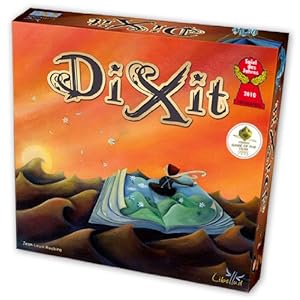
1. DIXIT
Dixit is a storytelling boardgame in the purest sense. Designed in France, it is noticeable because it is playable in any language. There is nothing to read--all the stories are made through the playing. The box DIXIT comes in contains a set of 84 gorgeously and enigmatically illustrated cards, with beautiful artwork by the artist Marie Cardouat (Google her, you'll soon discover what I mean). After all of the players are dealt a hand, one player takes the role of storyteller and chooses a card, describing it in one sentence. Each of the other players picks a card of their own that they feel might confuse the others at the table, given the storyteller's description, and the cards are shuffled, revealed, and each player votes on which one they think might be the storyteller's. If you trick the other players into voting for your card, you earn points. If you are the storyteller and people vote for your card, you earn points too.

Sounds simple, right? If you describe the card really bluntly, you'll win. There's the catch. The beauty and delight of DIXIT comes down to one simple rule: the storyteller gets NO points if everyone guesses their card correctly. So as storyteller, you ideally want every single person at the table to identify your card, except one. How do you do that? Subtlety, reference, metaphor... you decide. You're the storyteller, after all.

 
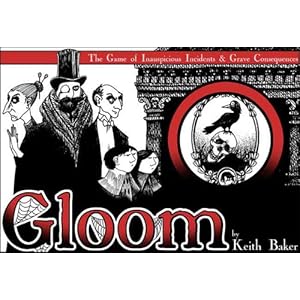
2. GLOOM
If DIXIT sounds a little bit too sweet for you, and you're a bit more of a Lemony Snicket family, there is always GLOOM. GLOOM is a card game heavily centred around the Victorian world of the penny dreadful novel, in which each of the players takes control of an unfortunately positioned family. As play progresses, cards are drawn, and the player's aim is to bring about as much misfortune to their own family as possible, hopefully ending in their untimely demise. As much as there are cards that say things like "bitten by a rabid dog" however, there are positive cards, signifying donations by surprise benefactors, or a trip to the circus, that you can use against the more distraught members of the other player's families, in an effort to bring them back up in their happiness.

The fun of GLOOM is not just in its whimsical cruelty and blessing, but also in the fact that as you play cards, you narrativise the game in progress. Through the strategic placement of events, a unique and hilarious story unfolds every time, as each player explains the sequence of actions that, for example, caused the twins in their family to become trapped on a train.

For a game so predicated on the miserable, it's actually a hilarious, creative, and extremely enjoyable experience to play GLOOM. For those with a sense of humour verging slightly more towards the macabre, it's bound to be a hit.


Keep me posted in the comments below about your thoughts on these games if you have played them before, intend to play them, or how they are received if you do decide to buy them. I'd also love to know if you have any book-themed or storytelling boardgames that you'd like to recommend yourself. I'm always on the lookout for more.

Other then that, it only remains for me to wish you all the joy that the next few weeks might bring, including, perhaps, one or two games, and more than a little reading.

Lyndon Riggall

Sunday, 2 December 2012

Save the books!


Recently I read an article saying that 10,000 copies of the original version of Good night, Sleep tight by Mem Fox had been pulped. (Interestingly it has recently been republished with illustrations by Judy Horacek.) Then I read that 20 of the 55 books that have won the Miles Franklin Award are out of print. (Admittedly, some have dated badly.) I wonder how many wonderful books go out of print or are remaindered long before they should be – all for the want of enough “someones” to promote the book?

What can we do? The first and most obvious task is to keep these titles in print. Ensure you keep buying those special books and share the joy/wonder as you give them away as gifts. Read and follow up on the recommendations made by our bloggers and all the generous souls who review books in magazines, on websites and blogs. Thank the wonderful people who run activities such as Readers’ Cup which introduce readers (and judges) to books they may not have chosen for themselves. Spruik the books you love –your passion might be the encouragement needed for someone to open that book.

Last week, Maureen mentioned some wonderful newer books that deserve a place in everyone’s library. And here are some others...

Sue de Gennaro Pros and cons of being a frog (Scholastic)
Corrine Fenton Hey Baby! (Walker)
Anna Fienberg & Stephen Michael King Figaro and Rumba and the Crocodile Café (Allen & Unwin)
Rose Foster The Industry (HarperCollins)
Morris Gleitzman After (Viking)
Gus Gordon Herman and Rosie (Viking)
Christine Harris and Ann James It’s a miroocool (Little Hare)
Pip Harvey I’ll tell you mine (UQP)
James Moloney Tamlyn (HarperCollins)
Amanda Niland & Christina Booth I wish there were dinosaurs (Windy Hollow)
Sally Odgers & Lisa Stewart Bushland Lullaby (Scholastic)
Jan Ormerod & Carol Thomson Looking for Rex (Little Hare)
Emily Rodda The Third Door (Scholastic)
Karen Tayleur Love notes from Vinegar House (Black Dog)