Welcome to the blog of the Tasmanian branch of the Children's Book Council of Australia!
Showing posts with label fantasy. Show all posts

Friday, 18 March 2022

Back to Deltora

Join Lyndon Riggall as he ignites an old passion for a wonderful fantasy series that enchanted young readers as they followed stalwart characters on challenging quests across the dangerous lands of Deltora.  


On my birthday this year there was one present that definitely took me by surprise. Actually, it was two presents, given to me by my friends Georgie and Mitchell, stacked in strange rectangular shapes that looked like two small shoeboxes. When I opened them, I gasped at what they contained: a complete original collection of Emily Rodda’s Deltora Quest 1, 2 and 3, as well as a few supplementary volumes. Something that had long been sleeping inside me was awakened.
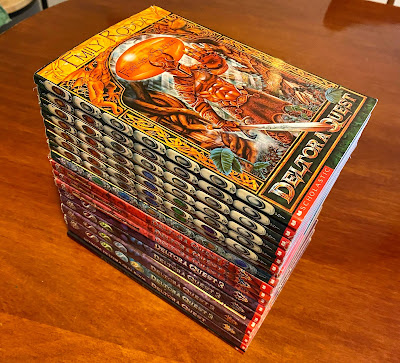

I never owned the Deltora Quest when I was a child, though I remember scouring the school library shelves each week for the volume with the right number of gems or the appropriate sections of pipe to match where I was in Lief’s story. Key among the initial appeal of the books (and the reason that I treasure them so much now), was that they were gorgeous. A few decades on, when every year book covers seem to include less and less detail, the series stands out as being aesthetically astonishing, each part enfolded in a feature illustration by Marc McBride that slyly whispers of the dangers that lie within. As I have been revisiting the novels over the past few weeks, their timelessness is evident. They are complex, fast-paced and short enough that they always leave the reader wanting more. While Rodda has written so many books and stories in and around the world created here (including, of course, Rowan of Rin, the Rondo books and the Three Doors trilogy), I must admit that for me it will always be Deltora Quest that is her masterpiece. The world Deltora has seen enormous global success, from 18 million copies sold worldwide, to an anime series that ran for sixty-five episodes. There have been rumours of Deltora coming to the big or small screen in English for decades, but for me it is sometimes very special to have a work of this quality without a thousand adaptations, variations and merchandising opportunities. Deltora Quest doesn’t need to be brought to the masses with an enormous budget to be one our greatest fantasy series for children. Readers know the secret.
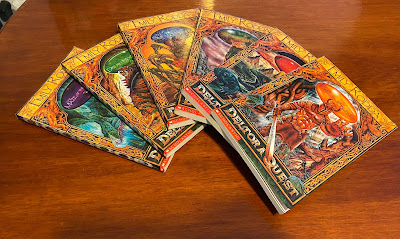
As a young primary school student, I ran to Deltora, and it has been exciting to see the door open once again and to be able to return. At the beginning of my own journey with the series, Deltora Quest was an exercise in simple adventure… I was breathless at the challenges faced by its heroes, trying to crack the puzzles and codes they came across before they solved them, simply enjoying the sheer wild fantasy that Rodda was creating. Now, I see the value of the messages hiding beneath the surface, too: the importance of working together, the fight to save the natural world and the need for leaders to stay in touch with their own humanity. For her part, Rodda seems to be in no way done with her creation. Her latest series set there, Star of Deltora, has only concluded in the last few years, while The Glimme, which was stunningly produced with her Deltora partner-in-crime Marc McBride, picked up an Honour award at the CBCA awards in 2020.


The first volume in the Deltora Quest series, The Forests of Silence, was released at the turn of the millennium, and as such it celebrated its 21st anniversary last year, with a new edition of the collection released in celebration. In the intervening time since my ten-year-old self first got his hands on the series, I am proud to state that Rodda’s work has lost none of its trademark sparkle or shine. It will always feel to me like a place half-forgotten in a dream; a memory lost in some unfathomable depth, like a treasure fallen into a dark lake. Some time before I had the confidence or the stamina to tackle such classics of fantasy as The Hobbit or The Lord of the Rings, when even C.S. Lewis could be daunting, Deltora was waiting for me, its magic begging to be released. I will always be grateful to Rodda for her sharp writing that was never puerile, for the complexity of her ideas and for her love of challenge and adventure. I will always be grateful for my friends, who knew that you could turn thirty-two and still believe in the imagined places that mattered to you when you were a child. 


Once, in a school library, we counted gems on spines and swapped books like secrets. Now, I hold them in my hand once again, and with every turn of the page I am in three places at once. I am here, on my couch; I am there in my school library, lying on a beanbag with my feet in the air…


…And best of all, I am, again, in the land of Deltora, where adventure awaits.


Lyndon Riggall is a writer and senior-secondary English teacher at Launceston College. His latest picture book, Becoming Ellie, was created in collaboration with Graeme Whittle, and he is also co-host, with Annie Warburton, of the Tamar Valley Writers’ Festival podcast. Lyndon can be found at http://www.lyndonriggall.com

Saturday, 14 September 2019

This is not a fairy tale - Jodi McAlister on Fantasy


Jodi McAlister, using her Valentine series as a springboard, poses an essential question about fantasy writing: ‘What’s it about?” Read on and discover the importance of a central theme and purpose and how these are pivotal to each title in the series.

At the beginning of every semester, I go around my uni classroom and ask my students what they like to write, and what they like to read. Almost every time, more than half the class will reply “fantasy”.

This has been both wonderful and challenging for me. It’s wonderful, because I’m an author of a young adult fantasy series (the Valentine series, published by Penguin Teen Australia), and so this makes me well positioned to teach them what they want to learn. But it’s also challenging, because it makes me interrogate my own love of fantasy: what is it about fantasy that’s so appealing?

The answer, on the surface, is obvious: it’s magic. The generally accepted definition of fantasy is that it includes an element of the impossible, something that could not exist in our world (as opposed to science fiction, which is a vision of a future which is possible but has not yet come about). That impossibility at the heart of fantasy is one of the things that draws us in, and thinking about how the impossible elements of the story operate is key to worldbuilding. If you could take the impossible parts of your story out and it wouldn’t have much effect, I frequently tell my students, then it’s probably not fantasy.

That said, if we focus on the impossible – on the magic – of fantasy too hard, we miss one of the most important things about it. Indeed, this is true of any kind of story: if we focus too hard on the mechanics, then we can lose sight of something truly central. All stories – fantasy or otherwise – have to be about something.

I thought about this a lot when I was writing my Valentine series. Beneath the trappings of fantasy (which in this case, are tied to some very scary, very powerful, and very murdery fairies), I wanted to be sure that there was a central thematic concern running through all three of the books. What I ultimately decided to focus on were emotions and attitudes that teenage girls are generally societally discouraged from feeling and/or expressing, but which I think are hugely powerful and important and which I wanted to embody not just in my teen girl heroine Pearl but in the people around her.

Valentine, the first book, is about desire: not just sexual and romantic desire, but that specific adolescent frustrated yearning for things you can’t quite name.

Ironheart is about rage. Girls are generally socialised to be nice and smooth things over, to not make a scene, but under that is an incredible wellspring of anger I wanted to express.

And Misrule is about ambition. If the recent heroism of teen girls like Emma Gonzalez and Greta Thunberg has shown us anything, it’s that teen girls have great capacity for leadership, even when people are trying to shut them up, and that’s something I think is incredibly potent.

This is a provocation I’d throw out to all aspiring fantasy authors – and, indeed, all aspiring authors in general. Setting aside the mechanics of how your story works: what is it about?

Jodi McAlister is the author of Valentine (2017), Ironheart (2018), and Misrule (2019). She is also an academic, and works as a Lecturer in Writing and Literature at Deakin University in Melbourne.
Twitter: @JodiMcA
Instagram: @jodimcalister

Editor’s note: Get the inside story from one of our bloggers who reviews Valentine and takes a look at the series: If this post has piqued your interest, discover more about Jodie and her writing in this interview.


Saturday, 14 October 2017

Enter Cello – A fantasy world with a difference

This week, discover the fantasy word of Cello created by young adult author Jaclyn Moriarty. Jackie deftly shares her love of this trilogy and provides plenty of hooks as she details the nuances of an alternative world and the trials and tribulations of teenagers displaced between Cello and Earth.

The ability of an author to create a world that captures the imagination of the reader is a key ingredient in fantasy fiction, and it is the world of Cello which is the real star of Jaclyn Moriarty’s Colours of Madeleine Trilogy. The Kingdom of Cello provides a rich backdrop for the characters’ struggles to return the missing royal family to Cello before their absence is discovered and is a major strength of the series.

Although the idea of a world linked to our own world is not new, the world of Cello is distinctly original and very attractive. What reader wouldn’t love to experience the Lake of Spells (only accessible to children no older than sixteen) and fish for the many spells there, or to visit the Cat Walk where cats of all sizes and species from all over the Kingdom gather to walk in the evening? The revelation that Cellians can be identified by a spray of colours which is visible on their inner elbow when lemon juice is applied is an appealing idea especially when you realise that Cellians transported to our world lose their memories of their former lives and have no idea that they are in fact from another world.  The Butterfly Child, Accidental Pilots and other Cellian oddities all add an element of magic and possibility to the world.

The provinces of Cello are all extremely different to each other as well as to our world. The technology minded Jagged Edgians are in stark contrast to the traditionally minded people of Old Quainte with their unusual and convoluted expressions. These differences add another dimension to the teenage themes explored in the books as characters see the world from totally different viewpoints depending on where they live– Keira from Jagged Edge sees the importance of endings while Elliott from the Farms needs beginnings.
Cello experiences Colour attacks and a system of warning bells has been put in place to keep people safe. Some colours can wound or even kill. Others can affect mood or perception. The importance of these colours and the Cello, to both Cello and our own world, revealed in the ending of the third book is plausible and resonates with current environmental theories.

Readers of Moriarty’s Ashbury/Brookfield novels will recognise her skill at supplementing her storytelling prose with letters, newspaper articles and extracts from the extremely irritating T.I. Candle’s guidebook. Often these play a key role in conveying information that will be essential to later story developments.

Comprising the novels A Corner of White, The Cracks in the Kingdom and A Tangle of Gold, the story begins with a girl in our world discovering a message from Cello in a broken parking meter. The teenage characters at the centre of the story both in Cello and our world experience usual teenage issues often amidst absent or disappointing parents. Finding a place where you feel you can fit in, as well as establishing your true identity, are key concerns. Discovering which cause is worth your support is not as easy as it may at first appear and may put you at odds with your friends.

If you haven’t read this series, track it down – you won’t be disappointed.

Jackie Crane
Reader