Welcome to the blog of the Tasmanian branch of the Children's Book Council of Australia!

Friday, 10 November 2023

Writing As Play

This week, Tasmanian author, Claire van Ryn shares the joy and freedom she has found in writing fiction and the open invitation the form offers to play with ideas and language.

I’m not a children’s book author. 

Yet, here I am writing for the CBCA Tasmania blog. And feeling rather chuffed about it, because it’s given me cause to look at my writing practice and scrutinise why I love it so very much.


This is where I landed: writing fiction is childsplay.


My writing forays began in journalism, meeting the daily demands of a newspaper: a certain number of articles each day, a certain number of words each article, a compelling angle to be found in each. I loved it. I grew exponentially in my craft. The people around me gave feedback so that my writing grew tighter, punchier, more accurate. 


Later, when I became a mum and wanted a career that fit with my children (and not the other way around), I produced copy for business clients. I learnt to write in their brand voice, to weave words that aligned with their unique personality. I met with them, interviewed them and teased out what their unique proposition was. That was fun too.


It wasn’t until I started writing my first work of fiction, The Secrets of the Huon Wren, published this year with Penguin Random House, that I realised the exquisite difference of writing fiction. Suddenly, I wrote whatever I wanted to write. Plots and characters unravelled from my brain, and I didn’t have to check the veracity in case of defamation. But more than that, all the childlike mannerisms that are often squashed as we progress to adulthood were invited back. ‘I need you!’ I called to my youth, and those whimsies came running back with glee, bringing with them my imagination like a great, whale-shaped helium balloon. I’m not sure why I wrote whale-shaped just now. It came to mind and I wrote it down. And that’s the beauty of working with the imagination as your writing buddy. The inexplicable happens and you tag along.


As I write the first draft of my second novel, there’s a tension between the pressure of producing a new work as good (as publishable!) as the first, while still enjoying the journey. I’m a pantser. That is, I don’t do a lot of plotting, preferring to ‘fly by the seat of my pants’ and see where inspiration carries me. It’s probably a lot more stressful! But it also frees me up to listen to the here and now and see what happens (I’ll save the ‘adulting’ for the editing process!).


Isn’t that the joy of childhood? To play, to be fully present in this moment, to relish the details? That’s certainly what I’ve marvelled at in my own children.


Writing fiction is childsplay… not because it’s easy, but because of the invitation to listen to our imagination once more.


Claire van Ryn

Claire is an awarded writer based in Launceston, currently working on her second novel. Her debut fiction The Secrets of the Huon Wren was published by Penguin Random House in June this year and heroes the Tasmanian landscape. It is available at all good bookshops, or online here.


Follow Claire’s writing forays:

On Instagram @clairevanryn 

On Facebook @clairevanryn.writer

On her website www.clairevanryn.com

Saturday, 4 November 2023

A Magical Visit to the NCACL - Children’s Literature Treasure Trove

Recently, whilst visiting Canberra, Jennie Bales had the opportunity for a tour of the National Centre for Australian Children’s Literature (NCACL). What a treat this was – a highlight of the holiday and a breathtaking and enchanting experience under the expert and informed guidance of Dr Belle Alderman AM, the Director of the NCACL


This visit was long overdue – originally planned as an excursion during the ASLA conference in 2019 – unfortunately the trip to Canberra was cancelled for personal reasons. However, ongoing communications with Belle over the years has ensured we have established a firm long distance friendship inspired by a shared passion for children’s literature. Belle is a stalwart in writing about the NCACL’s many initiatives far and wide and regularly for this very blog! When I let Belle now that I was heading to the ACT in September an invitation to visit was quickly forthcoming and just as quickly accepted.

An easy bus trip out the University of Canberra, clear signage led us to the library where Belle arrived to escort us down to the lower level. The NCACL sits below  the library and faces onto a pleasant courtyard and adjacent café so sees lots of traffic. On entering, it was lovely to meet some of the volunteer staff where coffee and home-made cake were consumed along with some interesting personal tales of favourite books, authors, aspects of the collection and insights into the various forays we had each made exploring this fascinating world of children’s literature.

The public space is divided between a working area for the maintenance of the collection and a small open area with some framed illustrations, tables, ephemera, books on display and a table area used to showcase a particular creator or work for visitors. During the visit this table was laden with just a tiny sample of the treasures that are housed around the lower levels – space being of a premium and in short supply. Spread out on a display table during my visit was the stunning artwork for Desert Lake. The story of Kati Thanda-Lake Eyre (2016) written by Pamela Freeman and illustrated by Liz Anelli. This was accompanied by a fascinating array of accompanying material including Anelli’s notes on the manuscript, drafts, dummy book and so much more. To get a taste of the scope of material collected by the NCACL it is worth watching a video produced by Liz Anelli – a fascinating and informative behind the scenes sharing of the work and material generated for the more recently published Dry to Dry: The Seasons of the Kakadu (Freeman & Anelli, 2020). 

Photograph of original artwork by Liz Anellie for
Desert Lake: The Story of Kati Thankda-Lake Eyre (Freeman & Anelli, 2016)


As we traversed the corridors Belle opened door after door filled with filing cabinets, archival boxes, filing drawers and so much more! Each section carefully labelled to assist in finding requested material and to ensure incoming material is stored safely and in the right place! And of course there are the practical Resources – the databases, curated lists, catalogue, bibliographies and so much more to assist teacher librarians, librarians, educators and book lovers to help them find ‘just the right book’!


But the ‘pièce de résistance’ was opening the door to the book collection – Wow!


Dr Belle Alderman with the NCACL book collection


As a proud owner of a signature bear, decorated by Marc McBride as part of a fund raising auction run be CBCA in 2003, it was also a treat to see that some other bears have found their way to the Canberra and been added to the collection of ephemera that is just as fascinating to behold. 

I could write endlessly about this memorable and special visit and the warm welcome I received. It was so inspirational that I asked Belle if we could offer a presentation to interested  children’s literature fans – there may well be something that you have stored away that could add to the collection or something that you could take on board in a volunteer capacity as the NCACL relies on volunteers and donations to maintain and continue this vital work. If this post has piqued your interest, consider joining Belle and Jennie on the 15 November, 2023 when we are Lifting the Lid on a Literary Treasure. Or catch the recording at a later date at Eduwebinar, which is kindly donating a percentage of the proceeds to the NCACL.


Jennie Bales

Retired teacher librarian and adjunct lecturer

CBCA Tasmania Social Media Coordinator

Sunday, 29 October 2023

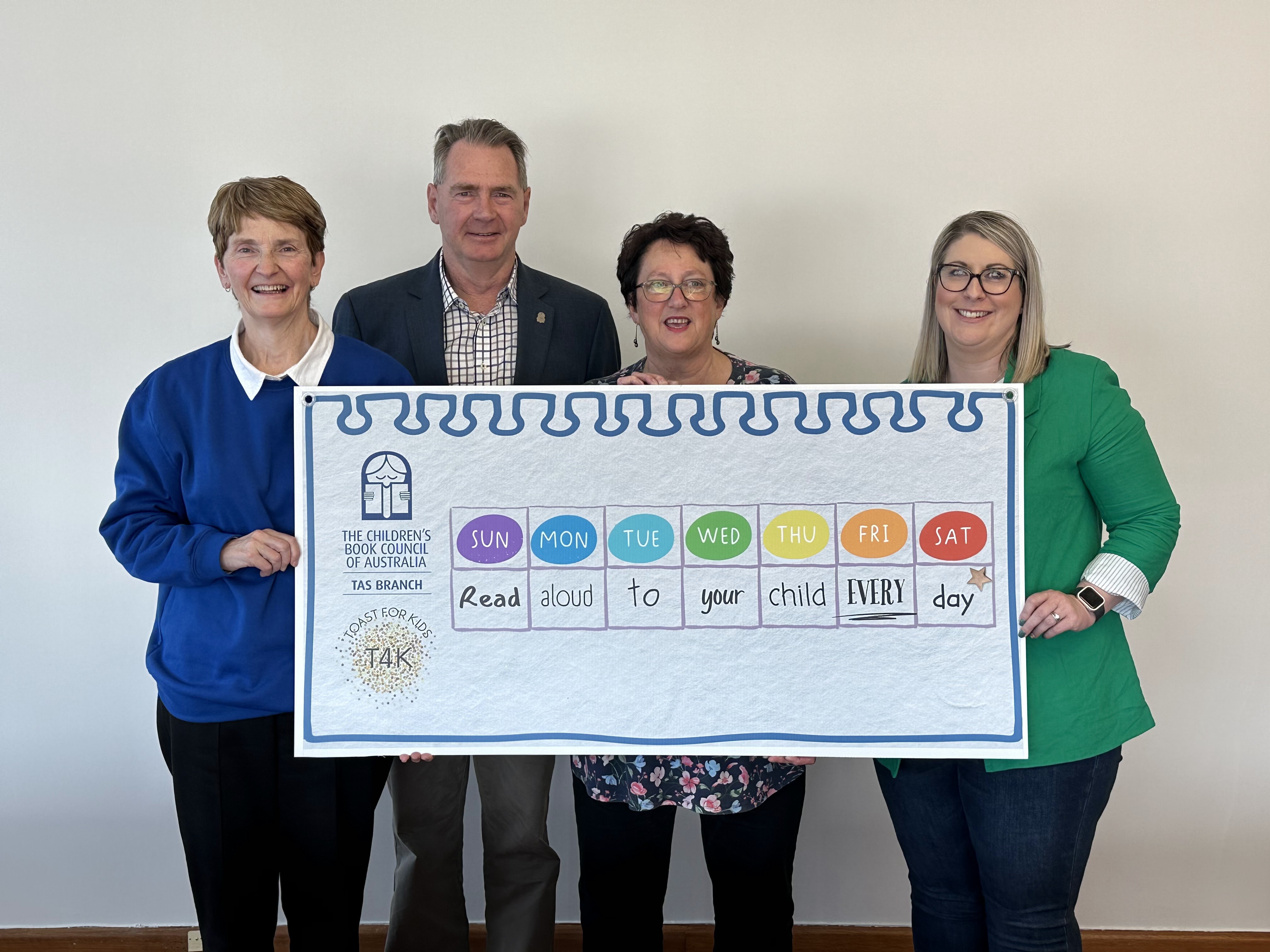
Read Aloud to Your Child Every Day

CBCA Tasmania, in partnership with Toast for Kids Charity launched a new campaign, “Read Aloud to Your Child Every Day”, in Hobart on the weekend at Mathers House, during the Sunday Farm Gate Market. Families that joined us had the opportunity to receive a copy of the recent Toast 4 Kids Tassie Rhymes for Little Tigers (Joy, 2022) or a different complimentary book to start their own Read Aloud to your Child Every Day commitment.

The Tasmanian Branch, Children’s Book Council of Australia, partnering with Toast for Kids Charity Inc., are proud to launch the national campaign “Read Aloud to Your Child Every Day”, a simple message encouraging parents, grandparents, siblings and carers to read to their children for their literary growth and education; investing in their future.

CBCA Tasmania Executive present the new slogan at the AGM, October 2023
L to R: Roxanne Steenbergen, Vice President; Steve Martin, President; Felicity Sly, Treasurer;
Loretta Brazendale, Secretary

Recently released NAPLAN data (see ABC News report) showed that one in three school students throughout Australia are not meeting minimum numeracy and literacy expectations, and one in ten are so far behind they need additional support. Furthermore, over decades Tasmania continues to suffer from an illiteracy rate of 50%. Informed by these facts, we are championing our cause to develop a culture of “Read Aloud to Your Child Every Day”, locally, state-wide and nationally.


We are commencing a national campaign, reaching out to institutes, governments, schools, parent groups, agencies, not for profits, speech pathologists, writers’ groups, book and reading advocates, presenting the opportunity to partner with the effort, adopting and promoting the one message: “Read Aloud to Your Child Every Day”.

Steve Martin & Felicity open proceedings
Audience members receive a free gift of Tassie Rhymes for Little Tigers
Through creating such a national coalition it is hoped that it will provide a consistent and positive message that encourages a culture to “Read Aloud to Your Child Every Day”, thus becoming part of our normal daily regimen, assisting in lifting literacy rates and expanding opportunities for young people. One thousand voices with one message can make a difference.


Steve Martin

President, CBCA Tasmania and Toast  for Kids

Friday, 20 October 2023

Northern Secondary Readers’ Cup

The Northern Secondary Schools’ Readers’ Cup also celebrated its 20th anniversary this year, with this special report from Jess Marston sharing her first experience in judging this competition. Jessica enjoyed this different secondary perspective rather than organising and participating in the Primary event (check it out here).


The Secondary Readers’ Cup for the North was in Term 3, with four teams competing for the prized trophy.


Hosts, Scotch Oakburn College, were also joined by teams from Newstead Christian School, Launceston Church Grammar School and Queechy High School.


The participants arrived with heads and hearts richer for the wonderful book list provided to them for this year’s event.


These were 2023 CBCA Shortlisted books The Way of Dog – Zana Fraillon and Xavier in the Meantime – Kate Gordon, along with tried and tested classics Stargirl – Jerry Spinelli, The Single Shard – Linda Sue Park, Millie and the Night Heron – Catherine Bateson and The Heaven Shop – Deborah Ellis.  These were all first time reads for me, and I found each to be so full of heart, with characters that will definitely stay with me for a long time.  Added to this impressive list of novels was Drew Daywalt’s delightful picture book The Day the Crayons Quit.

Our teams began the event with quiz rounds to test their recall knowledge of the books, their characters, settings, events and themes.  Questions were given to the participants aloud, with answers arrived at collaboratively within each team.  Quiz rounds were interspersed with Creative Presentations from each team.

This was my first experience with the Secondary Readers’ Cup so I was very eager to see each team’s approach to sharing the deeper messages and understandings they gained from the books.


Co-judge Carol Fuller and I were definitely treated with extremely thoughtful and creative responses that showed empathy, understanding and connection.  With the expectation that teams showcased a minimum of three titles, all teams chose to feature most, if not all, of the books, which we were very impressed with.  


Following the completion of the Quiz, Creative Presentations and a pizza lunch, the results of the 20th Northern Secondary Readers’ Cup were announced with Newstead Christian School the excited winners.


The winning team…


Newstead Christian School's Creative Performance

I would like to acknowledge the time and effort given by the school staff who support this wonderful expression of learning through literature, and for their part in promoting reading for enjoyment.


Particular thanks must go to host David Morris, Scotch Oakburn College Librarian, for his long-term commitment to the continuation of this important event, Petrarch’s Bookshop for their ongoing support of Readers’ Cup events in Northern Tasmania, and of course the CBCA Tasmanian Branch for their support and sponsorship.


Jess Marston 

Teacher Librarian, Hagley Farm School

Saturday, 30 September 2023

Saving species through story

Can stories save the world? Dr Sarah Pye thinks they can!

This week’s blog introduces a series of literary non fiction texts focusing on endangered animals in South East Asia, the conservation work of Dr Wong and the many projects of the author, Dr Sarah Pye in sharing her knowledge and experiences with young readers and students in schools.

It was a humid 2012 day in Borneo. The hotel receptionist had just found out I was a freelance writer gathering fodder for a feature story about wildlife tourism. “You need to talk to Dr Wong,” she said, scribbling a phone number onto her notepad and handing me the phone.


Little did I know that day would change my life.


Sun bear at the Bornean Sun Bear
Conservation Centre ©
Seeing sun bears for the first time

Dr Wong invited me to visit the Bornean Sun Bear Conservation Centre, not yet open to the public. As I stood on the observation platform watching the world’s smallest bear swinging from a branch 50m in the air, I was hooked. “There are far fewer sun bears than orangutans,” Wong explained. “I have dedicated my life to saving the sun bear.”


I asked what I could do to help.

“Do what you do best,” came the reply.


Sarah Pye with Wong Siew Te ©
Do what you do best!

Those five powerful words have shaped my last decade. Yes, I wrote the article, but I also wrote Wong’s biography (for adults) as a Doctor of Creative Arts degree, exploring how narratives can engage non-scientists in conservation. However, when Saving Sun Bears was published in 2020, I realised my job had only just begun. I needed to reach the next generation. 


Making a mini rainforest | © Jessie Dee
Why are nonfiction conservation stories for children important?

Stories about iconic animals can evoke emotions like wonder, empathy and concern. They can foster a sense of environmental stewardship and inspire children to become change makers. So, back at the keyboard, I started writing middle-grade children’s books about Wong’s life. There are now six books in the Wildlife Wong series. Each one focuses on Wong’s adventures with a different species: sun bears, orangutans, pygmy elephants, bearded pigs, fig wasps and Sumatran rhinos, but they are innovative in their structure.

But what if kids don’t like reading?

As any teacher will tell you, children learn in different ways. To engage with differing preferences, I decided to include different touchpoints. Each Wildlife Wong books includes a nonfiction narrative (or story); informational text or cool animal facts; sketches and photographs which make it look like a field journal; and experiments which link back to the narrative and engage those reluctant readers. This innovative style led to them being shortlisted for an Australian Educational Publishing Award in 2022. 

Sumatran rhino sketch of baby Mina and her mother |
© Woon Bing Chang


Sarah Pye with Pongo | © Jessie Dee
Storytelling puppets

The next step was extending my reach by visiting schools, so I developed workshops around reading my stories and conducting the experiments. Most recently, I started incorporating the art of puppetry! I now visit schools together with my puppet sidekicks, Luna the sun bear and Pongo the orangutan. The response has been incredible. This August, for instance, we spent 12 full days in schools, directly interacting with over 1,200 students. With the help of technology, many of them even got to meet the real Wildlife Wong!


Tours to Borneo

I’m not done yet! I am excited to announce I have just launched a 10-day guided tour of Borneo for next August, during which Wong will take my guests on a behind-the-scenes tour of the Bornean Sun Bear Conservation Centre! 


When he said, “Do what you do best”, Wong had no idea it would spawn a doctorate, seven books and a lasting friendship. So, I now ask you the same question: what can YOU do best to help our endangered animals?


Dr Sarah Pye is an award-winning biography and children’s author, an environmentalist and avid traveller.

Web: https://sarahrpye.com/

FB: https://www.facebook.com/SarahRPye

Instagram: https://www.instagram.com/author_sarahrpye/

Twitter: https://twitter.com/AuthorSarahPye

LinkedIn: https://www.linkedin.com/in/sarahpye/


Editor's note: Sarah and I connected online via a shared passion for animal conservation issues conveyed through story. It was a pleasure to read and review her latest book in the series - Wildlife Wong and the Sumatran Rhino. Read my review!


Saturday, 23 September 2023

Why Book Clubs Matter

This week Lyndon considers the power of sharing our reading experiences and how book clubs can add richness and deeper connections to the books we have engaged with.


We often think of reading and writing as solitary acts. These pastimes, we know, are the hobbies of the reclusive eccentric. As John Green states, writing is “a profession for introverts who want to tell you a story but don't want to make eye contact while telling it.” 


Yet if that’s the case, why is it that some of the best moments I’ve experienced in reading have not been those when I have been alone in the experience? When I think of the core memories I associate with my love of books, of course there are winter nights wrapped in a blanket by the fire with a hot chocolate and a great six-hundred-page-doorstop, but conversely, I also think of the books that become a shared cultural moment as everyone discussed them, the ones I lined up for outside shops, or the ones with a great twist that sparked a series of text messages with someone who I knew would share the agony of a secret shock with me. The rise of #BookTok, I think, indicative of our desire for this sense of community around reading, and ultimately, I believe, the existence of the book itself relies on the idea that it is part of a conversation between at least two people: the writer and the reader. Reading may be done alone, but stories are always something we make together.

It is interesting to consider how and why readers converge. I had long dreamed of joining a book club by the time I was invited to one by my friend Georgie. Her group of friends, known as the “We Drink and We Know Things Literary Circle” meets at a local bar or restaurant every four weeks, where each of us emerges from hiding for a big hearty meal and an even heartier discussion. A book club, I have discovered, is about several things. It is about friendship. It is about civilised disagreement, seeking clarity, and answering questions of interpretation. It is about the accountability involved that ensures that each of us at least finds the time to read one book a month, and it is about occasionally having your heart broken when no-one loves a book quite as much as you do. Mostly, however, the guiding principle of a book club is the same as that of the English classroom: it is founded on the fundamental belief that when we work together to unpack a story we gain more from it.


At Launceston College this year, we decided to attempt to bring some sense of this culture to the school as an extension of what we had seen in the Shadow Judging process. We started three new clubs centred on a love of story: a Launceston College Film Club, Writers’ Club, and Book Club. For the last of these each month, the library orders six copies of an individual book selected by the group, and students have a month to read them while they are shared around. We meet in a lunch break, and across our reading we explore different genres and ideas, with the students challenging each other to consider the varied perspectives they each bring to a work. This year, perhaps, the hot favourite has been V.E. Schwab’s The Invisible Life of Addie LaRue, but there have been wonderful and rich discussions for every text that we have engaged with. Whether the book is loved or hated (and usually it is both depending on who you talk to), there is always a lot to discuss. The only truly dangerous book is an average one.

One of our school club members, Zina, had her sister Aria
design these amazing badges!

I love being part of both my book clubs, and I feel sorry for anyone who does not have that experience as part of their lives. The good news is that wherever there are readers, there is hope. Everyone, no matter their age, should be able to share the experience of reading.


So… if you aren’t already part of a book club…

Why not start one?


Lyndon Riggall
Lyndon is a writer, teacher, and Co-President of the Tamar Valley Writers’ Festival. He can be found @lyndonriggall and at
www.lyndonriggall.com