Welcome to the blog of the Tasmanian branch of the Children's Book Council of Australia!

Monday, 27 May 2013

Have you seen these?

I have had a lovely time recently re-reading, something I don’t usually do. But there have also been new things to enjoy. Here are some of them.
Seadog by Claire Saxby, illustrated by Tom Jellet, published by Random House
Seadog captures all the joy that having a scruffy lovable dog can bring to a family. Jellet’s illustrations capture the adventurous and mischievous nature of the dog in many different environments. We learn exactly what the dog isn’t and the simple refrain tells us that he’s a seadog. Just great for reading aloud or sharing with a 3-5 year old.

Funny Bums by Mark Norman, published by Black Dog Books     
Have you ever really thought about animal bottoms? This is an information book full of great photographic images combined with weird and wonderful facts, introducing children to a part of the animal which we rarely focus on. Indirectly, through text and images, children develop early concepts of evolution, adaptation, ecology and survival. The animals range in size from the elephant on the cover through to small beetles which have an exploding backside and many in between.

Sidney, Stella and the Moon by Emma Yarlett. Templar Publishing
Sidney and Stella constantly bicker and, after one fight, bounce their ball so high that it smashes the moon out of the sky. Of course, they have to find a replacement and the book recounts the adventure they go on to achieve this. Right from the start it is obviously fantasy and the reader joins in with the wacky ideas they try. Great illustrations include a double fold-out page. The subtle lesson from the book, the need to share and reach a common goal, is well-executed.
Flora and the Flamingo by Molly Idle, published by Chronicle Books
This is a wordless picture book which will appeal to readers of all ages, but especially young budding dancers. Flora, dressed in flippers, swimsuit and bathing hat, meets a flamingo and imitates its movements. When she mucks up, the flamingo mocks, eventually relents and together they perform. The great strengths of the book are the many flaps which change the reader’s perception of what is actually happening. This is a gently humorous story about friendship. It’s a pity that its pinkness may put off parents of boys, who are sure to enjoy the humour as much as girls will.

The Frank Show by David Macintosh. Harper Collins
David Macintosh is one of my favourites. When the boy has to give a one-minute talk at school about a family member, he discounts everyone till he is only left with his grandfather Frank. But he is so boring! He’s not as interesting as other class mates’ family members. He doesn’t like anything the boy does, doesn't like noise, or today's music, or gadgets and gizmos. But the boy discovers his grandfather is much more than he knew or expected. A good humorous story, with wonderfully detailed but off-key illustrations to explore, about generational differences and acceptance of others, aimed at lower primary students.

And now for books aimed at older readers. Echoing Carol’s blog last week, the following can be enjoyed by readers of all ages, not only the ones for whom they have originally been aimed.
Ketchup Clouds by Annabel Pitcher, published by Indigo.
This was the YA and overall the winner of the Waterstones Children’s Book Prize, which I learned about through the last CBCA Tas newsletter. (Thanks Penny). It’s a great cover which is sure to attract readers. Zoe writes to Stuart Harris, a man on death row in Texas, and through her letters unburdens her terrible secret, slowly allowing Harris, and the reader, to learn more about her crime. Zoe’s voice is believable – ranging from the worldly wise to the naïve and immature. There are lots of themes which will appeal especially to teenage readers.

Boundless by Cynthia Hand. HarperCollins
This is the final book in the Unearthly trilogy. Fans of the series are sure to be pleased by it, but for me, coming to it without knowledge of the previous books, I found it uncompelling. This may have to do with my age but also my personal preference is not for paranormal romance, despite it being well-written. Clara has learned to live a normal life along with her Angelblood heritage, but now she is torn between her love for both Tucker and Christian. There are themes of parental and romantic love, along with the place of religion in modern life.

Song for a Scarlet Runner by Julie Hunt. Published by Allen & Unwin
This is a great fantasy, peopled by some unexpected characters, without the typical royal intrigues, treasure seeking and fighting. Peat is blamed after the stranger’s visit brings death and disease and therefore she is forced from her farm home. Her journey takes her through an interesting landscape. There she meets some wonderful people, including Eadie, Mother Moss, and Siltboy, the 900 year-old child with quaint language and outlook. I hope there’s a sequel with more of Peat’s adventures but Julie may decide that her readers are better left with their own imagination creating Peat’s future life. (Thanks to Allen & Unwin for my review copy).

What have been your favourites recently? Please let us all know.
Maureen Mann

Sunday, 19 May 2013

ON FRACTURING FAIRY TALES


Once upon a time there were no computer games, movies, televisions or printed books. In those days only voices told stories. Stories swirled around in the smoke of campfires and stone hearths and chimneys, changing shape according to the imagination, narrative skill and world view of every teller. Stories were told to pass the time. To make sense of birth, death and everything in between. To amuse children and to caution them about the dangers of certain behaviours.

The archaic tales were often set in dream-like, magical lands which were populated not only by humans, but by talking animals and objects, as well as witches, wizards, fairies, elves, trolls, giants, ogres, pookas, mermaids, selkies, undines, leprechauns and other ethereal, creepy or downright evil characters. Over generations, favourite stories passed into folk lore. And with the advent of the publishing industry, ‘fairy tales’ began to be written down and published.

As early as 1697, Charles Perrault saw the publication of his delightful French fairy tales (Histoires ou contes du temps passé). Soon afterwards, his countryman, Antoine Galland, translated a collection of Middle Eastern tales known as the Thousand and One Nights (Les Mille et Une Nuits, contes arabes traduit en français, 1704-1712). In 1812 the German academics, Jacob and Wilhelm Grimm, brought out Kinder-und Hausmärchen (commonly translated as Tales from the Brothers Grimm). Hans Christian Andersen, a prolific inventor of Danish fairy tales, had his ‘Eventyr’ published between 1835 and 1872. In 1887 ‘Speranza’, also known as Lady Jane Wilde (mother of Oscar Wilde), recorded the fairy tales of Ireland in Ancient Legends, Mystic Charms and Superstitions of Ireland while more recently, Iona and Peter Opie collected and edited The Classic Fairy Tales, 1974.

The study and interpretation of fairy and folk tales is now an academic discipline as dense, surprising and foreboding as a medieval forest. Theoreticians including Sir James George Frazer (The Golden Bough: A Study in Magic and Religions, 1890), Joseph Campbell (The Hero with a Thousand Faces, 1949) and Bruno Bettelheim (The Uses of Enchantment: The Meaning and Interpretation of Fairy Tales, 1976) have all recognised that deep mythical, psychic, sexual, and political meanings lie below the surface of fairy tales.

The following well-known fairy tales, for example, can be seen to embed messages about gender, patriarchy, class, and/or colonialism which may be regarded as somewhat less palatable today than they were in ages past:
The Frog Prince and Beauty & the Beast:   
Girls, don’t kick up a fuss if your father marries you off to a toad or a beast because your new husband may turn out to be a handsome prince in disguise.

Cinderella:
Just grin and bear it, girls, even when forced into domestic slavery; because if you do, your fairy godmother may one day appear and help to arrange a fairy tale wedding for you.

Little Red Riding Hood:
Always stick to the straight and narrow, girls, because if you don’t you could be led astray by a Big Bad Wolf who may fool you into thinking he is as sweet and innocent as your granny.

Jack and the Beanstalk and Goldilocks:
There is no need to despair if you are poor, dim-witted, or prone to walking into other people’s houses and helping yourself to whatever takes your fancy. There are other lands which are ripe for the plundering. But flesh-eating bears and ogres live there, so you had better be nimble and quick when you steal their food or treasures and break whatever they hold dear.

When Samuel Johnson completed his Dictionary of the English Language he fixed the previously fluid spelling of the English language to an England of 1755. Yet his, and all other the other subsequent dictionaries, need to be constantly updated because the meanings of words shift around; new words and phrases enter the common vocabulary, while others become obsolete. Similarly, fairy tales are constantly being told and retold for sheer pleasure, or because writers, publishers, parents, educators, or guardians of public morality want to change the messages encoded within them.

Nihilism of any sort, along with references to sexual acts or pregnancy, or to overt violence and death, has been expurgated from the texts of most earlier fairy tales. Over time, the protagonists of fairy tales have been granted happy-ever-after endings, which are seen as more suitable for children than some of the more gruesome endings of some earlier texts. In the twentieth and early twenty-first centuries, fairy tales have been further exposed to a smiley-faced homogenisation by the ever-popular Walt Disney film studios.

Yet there is no denying the childish, yet universal, appeal of the archetypal plots of fairy tales and the attraction of their naïve, astute, funny, and downright wicked characters. This is why fairy tales, with their imaginative qualities, their psychological significance, and ability to convey encoded messages, have always sparked the interests of writers, educators, parents, and guardians of public morality.

Perhaps as a reaction to the progressive bowdlerisation of fairy tales, Roald Dahl, the foremost writer of children’s stories of his day, applied his funny, wicked, and subversive wit to fairy tales. When he brought out his Revolting Rhymes in 1982 he became a forerunner of what is now a recognised sub-genre of children’s literature, the ‘fractured fairy tale.’

THE ECOTALES
During a heated exchange on climate change at a dinner party I hosted a couple of years ago I received a call from my muse to fracture a fairy tale. Instead of an acorn falling on Chicken Licken’s head, a wave could splash over him, and he could sound the alarm that the sea level is rising. All the stock characters in the climate change debate can be found in that fairy tale. There is the curious chicken who wants to know why the sea level is rising and how to stop it from rising any further. Turkey Lurkey could bury her head in the sand. The geese and ducks could thoughtlessly quack out Chicken Licken’s alarm. Foxie Loxie could be the climate denier who tries to lure the birds into a boat and eat them up. Jowly Owly could be the climate change expert who explains the carbon cycle to them. And Farmer King and his fine feathered friends could work out how to minimise carbon pollution on their farm by the sea. Thank you, Muse!

Inspired by the cosmologists’ ‘Goldilocks Theory’ (life evolved on Earth because the conditions were JUST RIGHT!), I then wrote Messy Lox Goes to the Planet of the Bears, a futuristic ecotale about a young space cadet who sails her space bug around the Ursa Minor (Little Bear) galaxy, visiting a large planet which is too hot, a medium-sized planet which is too cold, and a baby planet which is JUST RIGHT! She
starts to pollute the environment of the baby planet until three bears let her know exactly what they think of humans and their pollution.


The tide of inspiration kept flooding in. Because ‘Cindy’ is kept locked up by her wicked step-family, she must have the smallest carbon footprint in the land. Why not give her diamond slippers, since diamond is the hardest form of carbon? She could be kitted out for the ball by a fairy godmother who works in an op shop and she could marry a prince who is potty about organic gardening.

Bling could be the genie of Consumerism. The fisherman who discovers him and benefits from his bounty could later learn that the fish and birds of the ocean will only survive if he puts the genie back inside the bottle.

Little Emerald Ryding-Hoode and her granny could try to save an endangered wolf.

Prince Pobblebonk could warn a prissy princess about the dangers of poisoning the waterways.

Juzzy could steal a golden egg-laying goose from a very tall man who lives at the top of a beanstalk, and be put to work in an organic garden for the next three years.


Three Little Porkies could find out about renewable energy sources from the Big Bad Wolf.

And Cool Girl (Snow White) could have a sensational time singing, gardening, cooking, and preserving garden produce with seven short, but very talented, brothers.

After their many trials and tribulations, all my protagonists could do their best to live sustainably ever after (most of the time anyway).

USING THE ECOTALES IN THE CLASSROOM
The Smallest Carbon Footprint in the Land (IPKidz, 2013) provides limitless opportunities for teachers from K-12 to design classroom activities around Sustainability, which is an underlying strand to the National Curriculum.
Students could be asked to discuss, research, and write about:
·         What is meant by a carbon footprint, the greenhouse effect and climate change?
·         How can we reduce carbon and other forms of pollution in our everyday lives?
·         What are the benefits of organic gardening?
·         Why should we conserve native habitats and preserve endangered species?
·         What is meant by renewable energy?
·         How is the marine food chain affected by consumerism and globalisation?

Anne Morgan


The Smallest Carbon Footprint in the Land can be ordered through bookstores or from the publishers’ website, www.ipoz.biz/Titles/SCF.htm.

Anne Morgan has a PhD in Writing and a Master of Education Degree. Her books include the Captain Clawbeak series of junior novels (Random House Australia) and The Sky Dreamer (IP Kidz). Her latest book is The Smallest Carbon Footprint in the Land & Other Ecotales, illustrated by Gay McKinnon. She lives on Bruny Island, where she has an adventure a day at Adventure Bay. Her website is www.annemorgan.com.au

Friday, 10 May 2013

Is Young Adult material only for teenagers ?


I am a member of two adult book groups and also, as a member of CBCA, I read widely from so called ‘children’s’ literature and most specifically a lot of young adult and older reader fiction, perhaps a hangover from my years as a senior secondary teacher.
As a CBCA judge I experienced the conundrums of trying to separate young adult literature from teenage literature (older reader as outlined in the CBCA guidelines) and YA (young adult) from adult literature. Just where does the line come and does it really exist?  And should it exist? After reading several really good YA books and some really boring ‘adult’ books, I’m wondering how the publishers distinguish between the two.  I also wondered how many really outstanding young adult books are neglected by adult readers just because they are marketed as young adult material. Cases in point include Craig Silvey’s  Jasper Jones, Stephanie Myer’s The Host, Suzanne Collins’ The Hunger Games and Markus Zusak’s The Book Thief.  I must admit that this last one did get shifted from YA to adult once the publishers and book sellers discovered its wider potential.

However the point is that some adults appear to dismiss YA literature out of hand just because it is labelled YA.  I have managed to persuade one of my adult book groups and some mature friends to read Jasper Jones and Kill the Possum by James Maloney and these books have been greatly enjoyed, but one of my YA favourites, The Host, suffers from its connection to The Twilight series.  It is a real pity in my opinion that this imaginary line between YA and adult fiction is guiding adult readers away from some of the best literature being published.
Yes, the line is an artificial conceit dreamed up to ‘protect’ children from reading unsuitable material and to avoid irate parents objecting to materials set as texts in schools but as CBCA is an organisation to whom parents refer for guidance about suitable books, we need to know what we are talking about.  As far as early readers, babies and toddlers, and younger readers from five up to 12 are concerned, the lines of suitability are quite easily drawn, although Morris Gleitzman has pushed this boundary with his series Then, Now, After and Once. But at the other end of the scale things are far more problematic.
Obviously by the time readers reach 18, they are mature readers in terms of vocabulary and intellectual capacity and perhaps only life experience separates young adult from adults.   However even this is a great generalisation when one thinks about the young people in war zones with the army, or those students who spend their holidays building schools and clinics in Cambodia or, even more pertinent, those refugee teenagers who have fled from war torn countries and witnessed and lived events most Australian adults only understand through explicit news bulletins.
So what are the differences?  Well, sex and violence is generally less explicit, more subdued and less gratuitous in YA but that probably adds to the literary quality of YA rather than detract from it.  The text is usually more succinct in YA but that is also a positive for me.  My last several ‘adult’ books have taken almost a third of the book before really grabbing my attention.  ‘More grown up’ doesn’t necessarily mean the writing has to be verbose and as for lyrical prose, that is certainly present in YA literature.  Try Graffiti Moon by Cath Crowley.  So if I contend that the quality of writing is at least equal if not better in YA literature, what does set these categories apart?
It comes down to themes, plots and genre.  Apart from the perpetual murder mysteries, forensic investigations, historical, travelogues and biographical varieties, the imagination and scope of adult literature seems to pale into insignificance next to YA - or is that just a product of my choices?  Granted, real life and politics feature highly and successfully in the adult category.  You can’t get more relevant than Jodi Picoult’s Nineteen Minutes (about a high school massacre) or Anna Funder’s All that I Am (about Nazi activities outside of Germany before and during World War II).  Why was this not part of my history lessons?

But by choosing YA I can not only read about real life as in The Convent by Maureen McCarthy but I also have access to the far more interesting and gripping post apocalyptic, dystopian, steam punk, fantasy and hybrids of all of the above that are being published now.  Try Scott Westerfeld’s Leviathan Trilogy (steam punk) or S.D Crockett’s After the Snow, set in a world where climate change has not only changed the environment but the whole social order, or, I say it again, Susan Collins’ The Hunger Games Trilogy, (dystopian) which has quite deep and sobering allegories of current western civilization where the rich and powerful rule and the under classes are pushed to revolution.  I must say that the best reading I have done in the past year has been produced by YA writers.

So what is my point in writing this blog?  I want to establish that a true reader must not become enmeshed in those artificial descriptions employed by publishers, which segregate books into age categories; that there is a huge amount of wonderful literature out there under the heading of YA that adults should be reading; and that for rewarding reading one needs to keep an eye on material published for all age groups.    

 Carol Fuller

Sunday, 5 May 2013

Glenora District High School students’ trip to Fullers bookstore


On Wednesday the 20th March, students from Grade 3/4 at Glenora District High School travelled to Fullers bookstore in Collins Street, Hobart. The purpose of the excursion was to expose students to a range of texts in a different environment, listen to a story, participate in a reading activity, and receive a general overview of how a bookstore operates. Also, many students had never been to a bookstore and they wanted to see the place where their teacher buys armloads of books.
Jen kindly spent an hour with the students showing them some of the latest children’s book releases, reading them excerpts from several books and questioning the students about the books they are reading. The students were given forms to become members of Fullers Ferrets, a free children’s book group.
While the students at Glenora have access to a wide variety of fiction and non-fiction texts in our school library, seeing Fullers’ 10,000 titles arranged for different audiences and genres has motivated many students to read a greater range of texts.  The outing had the desired effect of encouraging students’ engagement in their reading through increased participation in our Home Reader program. Five students have attained their certificates for twenty-five nights of reading since the excursion.
The students really enjoyed the excursion. They browsed the titles and merchandise with nearly half the students making purchases. They also enjoyed a chocolate milkshake from the Fullers Café. The student visits, organised by Fullers, are a wonderful activity. Thank you very much Jen and the other staff at Fullers.
Helen Thomsett

Thursday, 25 April 2013

From scientist to children’s book illustrator

Hobart artist Gay McKinnon recently launched her first book as illustrator, ‘The Smallest Carbon Footprint in the Land and other eco-tales’ by Anne Morgan.  Gay has a PhD in eucalypt genetics and worked for over twenty years as a biochemist, organic chemist and molecular geneticist before changing careers in 2009. She talks about the switch from science to children’s book illustration and the hurdles along the way.
From the age of six, I knew that I wanted to illustrate children’s books.  My grandmother had a large collection of classic illustrated books dating back to the early 20th century, and I learnt to draw by copying them and sketching the people around me.  Growing up in rural Queensland, I fantasised that one day my talent would be discovered and I’d become the modern day equivalent of Edmund Dulac. 
No magic carpet appeared to whisk me into my chosen career.  In those pre-internet days, I could find no information about such an obscure profession, and lacked even the chance to study art to matriculation level.  Women everywhere were being liberated, and entering male-dominated careers was the key to independence.  High school guidance officers snorted at the mention of a career in the arts.  I studied a rigid curriculum of maths, physics, and chemistry, with the strange addition of typing – arguably the most useful skill I ever mastered.  On finishing school I resisted taking a highly structured occupational degree and chose science, a qualification that allowed me to work with considerable freedom on a series of projects and write and publish papers.
My life as an artist went on in the background with study, exhibitions, a part-time glass studio and finally teaching.  By 2008, I was lecturing part-time in studio glass in Launceston while working as a research-only science academic in Hobart.  By the end of the year, I knew I would burst if I tried to combine art and science any longer.  I wound up my scientific research projects and began studying illustration online, practising, attending conferences, joining local support groups, and entering competitions – a few of which I won.
In 2011, knowing my background, author Anne Morgan asked me to provide some concept illustrations for her new climate change picture book manuscript.  I embraced this as an interesting challenge, completed two drawings, went on a six-week holiday, and promptly forgot about them.  On return, I discovered that Anne’s manuscript had blossomed into a collection of nine eco-tales!  Happily, publisher IPKidz said ‘yes’ to both Anne’s book (now titled ‘The Smallest Carbon Footprint in the Land and other eco-tales’) and my illustrations, and I had about nine months to complete over thirty black and white ink drawings and a colour cover.
Messylox and the three bears

Because the book ‘recycled’ traditional stories, both Anne and I thought it would be fun to use a retro illustration style.  I was already a fan of 1950’s and 60’s illustrators and cartoonists, including Hilary Knight (creator of Eloise), Charles M. Schulz (Snoopy), Jean-Jacques Sempe (Nicholas) and Ronald Searle (the girls of St Trinian’s).  These wonderful artists drew with spatter and flair, imbuing their characters with innocent lunacy.  In studying their work I became aware of my own limitations, but also learnt how to overcome many of them.  Family and friends became accustomed to seeing me with black stains on all the fingers of my right hand!
 
Juzzy's cow
Anne’s book offered wonderful scope for illustration, as all of the stories contained different types of characters – canny pigs, wolves, a scruffy prince, a clueless space cadet, an angry Scot – and all of them needed to be funny to match the imaginative text.  Many times I ripped up drawings, thinking that to be consistently funny was harder than securing a scientific research grant.  By the time I finished, I felt as if my brain had been completely overhauled.  It used to be an analytical instrument geared to detecting logical inconsistencies.  Now it’s a far more flexible system, more open to emotional nuance, better able to see patterns and links between different objects and ways to combine them into a satisfying whole.
I’m delighted to have published my first book as an illustrator.  As a result of this work I am now illustrating two picture books on traditional life in Sudan (When I was a boy in Sudan, by Terry Whitebeach and Sarafino Enadio).  I would say to new illustrators: ‘Take every opportunity to develop your abilities – you never know where it will lead.’  I find illustration completely satisfying on both an intellectual and emotional level.  It’s brought me challenges and dimensions that I would never have experienced had I stayed in scientific research.  I wonder, though, if I could ever have conquered the difficulties without first having a career in science.  Although this is my first children’s book, I think it’s my 35th publication!

Gay McKinnon

Monday, 15 April 2013

Ailsa's comments on the Older Readers' shortlist


The Book of the Year: Older Readers category has certainly caught me by surprise this year. Although we had copies of all the books in the list at Rose Bay High, I had only read one of these and I have been desperately trying to catch up on my reading since the Shortlist was announced. 

I have nothing but praise for Neil Grant's The Ink Bridge, which is both illuminating and confronting in its portrayal of life in Afghanistan through the eyes of Omed, fleeing from his home in Bamiyan after falling foul of the Taliban and risking certain death. The story of Omed's perilous journey to Australia and the friendship that ensues with a boy called Hec, who is suffering his own private torment, is set out in three distinct parts.

First there is Omed's story, followed by Hec's story, which intersects with Omed's when Omed goes to work at a candle factory belonging to Hec's father. Lastly, there is 'Across the Bridge' which follows Hec's journey to Afghanistan as a young man of twenty two, searching for his friend Omed who was deported back to Afghanistan after a relatively short time in Australia.

This part highlights many of the problems facing Afghanis as Hec travels through a war-ravaged Afghanistan in search of Omed, trying to piece together what happened to him after leaving Australia and enabling Hec to tell his story.

It certainly wouldn't surprise me if this was the winning book in the Older Reader's category considering the quality of the writing and the storyline, so I'll be keen to hear what the judges think come August.


Maureen :
I wonder how accurate Ailsa is. Do you agree with her? Which book do you think should be the winner?

Saturday, 6 April 2013

How many have we got right? Guessing the Short List Part 2 by Nella and Maureen

Just before the Caldecott short list was announced in January – and sadly we in Australia often miss celebrating these wonderful books – Phil and Erin Stead (authors & illustrators themselves) created a list of their own favourites, much as Nella and Maureen are doing for the CBCA shortlists. Their blog is often thoughtful and thought-provoking so you might like to have a browse. In the same way as it was last week, you’ll find the link at the bottom of this current blog.
To paraphrase part of Phil’s blog, Nella and Maureen are trying to share some of the 2012 Australian books for children and young adults which had an impact on them. Not all of them will appeal to all people, and so we expect some disagreement from our readers. In the same way, we are likely to disagree with the CBCA judges’ decisions. But it won’t take away our confidence in the process the judges go through. It won’t diminish the power of the books we have included or the ones the judges choose.

So now to our choices this week, starting with Younger Readers. This is the category which always has the largest number of entries – 170 YR entries for books published in 2012 – so there was lots of competition.
Younger Readers
Anna Branford & Sarah Davis
Violet Mackerel’s Personal Space (Walker)
This is the 4th in the series about Violet Mackerel. The story and themes are a little more complex than previous titles, in that they deal with the emotions of other people. There’s also the unsettling feelings brought on by Mum’s new marriage and moving house. Violet’s voice will appeal to young girls as will her quirky and enthusiastic character.
Elizabeth Fensham
Matty and Bill for Keeps (UQP)
The adventures of Matty and Bill continue – helping a visiting English boy escape Isabelle Farquay-Jones, ensuring Bill’s dad Troy isn’t caught up in illegal activities and learning secret cultural practices. A warm story about friendship and growing up.
Anna Fienberg & Stephen King
Figaro and Rumba and the Crocodile Cafe (Allen & Unwin)
A fun picture book in six chapters. Figaro the dog, prone to hypochondria & dramatics, and Rumba, the dancing singing cat from Cuba, become caught up in a cat-napping adventure when they ride the Very Fast Train.
Anna Fienberg
Louis beside himself (Allen & Unwin)
13 year old Louis and his sister Rosie are being brought up by their loving Dad. Mum has died.  Louis’s sports mad dad is not sympathetic to his son’s love of reading and his passionate interest in words.  Louis supports his friends who are having difficulties. Fast paced and humorous.
Jackie French
Pennies for Hitler (Harper Collins)
Georg(e) is smuggled out from Nazi Germany via England, and eventually reaches Australia. On the way he has to cope with enormous changes in his speech, location and family. French’s story is slow paced but well-researched.
Morris Gleitzman
After (Penguin)
Continues Felix's adventures in World War Two, where he faces perhaps his greatest challenge - to reconcile hatred and healing and to find hope when he's lost almost everything.

Sonya Hartnett
The Children of the King (Penguin)
Hartnett, with her trademark beautiful writing, combines children evacuated from World War 2 London with the history of Richard III and the princes in the tower.  There are great insights into the psychology of young people and strong characterisation. Readers may need to be encouraged to see beyond the hardback presentation and bland cover.
Glenda Millard & Stephen Michael King
Tender Moments of Saffron Silk (HarperCollins)
I know many people find the Silk family saccharine sweet but I wished I’d had this when my child first started experiencing migraines.


Emily Rodda

The Silver Door & The Third Door (Omnibus)
Further adventures of Rye and Sonia in the world beyond the Wall of Weld.

Lian Tanner
The Keepers : Book 3 : Path of the Beasts (Allen & Unwin)
A stunning finish to this wonderful trilogy.

Things a Map Won’t Show You
edited by Susan la Marca and Pam Macintyre. (Penguin)
It’s good to see a great collection of diverse poems and short stories from old and new authors who were given free range in choosing their subject matter. We’ve wondered whether it should be put into Older Readers but it’s one of those titles where some parts fit into either category.
Our Notables:
Catherine Bateson Star (Omnibus)
Pamela Freeman & Tamsin Ainslie Princess Betony and the Unicorn (Walker)
Roland Harvey On the Farm (Allen & Unwin)
Petra James & Roy Chen Arkie Sparkle series (Pan Macmillan)
Stephen Dando-Collins Caesar the war dog (Random House)
Sofie Laguna and Anna Pignataro The Forever House (Penguin)
Steven Lochran Vanguard Prime (Penguin)
Fiona McIntosh Rumpelgeist (Penguin)
Marianne Musgrove Beginners’ Guide to Revenge (Woolshed)
Katrina Nannestad Red Dirt Diary 2 : Blue about Love (Harper Collins)
Jan Ormerod & Carol Thompson Looking for Rex (Little Hare)


Picture Book:
This is Maureen’s favourite category so she found it hard to choose just a few titles, and because of that has probably whittled it down further than it needs to be! There is a change of rules this year for the BOTY Awards. No title can be listed in more than one fiction category, so there are books here which the judges may consider in Early Childhood.
Suzanne Gervay and Anna Pignataro

Ships in the Field (Ford Street)
This is a deceptively multi-layered book which deserves repeated readings. The family is making a new home after the devastation of escaping from the war, though the memories continue to haunt them all. Their hope for the future are the fields where the ‘ships’ graze, and the place that brings them new life.

Gus Gordon
Herman & Rosie (Penguin)
A lonely alligator and a deer are brought together by music. Inside the enticing cover are detailed illustrations, wonderfully quirky characters, and imaginative use of the broad range of different media used. A celebration of music and friendship.


Julie Hunt & Ron Brooks
The Coat (Allen & Unwin)
A magic coat transforms a downtrodden man.  At first, there is no colour, reflecting the dejection of both man and coat; colour seeps in, becoming a deep rich wash of colour as the man finds friendship and self assuredness. 
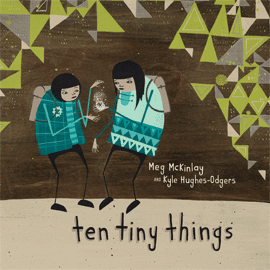
Meg McKinlay & Kyle Hughes-Odgers
Ten Tiny Things
As two children are forced to walk to school, they become aware of the wonder of the world.  The stylised and other-worldly illustrations are earthy tones of browns, greens and blues –cool despite the hot weather the children are experiencing. 


Madeleine Meyer
Carpet (Windy Hollow)
Meyer presents a biography of a carpet from its creation, through its life stages to its eventual recycling.  A beautiful book about the cycles of life.
Tohby Riddle
Unforgotten (Allen & Unwin)
The illustrations, on black paper, are a mixture of full page photographic collages and comic strips reminiscent of film stills.  The location is anywhere and everywhere. The people, some with statue heads, others hand drawn, are from differing times and places.  New buildings reflect older ones. This is a picture book for the older reader, dark and gritty yet haunting and thought-provoking.
Alison Reynolds and Heath McKenzie
A Year With Marmalade (Five Mile Press)
When Maddy has to go away for a year, she leaves her cat with Ella. The progress of the year is shown through the changing seasons, in the pen, ink and watercolour drawings but the reader also sees old and new friendships and comes to understand that change can be a good thing.
 Anna Walker
Peggy (Scholastic)
A brave hen sets off from her snug roost on an unexpected big adventure into the big city.  The muted illustrations, in a variety of media, make great use of the page though often allow for a light-hearted giggle.
Oscar Wilde & Ritva Voutila
The Selfish Giant (Allen & Unwin)
The rules allow for a retelling, so long as the changes are obvious. This richly illustrated book should be on everyone’s long list. The stunning double-page oil paintings are richly detailed –perfect for this allegorical story. The text reflects the style and punctuation of the original.
Notables:
Sean E Avery All Monkeys Love Bananas  (Fremantle Press)
Nick Bland and Stephen Michael King The Magnificent Tree (Scholastic)
Gary Crew & Ross Watkins The Boy Who Grew into a Tree  (Penguin)
Libby Hathorn & Bruce Whatley A Boy Like Me  (HarperCollins)
Andrew King and Benjamin Johnston Engibear’s Dream (Little Steps)
Stephen Michael King A Bear and a Tree  (Penguin)
Danny Parker & Matt Ottley Tree: A little Story About Big Things (Hardie Grant)
Judy Paulson Baby Tawnies  (Random House)
Judith Rossell Oliver (Harper Collin)
Colin Thompson and Sarah Davis Fearless in Love (Harper Collin)

So, what did you think of our lists? Which of your favourites have we missed? And I wonder what the judges will have chosen. We now only have to wait till tomorrow, April 9th, to find out. The Short Lists will be announced in Canberra at midday. The lists will be available online from www.cbca.org.au but don’t be too precipitate, so that the site doesn’t crash from overuse.  

Phil and Erin Stead’s blog about their Caldecott choices can be found at http://philipstead.com/2013/01/22/announcing-the-4th-annual-phildecott-and-steadbery-awards/
It’s interesting to compare their list with the official result.