Welcome to the blog of the Tasmanian branch of the Children's Book Council of Australia!

Friday, 25 March 2022

The Bungles: - A Journey of the Imagination

It is always intriguing to discover the inspiration behind stories as they blossom from an idea to into something tangible. This week, Irene Cowell shares an early collaboration in the creation of The Bungles.        


One morning “The Bungles” arrived, ready for action when I awoke. My husband, artist Ken Cowell and I had already discussed a collaboration: he would illustrate, I would write, a children’s Big Book. This book would be about our son, our first born, although he would already have been about nine years old. As a little child he’d been demanding; the human equivalent of a Perpetual Motion Machine, and just like one of his TV favourites, the 80’s character Monkey, “his nature was irrepressible.” He loved running away from me in very public spaces. One wintry day, when he was about three or four years of age, he ran fully clothed into the ocean. I was following, carrying a plastic ride-on toy he’d discarded. I waded in wearing my best boots, to pull out my very soggy child. As he grew older and began playing football, there was no need to chase him. We thought he was over the running game! That is until the day he “ran away”. The sad thing was we didn’t find the note he’d left until after his friend brought him home. But he hadn’t run too far. 


Why, you might ask, am I recounting these painful, slightly comical memories? It’s possible you’re even shaking your head at our ineptness as parents. But this is where the Bungles came from. We could imagine these potato-like creatures that would invade our hero’s home after dark. Each night of the week they would return, making more trouble, until mum’s arrival turned the chaos into fun.

Image from The Bungles. © Ken Cowell

The book with Ken’s joyous black and white illustrations was finished around 1988. I read it at school, children loved it. It took on a life of its own. I adapted the Bungles for teaching reading skills. We had fun singing the Bungles’ Song. We danced to it with our teddies so we could be naughty like the Bungles and “throw them down the stairs”. One of my Kindergarten boys returning a copy of the book he’d taken home told me with big expressive eyes, “Guess what, the Bungles came to my house last night!” I didn’t dare ask what they’d done. I used the Bungles to illustrate teaching techniques at a Literacy workshop. Later It morphed into “The Bungles- the Musical”, at a local schools’ concert. With Ken’s pop art props and a class of enthusiastic performers the Bungles came to life again.

Image from The Bungles. © Ken Cowell

No one ever questioned-“ Where did the Bungles come from?” Or- “What did the story mean?” But even though it was never articulated, the images and story of the Bungles was always met with enthusiasm. Recently I unpacked the slightly tattered original that had survived the move to another state and a very different time. The illustrations still had as much life in them as they had about thirty years ago. They could enthuse another generation of young readers. 


Some fun facts: As a teenager our son recorded himself on guitar and keyboard for the musical version. In the 90’s he was performing in a Punk Band. 

And just so you don’t have to ask…these days he’s a great Dad, and that ”irrepressible” grin can still be seen.


Irene Cowell
Author/illustrator of Y/A Fantasy
Rainbow Island Tapestry of Time, Forty South Publishing.

Friday, 18 March 2022

Back to Deltora

Join Lyndon Riggall as he ignites an old passion for a wonderful fantasy series that enchanted young readers as they followed stalwart characters on challenging quests across the dangerous lands of Deltora.  


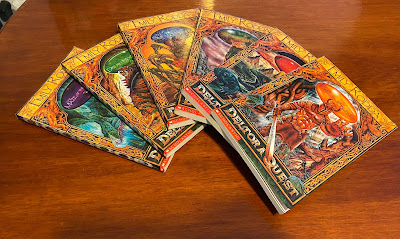
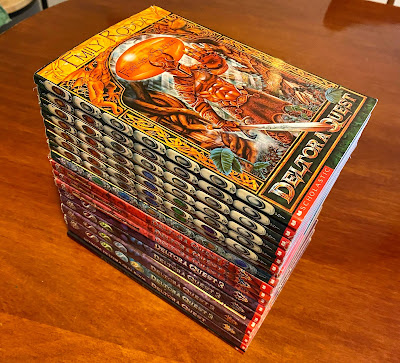
On my birthday this year there was one present that definitely took me by surprise. Actually, it was two presents, given to me by my friends Georgie and Mitchell, stacked in strange rectangular shapes that looked like two small shoeboxes. When I opened them, I gasped at what they contained: a complete original collection of Emily Rodda’s Deltora Quest 1, 2 and 3, as well as a few supplementary volumes. Something that had long been sleeping inside me was awakened.


I never owned the Deltora Quest when I was a child, though I remember scouring the school library shelves each week for the volume with the right number of gems or the appropriate sections of pipe to match where I was in Lief’s story. Key among the initial appeal of the books (and the reason that I treasure them so much now), was that they were gorgeous. A few decades on, when every year book covers seem to include less and less detail, the series stands out as being aesthetically astonishing, each part enfolded in a feature illustration by Marc McBride that slyly whispers of the dangers that lie within. As I have been revisiting the novels over the past few weeks, their timelessness is evident. They are complex, fast-paced and short enough that they always leave the reader wanting more. While Rodda has written so many books and stories in and around the world created here (including, of course, Rowan of Rin, the Rondo books and the Three Doors trilogy), I must admit that for me it will always be Deltora Quest that is her masterpiece. The world Deltora has seen enormous global success, from 18 million copies sold worldwide, to an anime series that ran for sixty-five episodes. There have been rumours of Deltora coming to the big or small screen in English for decades, but for me it is sometimes very special to have a work of this quality without a thousand adaptations, variations and merchandising opportunities. Deltora Quest doesn’t need to be brought to the masses with an enormous budget to be one our greatest fantasy series for children. Readers know the secret.

As a young primary school student, I ran to Deltora, and it has been exciting to see the door open once again and to be able to return. At the beginning of my own journey with the series, Deltora Quest was an exercise in simple adventure… I was breathless at the challenges faced by its heroes, trying to crack the puzzles and codes they came across before they solved them, simply enjoying the sheer wild fantasy that Rodda was creating. Now, I see the value of the messages hiding beneath the surface, too: the importance of working together, the fight to save the natural world and the need for leaders to stay in touch with their own humanity. For her part, Rodda seems to be in no way done with her creation. Her latest series set there, Star of Deltora, has only concluded in the last few years, while The Glimme, which was stunningly produced with her Deltora partner-in-crime Marc McBride, picked up an Honour award at the CBCA awards in 2020.


The first volume in the Deltora Quest series, The Forests of Silence, was released at the turn of the millennium, and as such it celebrated its 21st anniversary last year, with a new edition of the collection released in celebration. In the intervening time since my ten-year-old self first got his hands on the series, I am proud to state that Rodda’s work has lost none of its trademark sparkle or shine. It will always feel to me like a place half-forgotten in a dream; a memory lost in some unfathomable depth, like a treasure fallen into a dark lake. Some time before I had the confidence or the stamina to tackle such classics of fantasy as The Hobbit or The Lord of the Rings, when even C.S. Lewis could be daunting, Deltora was waiting for me, its magic begging to be released. I will always be grateful to Rodda for her sharp writing that was never puerile, for the complexity of her ideas and for her love of challenge and adventure. I will always be grateful for my friends, who knew that you could turn thirty-two and still believe in the imagined places that mattered to you when you were a child. 


Once, in a school library, we counted gems on spines and swapped books like secrets. Now, I hold them in my hand once again, and with every turn of the page I am in three places at once. I am here, on my couch; I am there in my school library, lying on a beanbag with my feet in the air…


…And best of all, I am, again, in the land of Deltora, where adventure awaits.


Lyndon Riggall is a writer and senior-secondary English teacher at Launceston College. His latest picture book, Becoming Ellie, was created in collaboration with Graeme Whittle, and he is also co-host, with Annie Warburton, of the Tamar Valley Writers’ Festival podcast. Lyndon can be found at http://www.lyndonriggall.com

Friday, 11 March 2022

Tyenna: Through My Eyes – Australian Disaster Zones

Julie Hunt, co-author of Tyenna, talks about the inspiration and key messaging in writing this first riveting title in a new segment of Allen & Unwin’s Through My Eyes series. Discover a unique wilderness in Tasmania through the eyes of Tyenna and be inspired to investigate this series further as future titles are published. 


Anxiety is the currency of our times; social media and endless news footage give us no respite from pressing contemporary issues: the global pandemic, climate-change-generated extreme weather events, civil unrest and war. How to help young people develop resilience, hope and agency is a question with which parents, educators and mental health practitioners grapple. Story offers one possibility. Stories of children facing and successfully navigating challenging events. 


Tyenna fits that brief as do all the Through My Eyes novels. The series was created by Lyn White with the idea of inspiring and informing young readers as they follow kids their own age into dangerous real-world situations. The first series looked at children in conflict zones and although I’m way beyond the target age group I can’t forget the main character in Emilio and everything I learned about crime in Mexico after his mother was kidnapped. The same goes for Shaozhen, a book from the next series which is about natural disasters. I could picture that village in China at the moment when the well ran dry, and feel what the character felt as he realised the implications. The stories are real, immediate and all too believable. 


Tyenna (2022) by Julie Hunt &
Terry Whitebeach.
Allen & Unwin

Our book is the first in a new series set in Australia. The story takes place in the summer of 2019 when a series of dry lightning strikes started fires all over Tasmania. No human life was lost and only a few buildings were destroyed but over 200,000 hectares of bush was burned, much of it in world heritage areas. 


Thirteen-year-old Tyenna loves pencil pines, bushwalking and hanging out with her best friend Lily. She arrives from Melbourne to stay with her grandparents in the Central Highlands of Tasmania expecting a fun summer holiday but the threat of fire changes everything and when she discovers a runaway boy hiding out and promises to keep quiet about his presence she finds herself facing a life and death dilemma. 


Floods, fires, droughts, cyclones – as the planet gets warmer what were once one-off events are becoming alarmingly frequent. Add Covid to the mix and we seem to be lurching from one disaster to the next. We are certainly in a climate crisis and this week floods on the eastern seaboard were declared a national emergency. The future is uncertain and it’s a difficult time to be growing up. How to allay fear and give young people hope?


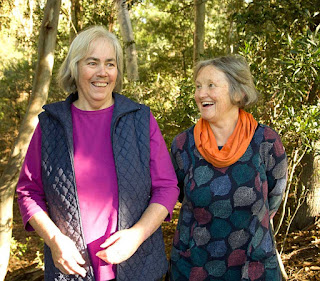
Co-authors of Tyenna, Terry Whitebeach and Julie Hunt
© Image: Daniela Brozek

With Tyenna we tried to create a courageous and resourceful character who is torn between keeping her word and remaining loyal to her stalwart grandparents, a tense situation at any time but worse in the midst of an emergency. We hope the story will raise questions in the classroom and beyond, and will encourage creative thinking, both about immediate fire safety and in response to the pressing issue of climate change. We’re in the Pyrocene now, Tye reads in a text from her friend. To quote from the book: 


‘The Earth hurtling into a new geological epoch. So much change in just a few decades – time speeding up. It’s certainly sped up for Tye and whirled her into a brand-new life... It’s only a year since Greta Thunberg first protested outside the Swedish parliament, and now teenagers the world over are organising school climate strikes. Hope lies only in action – that’s the Swedish girl’s message. Tye agrees.’


We gave our character agency through engagement. She helps with the community response during the fires despite her own private crisis, and she works to repair the damage afterwards. 


The story has an upbeat ending. Tye plants a tiny pencil pine seedling, hoping it will not just survive but thrive. She has found her place in the world, working for the future and the challenges that lie ahead.


Julie Hunt

Tasmania children’s author

W: http://www.juliehunt.com.au/


Editor's note: Watch a brief but informative introduction to the book by the authors and read a review of Tyenna.


Friday, 4 March 2022

Cultural diversity celebrated through stories

This week’s post works in tandem with the previous coverage of the NCACL Cultural Diversity database. Maureen Mann has risen to the challenge to explore the database and seek out titles that she discovered. She shares her thoughts and reactions here.

I have enjoyed exploring the NCACL Cultural Diversity database following on from Dr Belle Alderman’s blog last week. For me, the format is not as user friendly as the Indigenous one is. Each book is listed with the information about it in columns across the screen. The last column is Annotation and of course it is much longer than the other levels of information. For me, this makes it much clumsier to read and there’s lots of scrolling down the page to get to the next title listed. But, having made that relatively small criticism, the database is full of wonderful titles. It’s easy to browse by image, and there are search tools too, though these would benefit from a little bit more finessing. I look forward to further explorations, and new additions as they happen.


Having made some criticisms, it’s a fantastic resource. I also must remember that it’s all built by volunteers, under the umbrella of the National Centre for Australian Children’s Literature, and it will continue to evolve as time and funding allows. Maybe if you’d like to help you could contact the NCACL. They’d love sponsorship, donations to special projects or more volunteers, even if you don’t live in Canberra.


Did you check out the covers which were included last week?

Here are some of the titles that I have explored over recently. 


What Do You Call Your Grandma? and What Do You Call Your Grandpa? by Ashleigh Barton and Martina Heiduczek, 2021 and 2020. Harper Collins.

Each books has a similar format, but the cultures included differ. Each grandparent gets a double page spread showing the child and grandparent, who is rarely stereotyped, doing their favourite things. The accompanying verse helps with pronunciation of a traditional name from that culture. The book demonstrates that all children across the world have a special relationship with their grandparents. A glossary at the end of the book includes the meaning of the names and their locations


Under the Southern Cross
by Frane Lessac, 2018. Walker Books.

Bright primary-coloured illustrations support this night-time tour across Australia. Each page introduces the location, the activity described and the phrase under the Southern Cross (found in each illustration), along with some relevant factual information. Though there is a map at the end of the book showing all the locations, a small map on each page would have satisfied this reader, especially as the locations jump around our huge country. 


The Katha Chest by Radhiah Chowdhury and Lavanya Naidu, 2021. Allen & Unwin.

When Asiya visits Nanu’s house her favourite activity is exploring the chest containing the katha quilts, made from worn out saris. The rich detail, inspired by Bengali Pattachitra folk art, in the illustrations show both the quilt and the family’s activity where the reader sees a part of the original sari owner’s life.


When We Say Black Lives Matter
by Maxine Beneba Clarke, 2020. Hachette.

Rich dark colours make up the illustrations of this oversize book. Clarke wanted to explain to the multi-cultural children in her extended family why recent protests were so important but she doesn’t sensationalise it.  There’s lots to discuss and it’s not just a picture book for the very young.

Little Nic’s Big World by Nic Naitanui and Fatima Anaya, 2019. Allen & Unwin.

This, the second of Naitanui’s titles, features a school fete, titled “The World Comes To Us” where all the families bring their favourite foods and there are a lot of cultural activities. Nic has lost his bag containing his favourite cassava cake. Readers have to search for Nic’s lost bag as well as 16 other items.


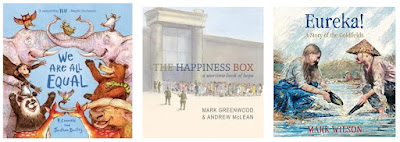
The Happiness Box: A Wartime Book of Hope by Mark Greenwood & Andrew McLean, 2018. Walker Books.

This is the true story, in picture book format, of some of the POWs in Changi Prison in 1942 who created Christmas presents for the children interned with and near them. One of these gifts was a book called The Happiness Box. All the presents were confiscated because the Japanese commander thought the book contained war secrets. A soldier offered to destroy the book but instead buried it and it was dug up in 1945, becoming a National Treasure. Though there are subtle references to the hardships the men suffered but the book also shows their resilience. 


If You Come to Earth by Sophie Blackall, 2020. Chronicle Books.

Blackall offers a microscopic perspective on many aspects of the world, both natural and man-made. It’s a guide to our world and a call for us all to look after and celebrates cultural and environmental diversity across the globe. The illustrations encourage the reader to pore through the detail as well as encouraging discussion of the differences and similarities. A picture book for all ages.


Little Lon by Andrew Kelly, Heather Potter and Mark Jackson, 2020. Wild Dog Books.

This is based on the recollections of Marie Hayes who lived in the Lonsdale St area of Melbourne in the 1920s and 1930s. The reader meets some of the many others from all over the world who also lived there. It’s a wonderful celebration of a historical period, complete with descriptions of housing, food and lifestyle shown both in visual and verbal text. The endpapers add to the information given.  Though it’s picture book format, it’s not only for the very young. 


Always by Maurice Gleitzman, 2021. Penguin.

The last in the series which started with Once, combines the story of Felix, now 87, and Wassim 10 years old as was Felix in the first story. Set in Poland, it describes the racism and persecution which is eventually overcome. Felix and Wassim journey is to win the race to the WW2 ‘treasure’ which the Iron Weasels desperately want. An excellent, very readable story (as has the whole series been) which celebrates the power of love, friendship and hope.


Red Day by Sandy Fussell, 2020. Walker Books.

A story that combines historical fiction, based on the WW2 Cowra NSW prisoner of war camp, with magic realism reaches a satisfying conclusion. Charlie has synaesthesia, where everything has colours and into her life comes Kenichi, a Japanese exchange student whose family have tasked him with finding his grandfather’s grave. The book is full of complex characters, with many tensions surfacing. 


I hope you will also have fun searching through this, and the indigenous, databases.


Maureen Mann
Retired teacher librarian and avid reader


Friday, 25 February 2022

Step into the lives of others: A database of Australian children’s literature reflecting our diverse culture

Following on from posts over the previous fortnight celebrating Aboriginal literature and how to discover a wealth of titles via the NCACL Aboriginal and Torres Strait Islander Resource, this week introduces another excellent resource: The NCACL Cultural Diversity Database.


Here is the story behind the decision of the National Centre for Australian Children’s Literature to create a database of children’s books featuring cultural diversity. 


You may have heard the oft-quoted analogy—children’s books are ‘windows, sliding doors and mirrors’ explored here in this article. ‘A window is a resource that offers you a view into someone else’s experience. A sliding door allows the reader to enter the story and become a part of the world. A mirror is a story that reflects your own culture and helps you build your identity’ (We Are Teachers Staff, 2018, para. 4). Children’s books are the perfect medium to do all three.  

We all know that the Australian population is culturally diverse. The facts are available from the Australian Human Rights Commission website which states: ‘One in four of Australia’s 28 million people were born overseas; 46 per cent have at least one parent who was born overseas; and nearly 20 per cent of Australians speak a language other than English at home’(2014, para 5). These statistics and the windows, sliding doors and mirrors analogy motivated us to create a database featuring cultural diversity in Australian children’s books. 


We found other such databases in Canada and the United States. We studied these, chose their best features and decided what would work for Australia. We asked teachers, public librarians, teacher librarians, home schooling groups, researchers, specialists in children’s literature, literacy, English as an Additional Language/Dialect (EALD) and staff at the ACT Directorate of Education what would be useful? 

As our perspective on this topic developed, we needed to choose which books to include. The Centre is very fortunate to receive donations from publishers, authors and illustrators so we see the majority of Australian children’s books. We also extensively researched existing sources to discover others’ views on culturally diverse children’s books. Here are just a few that we examined: 

  • The Canadian Children’s Book Centre —Social Justice & Diversity Book Bank
  • United States non-profit organisation —We Need Diverse Books
  • AustLit: the Resource for Australian Literature 
  • Australian Multicultural Children’s Literature Award (1991-1995)
  • CBCA’s Notable Books (1990-)
  • International Board on Books for Young People Australia Honour Books
  • The White Ravens: A Selection of International Children’s and Youth Literature
  • Source Online: Subject Guide to Children’s Books 
  • Kerry White’s Australian Children’s Fiction: The Subject Guide (1993 and 1996)
  • Prime Minister’s Awards for Children and Young Adult Books and all State Premier’s awards

These, other bibliographies and databases, plus a wide range of people with expertise in this field, helped us determine what and how we would capture and deliver books featuring cultural diversity. We read hundreds of books, discussed, annotated and assigned key concepts then we added Australian Curriculum Links and the Early Years Learning Frameworks. We sought out database expertise and design at 372 Digital in Canberra. It was a big learning curve. We learned a new ‘language’ about databases and realised undreamed of possibilities. A year later, our Cultural Diversity database said ‘Hello!’ to the world.  People told us what they thought of the Cultural Diversity Database, and we added comments to our website.


“The database is accessible and interesting.  It seems to me that kids need to be hearing their own stories and more than ever the stories of others too and access to libraries and such information as you are putting together will go some way to help that along.”
Bob Graham | Author and Illustrator | April 25 2019


“This is an amazing initiative by the National Centre for Australian Children’s Literature – a database that can be searched for titles that showcase or promote diversity, be it cultural, linguistic, familial, political, geographical, historical. Explanations and background here, dive right in here.”
Australia School Library Association | Newsletter, 30 April 2019


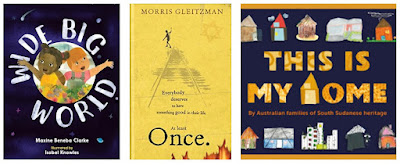
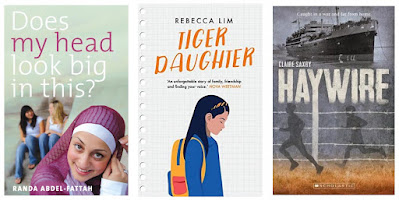
Pictures in this blog are jacket covers for just some of my favourites! Why not search for them on the database for publication information, curriculum links and plot summary.


Dr Belle Alderman AM, Emeritus Professor of Children's Literature 

Director, National Centre for Australian Children’s Literature Inc


References

We Are Teachers Staff (2018, July 12). What are windows, mirrors, and sliding glass doors? We Are Teachers. https://www.weareteachers.com/mirrors-and-windows/ 


Australian Human Rights Commission. (2014). Face the facts: Cultural diversity. https://humanrights.gov.au/our-work/education/face-facts-cultural-diversity 

Saturday, 19 February 2022

Discover engaging stories on the Aboriginal and or Torres Strait Islander Resource database

Maureen Mann has been inspired by the diverse voices represented on the NCACL Aboriginal and or Torres Strait Islander Resource database and follows up last week’s post by Dr Belle Alderman, to share some of her thoughts on a selection of titles located on the database.

I have been dipping in to the Aboriginal and or Torres Strait Islander Resource. Explore it here NCACL’s database.  (See last week’s blog from Dr Belle Alderman- A gateway to Aboriginal and Torres Strait Islander children’s literature) I’ve had some fun exploring the resource and then finding items to read. There were a few which I had already reported on in my blog last year while travelling in the Northern Territory but there were many more new-to-me titles. And there are many more which I haven’t had a chance of finding and reading – yet! 


The database is easy to use. Searches are easy. Look back at Dr Alderman’s listing last week for the details. Click on the cover after your search and a summary appears, with audience range listed. Then there’s more detail in subjects, annotation and teaching notes. 

Here are some of my choices, focussing more on books for early childhood and primary readers but something for secondary readers as well.


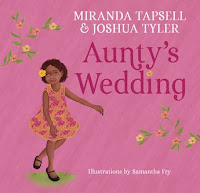
Aunty’s Wedding by Miranda Tapsell, Joshua Tyler & Samantha Fry. Allen & Unwin, 2020.

Everyone’s getting ready for the wedding. Maningawu describes what everyone will wear, and why there is a wedding. It’s a good introduction to Tiwi language with simple words woven into the narrative. Lovely illustrations, using bold colours. Great use of ‘white space’.


Azaria: A true story by Maree Coote. Walker Books, 2020.

This is a stunning description of the disappearance of baby Azaria Chamberlain at Uluru in 1980, the resultant police and justice investigation and how ignorance and the perils of mob thinking influenced the carriage of justice. The book tells all sides of the story: the family, the police, the indigenous trackers; its brilliant illustrations introduce many aspects of culture from across the world.


Backyard Birds by Helen Milroy. Fremantle Press, 2020.

Helen Milroy introduces the reader to many familiar birds. Each bird is shown on one page with an action statement opposite, often with rhyme or alliteration. Bright colours and swirling images attract the reader. 


Bindi by Kirli Saunders & Deb Leffler. Magabala Books, 2020.

This verse novel is one year in the life of indigenous girl Bindi Hoskins, her friends and family as they face the challenges of drought, fire and the complex world. The use of Gundungurra language enriches the reading experience and the pencil drawings enhance the reader’s understanding of Bindi’s world. 


Brother Moon by Maree McCarthy Yoelu & Samantha Fry. Magabala Books, 2020.

Told while sitting in a house beside the sea, this is great-grandpa Liman’s story about his brother, who slowly unfolds as the reader learns more details: wise, never growing old, brightest at night, changing shape, a helper during the hunt and a protector from unwelcome visitors. There’s a great double-page spread showing the moon’s phases and a joyful realisation by Hippy. Lovely evocative illustrations are done in pencil on dark paper. Both creators of this book are from the Northern Territory. Yoelu is a Wadjigany woman and Samantha Fry is descended from the Dagiman people.


Dry to Dry by Pamela Freeman & Liz Anelli. Walker Books, 2020.

Winner of the Eve Pownall Award in 2021. This is a wonderful depiction of the changing seasons in Kakadu in northern Australia. The reader sees the change from dry season through all the stages of the wet and back to the dry season. Along the way the myriad of animals, insects and birds are introduced to the reader. There’s a short summary of the six seasons recognised by indigenous inhabitants. 


Landing with Wings by Trace Balla. Allen & Unwin, 2020.

This is a complex and multi-levelled long picture book, or is it a graphic novel? Miri Blossom is forced to leave her beloved tea tree to move to the Goldfields, and doesn’t want to go. Miri, or Bloss, and her mum travel the train to get there, arriving in the dark. And then we, the reader, see her adjust to her new life, exploring, meeting new neighbours, and making a great adjustment – better than her mum, at times, who wants to move again. Bloss documents the changing seasons and landscape in her sketchbook, and we slowly see Mum adjusting and making friends. Details of cultural life in Dja Dja Wurrung country are incorporated seamlessly, with Balla guided by local elders. Created in Balla’s signature graphic novel format, full of detail and memorable characters.


Tell ‘em by Katrina Germein and Rosemary Sullivan and the children of Manyallaluk School. Harper Collins, 2020.

This exuberant celebration of all the things which the children of the Roper River region of the Northern Territory enjoy doing. As an adult, the reader will recognise the shouts from the children wanting to include their favourite activities, but younger readers will recognise many things. They will also learn about some Indigenous ceremonies, stories and how life in this remote area differs from their own.


Putting Australia on the Map by Carole Wilkinson. Simon & Schuster, 2020.

Wilkinson documents the slow discovery by European explorers of the existence of Australia, while also acknowledging that First Nations people had lived here for over 50,000. She comments on van Diemen’s timidity because he had been warned to expect ‘fierce savages’ and Dampier’s surprise that the Indigenous people didn’t envy the British way of life or admire their possessions. Throughout the book there are reproductions of contemporary maps which slowly expose the outline of what we now know as Australia. A highly readable non-fiction book which adults and younger readers will enjoy.


The Boy from the Mish by Gary Londesborough. Allen & Unwin, 2021.

This debut novel is the story of Jackson from the NSW South Coast after his Aunty Pam and his cousins on their annual visit from Sydney arrive with an extra person, Tomas. The growing attraction between Jackson and Tomas is the basis of the story. But there is more than their emerging relationship, including the definition of masculinity, identity, culture and the role of art in expression and healing. 


Maureen Mann
Retired teacher librarian and avid reader


Editor's note Each image is linked to its record on the database where you will discover intended audience, curriculum links, related subjects, an annotation and a link teacher resources if available.