Welcome to the blog of the Tasmanian branch of the Children's Book Council of Australia!

Friday, 21 December 2012

A Christmas List


As a teacher I have often been asked by parents and my students, “What books should/ ought/ must my child/I read?”  Usually I have answered this from a literacy point of view and replied, “What the individual finds interesting, since boredom or lack of interest is the biggest turn off for a beginning, developing, young, or even established reader”.  Alternatively my response has been to provide the latest list of CBCA shortlisted or notable titles, since keeping up with the latest trends is important.  Children especially dislike stories, characters and language that are outdated. Have you been watching the first James Bond films on TV?  How clichéd and outmoded in fashions of all types these relics seem.  The humour is wet, the clothes are most notably different, the action is tamer and dare I say it, Sean Connery doesn’t seem quite so suave. And talk about sexist!  Quite unobtrusively and without us noticing, our culture and society morph over the years, diminishing the vibrancy, relevance and appeal of many previously acclaimed books, stories, music and films.  This is of course one of the tests of a classic. If a work retains its application to current life and values, then it has that ‘je ne sais pas’ that makes it a literary work.  But even classic literature has its draw backs.  Usually one has to be a very dedicated reader to plow through some of the classics in their original form, hence the many adaptations and rehashes of these important reflection and representations of humanity, some good and some bad!  
As a child my first introduction to ‘the classics’ was through the monthly comic I was allowed. While my brother opted for ‘The Eagle’, a boys’ comic about spaceships and intergalactic adventure, I read my way through “A Tale of Two Cities”, “Jane Eyre”, “Macbeth”, and many more.  I wish I had kept them because only now in my mature years do I realize they probably formed the basis of my future as a reader and, I like to think, a person fairly well -versed in English literature.   Now such publications are called graphic novels and are easily accessible via the net but I must confess I’m not au fait with the quality of these more recent publications.
As I prepare my Christmas list for this year I have been thinking about how important it is for children to at least know but preferably read certain stories. Irrespective of any personal religious beliefs, how important is it for each of us to know the story behind Christmas or indeed many of the Bible stories?  How much does a person miss out on if they don’t understand about their Achilles’ heel or about ‘being a Scrooge’ or perhaps ‘ a Romeo’?  Reading is not just about sounding out the letters or knowing the meaning of each word. That is the literacy.  It’s also about access to that deeper understanding of the ideas, inferences, implications and allusions; in other words the literature.
So perhaps over the next few years, in my grandson’s Christmas stocking will be the best adaptation of Bible stories for children I can find; at least Dickens’  “A Christmas Carol”; definitely some myths and legends; some traditional nursery rhymes; some updated Peter Rabbit; “Wind in the Willows”; “House at Pooh Corner”; a series of graphic novels of the classics; Aesop’s’ Fables; Kipling’s “Just So Stories” and “Grimm’s Fairy Tales” at least, as well as the latest CBCA Book of the Year winners.  That should keep him well read and reasonably informed.  And what I have missed out, I’m sure others will add to my list.
Carol Fuller
PS  There is a little book called “Don’t Leave Childhood Without…” published by Specialist Children’s Booksellers that provides an excellent guide to the essential reading  to which I am alluding.

Wednesday, 19 December 2012

The truth about ‘Peggy’ (or: Choosing picture books for Christmas)


When talking with some early childhood teachers recently we began musing about what gives a book ‘kid appeal’ in this electronic age?
We used Peggy, by Anna Walker (Scholastic Books, 2012) as a test case. Now, Peggy is a black chook whom we first meet peering out the window of her ‘small house in a quiet street’. With gentle pastel tones and varied image framing, the author/illustrator engages us with Peggy’s daily routines – until, one blustery day, Peggy is swept up over the rooftops, into a bewildering city environment. She does ‘see things she’d never seen before’, but is greatly relieved to find her way back home – although, later, she ‘sometimes caught the train to the city’.
So, why does Peggy work so well with children and adults alike?
·         Peggy is an endearing character
·         She goes on adventures that engage readers and listeners emotionally in her journey
·         There is quirkiness in having a chook as the star of the story
·         The changing visual perspectives keep our eye curious and connected to the story
·         The picture text tells a tale way beyond the sparse word text, requiring viewers to unpack the humorous visual asides
·         &, it’s good fun!
I guess, the message is, when choosing picture books for children, whether for the classroom or under the tree, keep in mind the need for:
·         Humour and action
·         A story with enough tension to make us want to find out what happens
·         A word and picture story that’s worth re-visiting.
Works of great literary merit deserve accolades, but they won’t all necessarily win a chuckle of delight from a receiving child.
While every child is different and ‘age rules’ are somewhat risky, here is a rough guide:
Infants and toddlers tend to enjoy a book with one main character, a straightforward story and fairly literal illustrations, like Alison Lester’s Noni the Pony (Allen & Unwin, 2010).
As they turn 3 & 4, children are likely to expect books to entertain, so The Tall Man and the twelve babies, by Tom Niland Champion, Kilmeny Niland and Deborah Niland might hit the spot.
As they enter school, children are often ready for a ‘real story’ with many characters and more complex dialogue, such as Louie the pirate chef, (that’s ‘chef’, not ‘chief’)by Simon Mitchell & Ben Wood (Working Title Press, 2010).
Then, youngsters enjoy the zany and absurd such as Jackie French & Bruce Whatley’s Queen Victoria’s Underpants (Angus & Robertson, 2011) and Aaron Blabey’s ‘dark’ but intriguing titles, including The ghost of Miss Annabel Spoon (Viking, 2011).
What then, I hear you ask?
Well, I’m dedicated to getting children ‘hooked on books’, so I try to connect them with novelists I think they’ll like and titles that will make them want to read the series – starting with Tolkien’s The Hobbit as a pathway to the Lord of the Rings, the Our Australian Girls series (Puffin Books) and/or the fantasy novels of Isobelle Carmody, Lian Tanner and Emily Rodda.
And get ready to read to, read with and talk about good books to build that love of reading for life!

Jenni Connor


Friday, 7 December 2012

Two holiday games for the book lover

At this time of year, I usually go out and buy a couple of summer videogames, but having recently watched the Wil Wheaton hosted web series TABLETOP about tabletop gaming, I  decided that 2012 was the year of the boardgame for me. I was surprised to find that actually a good boardgame is not that expensive, and if you shop around you can buy a good one for half the price of something new for the Playstation 3. On top of that, my collection is distinctly book-themed, including the Lovecraftian ARKHAM HORROR, and the backstabby boardgame iteration of GAME OF THRONES, pleasantly designed prior to the arrival of the TV show, and as such featuring all-original artwork.

As we approach the holiday season, many of you might be looking for unique gifts for the bookworms amongst your family and friends, or alternatively for something fun to bring out once you've pulled all the crackers and everyone is too full to leave the table. With that in mind I thought I'd take the liberty to recommend two storytelling boardgames that have popped up in my travels, and which can be enjoyed by adults, and many children too.

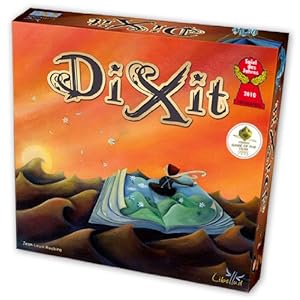
1. DIXIT
Dixit is a storytelling boardgame in the purest sense. Designed in France, it is noticeable because it is playable in any language. There is nothing to read--all the stories are made through the playing. The box DIXIT comes in contains a set of 84 gorgeously and enigmatically illustrated cards, with beautiful artwork by the artist Marie Cardouat (Google her, you'll soon discover what I mean). After all of the players are dealt a hand, one player takes the role of storyteller and chooses a card, describing it in one sentence. Each of the other players picks a card of their own that they feel might confuse the others at the table, given the storyteller's description, and the cards are shuffled, revealed, and each player votes on which one they think might be the storyteller's. If you trick the other players into voting for your card, you earn points. If you are the storyteller and people vote for your card, you earn points too.

Sounds simple, right? If you describe the card really bluntly, you'll win. There's the catch. The beauty and delight of DIXIT comes down to one simple rule: the storyteller gets NO points if everyone guesses their card correctly. So as storyteller, you ideally want every single person at the table to identify your card, except one. How do you do that? Subtlety, reference, metaphor... you decide. You're the storyteller, after all.

 
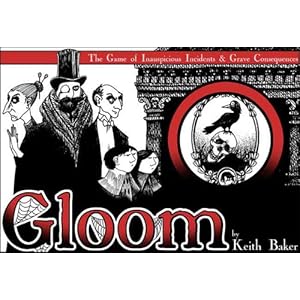
2. GLOOM
If DIXIT sounds a little bit too sweet for you, and you're a bit more of a Lemony Snicket family, there is always GLOOM. GLOOM is a card game heavily centred around the Victorian world of the penny dreadful novel, in which each of the players takes control of an unfortunately positioned family. As play progresses, cards are drawn, and the player's aim is to bring about as much misfortune to their own family as possible, hopefully ending in their untimely demise. As much as there are cards that say things like "bitten by a rabid dog" however, there are positive cards, signifying donations by surprise benefactors, or a trip to the circus, that you can use against the more distraught members of the other player's families, in an effort to bring them back up in their happiness.

The fun of GLOOM is not just in its whimsical cruelty and blessing, but also in the fact that as you play cards, you narrativise the game in progress. Through the strategic placement of events, a unique and hilarious story unfolds every time, as each player explains the sequence of actions that, for example, caused the twins in their family to become trapped on a train.

For a game so predicated on the miserable, it's actually a hilarious, creative, and extremely enjoyable experience to play GLOOM. For those with a sense of humour verging slightly more towards the macabre, it's bound to be a hit.


Keep me posted in the comments below about your thoughts on these games if you have played them before, intend to play them, or how they are received if you do decide to buy them. I'd also love to know if you have any book-themed or storytelling boardgames that you'd like to recommend yourself. I'm always on the lookout for more.

Other then that, it only remains for me to wish you all the joy that the next few weeks might bring, including, perhaps, one or two games, and more than a little reading.

Lyndon Riggall

Sunday, 2 December 2012

Save the books!


Recently I read an article saying that 10,000 copies of the original version of Good night, Sleep tight by Mem Fox had been pulped. (Interestingly it has recently been republished with illustrations by Judy Horacek.) Then I read that 20 of the 55 books that have won the Miles Franklin Award are out of print. (Admittedly, some have dated badly.) I wonder how many wonderful books go out of print or are remaindered long before they should be – all for the want of enough “someones” to promote the book?

What can we do? The first and most obvious task is to keep these titles in print. Ensure you keep buying those special books and share the joy/wonder as you give them away as gifts. Read and follow up on the recommendations made by our bloggers and all the generous souls who review books in magazines, on websites and blogs. Thank the wonderful people who run activities such as Readers’ Cup which introduce readers (and judges) to books they may not have chosen for themselves. Spruik the books you love –your passion might be the encouragement needed for someone to open that book.

Last week, Maureen mentioned some wonderful newer books that deserve a place in everyone’s library. And here are some others...

Sue de Gennaro Pros and cons of being a frog (Scholastic)
Corrine Fenton Hey Baby! (Walker)
Anna Fienberg & Stephen Michael King Figaro and Rumba and the Crocodile Café (Allen & Unwin)
Rose Foster The Industry (HarperCollins)
Morris Gleitzman After (Viking)
Gus Gordon Herman and Rosie (Viking)
Christine Harris and Ann James It’s a miroocool (Little Hare)
Pip Harvey I’ll tell you mine (UQP)
James Moloney Tamlyn (HarperCollins)
Amanda Niland & Christina Booth I wish there were dinosaurs (Windy Hollow)
Sally Odgers & Lisa Stewart Bushland Lullaby (Scholastic)
Jan Ormerod & Carol Thomson Looking for Rex (Little Hare)
Emily Rodda The Third Door (Scholastic)
Karen Tayleur Love notes from Vinegar House (Black Dog)

Sunday, 25 November 2012

Grandparents get up to date! - by Maureen Mann


This term I have been teaching a course on modern children’s literature (especially Australian), at the Launceston School for Seniors. It’s been extremely successful and I have decided to repeat it next year, though the content will change. The students are all enthusiastic readers but, until recently, haven’t read any of the wonderful books available at the moment. We really do have a fantastic selection of titles published around the world for young people of all ages.

The course has been planned to introduce the participants to a wide range of recent publications. Some of the activities have included looking at past books entered in the CBCA Awards, visiting a bookshop, reading new-to-student titles from the library and over the last 3 weeks browsing through some of the 2012 entries lent to us by Tasmania’s current Book of the Year judge. These last few weeks has given each of us the chance to read the most current books. Here are some of the picture books (which I have enjoyed) from the entries so far.

The Gift by Penny Matthews and Martin McKenna.

The small, plain brown bear sits in a toy shop, surrounded by special Christmas toys. One by one the other toys are bought but bear remains until late Christmas Eve when a small child falls in love with him. McKenna’s digitally created illustrations use a lot of white space and show the bear with all his emotions. It’s a wonderful heart-tugging book, and will especially appeal to those who collect Christmas stories.

Alex and the Watermelon Boat by Chris McKimmie

This story grew from McKimmie’s experiences during the 2011 floods in Brisbane. Alex has to go outside, though forbidden to, when his favourite stuffed toy hopped out the window. Using his watermelon boat to search, he sees the calamities of the flood. McKimmie’s easily recognisable illustrative style uses a wide range of techniques and materials which he lists at the back of the book. I love it.

The Terrible Suitcase by Emma Allen and Freya Blackwood

The young girl is so mad not to receive her requested bright red backpack as her first school bag. Instead it was a terrible suitcase but the narrator discovers that her bag has many adaptations that she didn’t expect, leading to a wide range of adventures. A multi-layered story.

Show Day by Penny Matthews and Andrew McLean

Matthews and McLean have again collaborated to produce a great book, appropriate for any part of Australia where agricultural shows are held. Many child readers will resonate with the story.

Bush Bash by Sally Morgan and Ambellin Kwaymullina

This is a counting book, combined with a song-like refrain and an I-spy element, using Australian animals. Kwaymullina’s brightly coloured illustrations reflect her Aboriginal heritage.

Pooka by Carol Chataway and Nin Rycroft

The family loves the stray dog that turned up on their doorstep, though Grandad keeps reminding everyone not to become attached. The narrator becomes depressed when Pooka’s owner collects her but bounces back when Pooka and her pups visit. Great use of white space and vibrant illustrations.

The Queen With the Wobbly Bottom by Philip Gwynne and Bruce Whatley

The queen doesn’t like her wobbly bottom and unsuccessfully offers rewards to change it. The poet comes along and teaches her that she is loved. A fun story which shows that praise can go a long way. It’s a great example of verbal and visual texts complementing each other. Whatley’s illustrations are not what we might expect.

Tom the Outback Mailman by Kristin Weidenbach and Timothy Ide

This is a fictionalised account of Tom Kruse, mailman along the Birdsville track from 1936 to 1963. A great way of showing city kids what life along the Track can be like. Lots of scope for further investigations.

Owl Know How by Cat Rabbit and Isobel Knowles

Cloud Town has begun to sink into the branches of a tree, so the friends make a machine to produce owls who life the town back up into the air. This book will be a great addition to school libraries with its illustrations created from 3-dimensional felt, cardboard and recycled materials.

Good Night Sleep Tight by Mem Fox and Judy Horacek

Skinny Doug is babysitting Bonnie and Ben who do all in their power not to have to go to sleep. Fox has combined her signature repetitive refrain with traditional nursery rhymes to create an excellent bedtime book.


Sunday, 18 November 2012

The Books We Took On Holiday - by Rachele Carnevale

On the train to Osaka!

In March this year our little family embarked on a three month trip of Japan and Europe.  Although we needed to pack as lightly as possible it was essential that we included a selection of picture books for our 16 month old son, Roman.  The prerequisites were that the books be light (therefore paperback) they must be tried and tested favourites (we had no room for duds) and there must be a couple of specific goodnight ones.

We put all of the possibilities on the floor, came up with a long list and then whittled it down to about ten titles.  These included golden oldies such as The Tiger Who Came to Tea, Meg and Mog, Harry the Dirty Dog, Hop on Pop, Hairy Maclary and Zachary Quack and Mister Magnolia - as well as more recent titles such as Penguin by Polly Dunbar, When the World is Ready for Bed by Gillian Shields and Maisy's Bedtime.

We also purchased an iPad for our travels on which we carried our Lonely Planet guides, a few e-books for Roman (Green Eggs and Ham and Moo by Matthew Van Fleet) and some animated adaptations of the Hairy Maclary and Maisy stories.

Osaka Ryokan


The decision to take physical books, despite the additional weight to our luggage was one of the best decisions we made.  Although we sometimes got quite bored with the small selection, we always managed to keep up our regular bedtime story time routine - no matter where we were.  We had stories while on long flights, train trips, ferry voyages and in tiny hotel rooms.  This regular routine not only comforted Roman and helped him go to sleep every night in the ever changing locations, but gave us a feeling of normalcy too.

The iPad was used in different situations, when Roman would get bored or grizzly on long trips by plane, train, bus or ferry.  However, rather than the e-books he much preferred watching the animations of familiar stories and the couple of episodes of Playschool we had put on the iPad.  We were so grateful to Maisy and Hairy Maclary on some of these trips.

Shinkansen to Kyoto

We had a couple of interesting book experiences on trains - one in Finland and one in Japan.  While travelling from snowy Helsinki to snowier Tampere in Finland, we were booked onto a carriage specially designed for families with small children.  This is the best idea ever! Not only were there lots of small kids, a mini train in the carriage for them to play on and a slide, but a whole bookshelf full of picture books too!  Despite the books being in the Finnish language, we had a lovely time looking at all of the pictures and making up the stories.  It was such a novelty for us to be looking at new books rather than our own scruffy selection. 

While travelling on a local train in Osaka in March, Roman, tired and grumpy (having been on the rails for hours since leaving Nagasaki), was in urgent need of entertainment.  Luckily, I had had the foresight to pack a couple of books in our bag and whipped out The Tiger Who Came to Tea.  It worked like magic!  As I was reading it to him I noticed that he wasn’t my only audience - the other passengers on the train were also listening.  I felt like a twit but tried to focus on Roman. Afterwards, a smartly dressed Japanese businessman came and chatted to us.  He said that he and his family had lived in Scotland a number of years ago and that he had read the same book to his children and they had loved it too.  It was such a lovely connection to have made.

As we travelled we picked up some more books to spice up our story time collection and weigh down our luggage.  We found a good English language selection of children's books in the Japanese bookstore Kinokuniya.  We bought some Curious George and Clifford titles there, amongst others.  We also bought books in other languages, including Japanese, Finnish, French and Italian.  Luckily, we already knew many of these stories word for word, such as Goodnight Moon (or Bonsoir Lune in French), otherwise we just made the stories up!  We always left the price stickers on the backs of the books we purchased overseas so we will always remember where we bought them.

Coming home to Roman's book collection was so exciting, there were so many choices, it felt like such a treat, and then visiting the library again and borrowing more was fantastic.  We were in book heaven after having such a small selection for such a long time. We still read our well travelled treasures regularly and they always remind us of the fun we had reading them on Roman’s great big overseas holiday.

Sunday, 11 November 2012

Open Spaces spark wondrous Imaginings! by Christina Booth

Bruce Whatley

Australian Society of Authors Open Spaces Retreat for Picture Book Creators, Sydney, 2012.

When we think of a retreat the word quiet springs to mind: personal, solitary time to work, reflect and consolidate. You might even have time to be guided by another, take long strolls to clear and sort your mind.

So what happens when a group of picture book creators meet in Sydney for a retreat? Plenty, but a lot of what we traditionally consider retreat essentials are reinvented and not a lot of quiet is had!

Picture book authors and illustrators (not unlike most authors and artisans) are cave dwelling creatures that work mostly in isolation and solitude. The ticking deadlines are our constant companions and the niggling domestic routine often oversteps its boundaries into the creative caves we have established, so when a retreat for picture book creators is offered then we must expect the unexpected, rules to be broken or adapted and noise and mess to be created.

What a treat. The ASA (Australian society of Author) invited us to move into the wonderful Hughenden Hotel in Woollahra, Sydney (near Paddington) to join them for a four day retreat of treats and experiences we could never achieve by ourselves.

We started on Thursday at lunch time. We were an awkward gathering of some strangers and old friends rabbiting around portfolios and samples and making small talk, nervously wondering what the next few days would bring and how much of our creative souls we were going to have to share. 

Twelve of us poured over the work of others, ‘oohing’ and ‘ahhing’, recognising pieces from books old and new and putting faces to the names of those who have them on covers.

We began the sessions by introducing ourselves, our work and what we wanted to achieve from the weekend. What inspiration and wonder, it was hard not to feel a bit overwhelmed by the talent before us.

Then the work began. Hard work? We were thrown into the creative pit of art supplies, provided by Micador and told to PLAY! All afternoon, with someone sitting beside us to talk to, and talk we did. We drew with textas, crayons, painted, rubbed and coloured and experimented with goodies we had only admired on the art shop shelves, what joy.

After a quick freshen up and the removal of crayon from under fingernails we braved the heat (it was over thirty degrees for this Tasmanian who had left Tassie trembling in her jumper and coat) and we headed to the piano lounge for a gathering of Sydney ASA members and guests for pre-dinner nibbles drinks and a book launch. How spoilt was I? Part of the program was the launch of my new book with Amanda Niland, ‘I Wish There Were Dinosaurs.’ The launch was wonderful, the honours done by the talented Libby Gleeson. Very apt as she has been a great encourager on my journey as an author and had also tutored Amanda.

Off for a lovely dinner followed by guest speaker Tohby Riddle who shared the process and journey of creating his book ‘Unforgotten.’ The only negative was a visit from a very large huntsman who decided to walk across the wall behind Tohby during the talk making it hard for those of us arachnophobes in the audience to look up at the power point presentation).

Friday was an early start. Early breakfast (6.30 am)put on by the hotel to accommodate our busy schedule and then we were off to catch a bus. Laurine acted as Miss Clavel and had us all safely travelling to Bondi to walk the shoreline and experience the Sculptures by the Sea exhibition. We went early to avoid the crowds which were shoulder to shoulder by midday. We now understood the early start. For someone unfamiliar with most parts of Sydney I felt like a wild schoolgirl let off her leash. What beautiful beaches and scenery (including one or two life guards) and amazing sculptures, something I recommend you all to see.

Fish and chips by the beach then a bus trip back to the hotel ready for a drawing lesson from Bruce Whatley (or should I say Dr. Bruce). Bruce studied the effects of right brained drawing for his PHD and we were treated to a session of drawing with our other hand. Seeing as not all retreaters were illustrators this threw up a decent challenge but fun was had by all and much was learned about how much better our wobbly hands are compared to our preferred hand. If fun is measured by mess then the fact that a lot of us looked like chimney sweeps by the end was a good indication of a great afternoon.
Collaboration times were scheduled throughout the progam and they went from quiet, reserved discussions and the nervous handing over of ideas and manuscripts to a full group show and tell session by the end of the weekend. As we grew to know and trust each other with our ‘babies’ we entered into great discussions of hope and potential for our work. Brainstorming characters, solving lumps and bumps in texts and generally encouraging each other in our journeys we solved niggling problems, started our new story ideas and boosted each other’s creativity. Whilst every activity we did was wonderful, this aspect of the weekend was perhaps the most rewarding.

Saturday saw a few of us up early for a stroll to the Paddington markets. Then back to the hotel to catch a ferry of taxi’s to visit the Brett Whitely studio. Palpitations. He might not be everyone’s cup of tea but he’s one of my favourite artists and it was almost too surreal to find myself viewing an exhibition of his works in his personal space, sitting and watching a DVD about his life and work in his sitting room and reading his rants, raves and quotes scribbled in-between magazine cuttings and personal photos adorning his studio walls. When I first heard we were going, I turned very Victorian and felt quite faint. (I am still curious as to whether the set of false teeth adhered to his painting belong to the owner of the brain, also attached to the same painting).

Another taxi ride to Kirribilli Park overlooking the harbour for a gourmet picnic lunch (Miss Clavel still had us safely together) and a time to explore the wonderful rescue work of Wendy Whitely. The gardens are spectacular and are full of wonderful birdlife and curiosities, all created out of an old railway yard that was/is disused. Wendy is preparing for the inevitable battle that they will one day want it back but it has become a favourite place for Sydneysiders to enjoy, relax in and as happened on the day we visited, get married in. Wendy was there, busy working with her volunteers and stopped to chat with us as we ate lunch. Some more collaboration work in the dappled shade at the bottom of the garden and then a walk to the ferry for a ride from Luna Park to the Circular Quay added to our journey.

We then caught a bus home to the hotel and a revisit of the markets before a very special visit to the second Dr Seuss Gallery in the world. We were surrounded by the very wonderful and colourful world of Dr Seuss prints and were all tempted to make a purchase but alas, they were a little out of our reach. 

We can dream however.

Back to the hotel, freshened up and in our colourful gear we headed back to the piano bar for Tapas, Spanish spiced wine and our last night of sharing and collaboration. We were treated (again, as she played for us on Friday also) to the beautiful violin renditions of Fiona Stewart (illustrator of Sally Odger’s Bush Lullaby), such a talented lady, professional musician, sculptor and illustrator extraordinaire. We were also joined by the passionate and lovely Susanne Gervay (hotel owner and author) for a number of the get-togethers.

Sadly, such gatherings must come to an end and after packing and a last collaboration time over breakfast on Sunday, we said our farewells and headed home.

Quiet we were not, in solitude we did not find ourselves but filled to the brim, inspired, motivated, engaged and raring to go we are.

Thanks to the ASA, especially Miss Clavel (Laurine Croasdale) and to Ann James for organising a most memorable and fantastic four days. Something that will help light up our lonely little caves and keep us inspired.

Strangers no more.

Until next year....
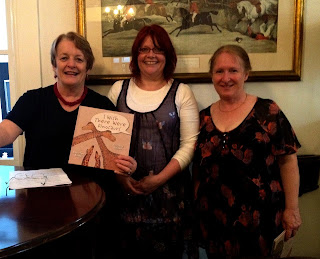
Christina at her book launch


Monday, 5 November 2012

Storytime at the Supermarket!


I have this morning presented the final Storytime at the Supermarket at Kingston, in the south of the state – a charming nearly-five-year-old and I read Kip by Christine Booth, I’m the best by Lucy Cousins, and a Big Book version of The little red hen. We enjoyed cock-a-doodle-doodling with gusto in all the right places; we noted that dogs who think they are the best can hurt their friends’ feelings; and we discussed where the Big Book version I had was not as good as our favourite versions of The little red hen.

One child wasn’t a very big audience, but it was enjoyable to share these stories while his mother and a friend looked on. Here in the south our audiences have been wildly variable in size, but there’s always been someone. I understand that experience in the north (at Prospect Plaza) has been much the same. We have been fortunate to have the support of the Kingborough Council at Kingston – Melissa has sent out digital copies of our flyers each month, and posted an A3 version in a few places. And we have been able to share a children’s activity space provided by the Council.

Storytime at the Supermarket was the brainchild of CBCA (Tas.) Inc. committee members in Launceston, to mark the National Year of Reading, and it has been successful in raising community awareness of CBCA activities. It’s taken time, of course, preparing a flyer to promote each session (on the first Monday of each month since March 2012), preparing a running sheet with lists of books chosen to illustrate a theme, songs and rhymes each month, and fronting up at the venue each session.

But all volunteers have enjoyed the process, and now the big question is, will we do it again next year? Melissa did ask me this morning, as I said good bye, if we planned to be available in the New Year. I had to say I wasn’t sure, but she knows how to get in touch if she needs some stories read!