Welcome to the blog of the Tasmanian branch of the Children's Book Council of Australia!

Sunday, 29 July 2012

Book Art! by Lyndon Riggall


My housemate Rach is always sanding something down, cutting something up, or glueing something on. She's a maker. Aside from that though, she's a reader too, and many of her creations are a throwback to favourite pieces of literature. Like our new mailbox, modelled on the Little Golden Book The Pokey Little Puppy.


Or this collage of odd socks that highlights a moment in which surely every Harry Potter fan cheered as they finished the chapter - when Lucius Malfoy accidentally grants Dobby his freedom.


Or maybe even this set of headrests from her Dr. Seussmobile?


No. I'm certainly not biased, and my favourite is this, my 22nd birthday present. A table and chairs decoupaged with Batman comics.


You don't need me to talk much this week, the images will speak for themselves. Maybe I can encourage you to think though, about what else can be done with a book, and how they can brighten a home as well as a mind.  The best part? You don't even have to come up with something of your own! All of Rach's projects are detailed on her blog at Bags of Characterhttp://www.bagsofcharacter.blogspot.com.au/

Just pick one and have a go! Best of luck!

Friday, 27 July 2012

Literature for children & young people – why does it matter & who cares? - by Jenni Connor


Reflections from an ‘old teacher, principal, curriculum writer & long term member of the Children’s Book council of Australia’ (CBCA). (Jenni Connor has just completed her term as Tasmanian Judge on the CBCA Awards Panel.)

In May this year, I was thrilled to attend the Maurice Saxby Lecture, presented by the Professor of Education and the Arts at Sydney University, Robyn Ewing.

Now ‘Maurie’, as I have known him, is in his ‘wisest years’, an elder statesman who still guides the NSW Branch in his gentle way and is still writing passionately about literature for children and young people for newspapers, magazines and journals. Maurice’s contribution to Australian Children’s Literature and the work of CBCA – which is HUGE – has been recognised through myriad awards, including Tasmania’s own Nan Chauncy award & the Dromkeen Medal; he is a Member of the Order of Australia and was the first National President of the CBCA.

I first met Maurie when we were judges in 1987 (that’s how old I am); he was already ‘famous’ and I was an ingĂ©nue from little old Tasmania. The revered Maurie could not have been more charming, oh, so gently reminding the panel of 8 judges about the criteria pertaining to each award and, regretfully, insisting that some titles that might have made the Older Readers category were really ‘Young Adult’ and beyond the scope of the awards at that time; he also quietly asked ‘Did you mean to have four books about dolphins in your shortlist?’ (Because that’s where we were heading.)

Tasmania hosted Maurie when he came to receive the Nan Chauncy Award and he was witty and charming as ever; he even endured a VERY hot walk into Chauncyvale the following day, although he declared he didn’t think he would be capable of repeating that experience.

So, it was a total joy to see Maurie thriving and among his friends at the Saxby Lecture. He had initially objected, saying ‘I’m not dead yet’, but Margaret Hamilton assured him it was not yet a ‘Memorial Lecture’.

Robyn Ewing, who is not only Professor at Sydney Uni, but has been president of key organisations devoted to teaching and literacy, such as Primary English Teachers’ Association (PETA) and the Australian Literacy Educators’ association (ALEA), spoke passionately about the core role of the arts, including the literary and visual arts, in the education of young people and the cultural life of a civilized society.

The event was hosted at the State Library of NSW and attracted an audience of over 200 writers, illustrators, educators, librarians, parents and members of the public.

I guess I’m interested in the fact that, when CBCA Tasmania worked hard to organise a valuable professional learning event in NW Tasmania, it was extremely difficult to get ‘a quorum’ because busy teachers were understandably preoccupied with student assessment and report writing.

I’m interested to ask: Have we got our priorities right? Should all schools be institutional members of CBCA Tasmania in support of ‘a cultural life and a civilized society’? Should all schools have access to a qualified school librarian to provide informed promotion of quality literature for young people? And, ‘How can we help people to realise that the path to literacy is paved with good books?’

Newspapers, including the Mercury, have recently run articles showing what a powerful tool ‘reading to young children’ can be in enhancing school and literacy success. Maybe we’re on the cusp of a reawakening to the immense joy and value to be found in the amazingly high quality literature Australian writers, illustrators and publishers produce??? I can only hope so.

Maurie and others have shown the way; let’s not lose another light on another hill!

Tuesday, 17 July 2012

It's All About The Story - by Nella Pickup


When we moved into our home 31 years ago, we made a stained glass window for our bathroom – a rainbow with a pot of gold.

Rainbows and pots of gold come in many guises. Rainbows are bright, elusive, and heavenly. Humans have used them to symbolise peace, hope and unity. For the more prosaic, a rainbow is a natural phenomenon- something science can explain.

We didn’t have enough sunshine for a rainbow, but the pot of gold was full. Carol Fuller, my husband Richard and I spent the last few days with Catriona Hoy and Claire Saxby as they spoke about linking literacy and primary school science using picture books. Their sessions were highly entertaining and informative. They are warm and very easy going people - a delight to host. Special thanks to them and to our very own Jenni Connor for their entertaining, informative and inspired presentations at Reading – it’s rocket science and more.

As I read the paper on Saturday and saw an advertisement for someone to write an Aboriginal children’s book on domestic violence, I remembered a comment made by all three speakers. “The story comes first”. Whenever we read a book, especially when we read to a child, choose the story. Books can be used for bibliotherapy or to instruct but all of us will learn the lesson much better if the story comes first.

More information about Reading - it's rocket science and more can be found at the CBCA events page.

Monday, 9 July 2012

How I learned to read - by Carol Fuller


Do you remember when you learned to read; when the sounds you made connected up with the squiggles on the page and imparted meaning? Most people will say that happened at school but I really question that.

While it is almost impossible to remember my own experience, I can well remember my daughter’s and I am now experiencing my grandson’s language development and I would say most definitely that all our language skills started well before we went to school.

From birth most parents start to teach their child to recognize objects and repeat the sound which labels that object. By being shown the object and hearing the sound repeated the child gradually builds a vocabulary upon which to build their first hesitant oral communications. What happens to a child’s developing vocabulary if there is little of this instructional conversation happening in the home?

The same happens with a child’s reading. They hear the story, illustrated and supported by the pictures which give added clues to the meaning of the story and if the story is heard enough times the child can say the story themselves by heart without the need to actually read the words. At some point in these repeated story hearings, helped by a nurturing parent, grandparent, older sibling or other, the fledgling reader begins to recognize that particular squiggles represent particular sounds, especially if at the same time the nurturing guide points to those squiggles and starts to ‘teach’ the child the alphabet sounds; both the long and short sounding alphabets that is. 

 So what happens if there are no books in the house, there is no reading of stories, no pointing to words and pictures, no saying of BOTH alphabets? What happens to that child’s grasp of talking, saying, reading and understanding? At best those children may be disadvantaged but school will help them. At worst these children will lag behind their peers by several years of lost developmental opportunity. No parent would want to do that to their child would they?

So almost by accident, and before she had even entered a formal classroom, my daughter learned the process of reading as will her son I expect since at three he can already tell me the words on each page of his ‘Little Monsters’ book by Jan Pienkowski. He even tells me the words with understanding because it is a very short and simple group of ideas with very engaging pop out pictures that stimulate and remind him of the story.

So what is the point of this blog? The message is that if parents want to give their children the best advantages in life, they cannot afford to waste those years prior to formal school. They have a most important opportunity even responsibility to start their children’s language development from birth. This means talking, using words, singing nursery rhymes, explaining words and most of all having books to read and share. Learning in the home before school starts sets a child up for life.

Certainly school honed and consolidated what I learned at home but there were at least five years of language development before that. I don’t think my parents understood what an advantage they were giving me. They were of a generation who thought school had all the answers but after many years as a teacher and then as a mother and grandmother I understand that it was they who set me on the right track. Thank goodness for me that my parents didn’t waste a moment of my pre-school years. Shouldn’t all children be as lucky?

Monday, 2 July 2012

Signed, Signed, Signed, Signed, Signed! By Lyndon Riggall


So I've hit a point where I'm wondering why I ever buy unsigned books. In the current economic climate it is more important than ever that we sometimes go out of our way to buy books from independent stores rather than massive chains like Kmart of The Book Depository. But even I can't deny the bargains on offer by massive establishments that can buy mountains of books at a reduced price and pass that saving on. How could an indie establishment compete? The answer for me is simple: give me scribbles.

I love signed books. I love owning a copy of something the author has touched, I get inspired by the inscription they write for me, and they make really lovely gifts to other fans. I'll happily waive my free postage perk if I can get hold of an inscription. Tracking them down though, can be hard. I've been to quite a few really great author events in Tassie recently, Isobelle Carmody and Christopher Paolini to name the two that I was most excited about. But what about my international favourites, who might have no plans of coming anywhere here for a long time yet?

Recently I've struck up alliances with two great bookstores in the U.S. One is Quail Ridge Books in North Carolina, the other is Word in Brooklyn. They've both been really great at allowing me to pre-pay for books that they've sent to me after the authors have visited them. In the past few weeks I've seen copies from John Scalzi, John Hodgman, Lev Grossman and Josh Ritter arrive at my door, and I've been so excited about opening them up. The bookstores have only been too happy to help, and the nature of some of the inscriptions seems to indicate that the authors have too, and have been told a little bit about me by the bookstore staff.

So here's my advice: give yourself a treat. Look up your favourite author, and check their upcoming appearances. It'll usually be under a tab with a title like 'Events' on their official website. Find a bookstore they're heading to in the next couple of weeks that you like the sound of, and either email the store or call them up (from a home phone it's not expensive and they're fun to talk to!) asking if you can pre-pay for an inscribed copy.

Support your authors, support your independent bookstores, and buy something unique from the other side of the world. This really is what the internet is for. Then, when it arrives, ravenously tear open the box and sit back in your armchair, reading a favourite that the author has touched with their very own hands. Do all this and remind yourself how lucky you are. Ebooks haven't quite taken over all the old pleasures just yet.

Tuesday, 26 June 2012

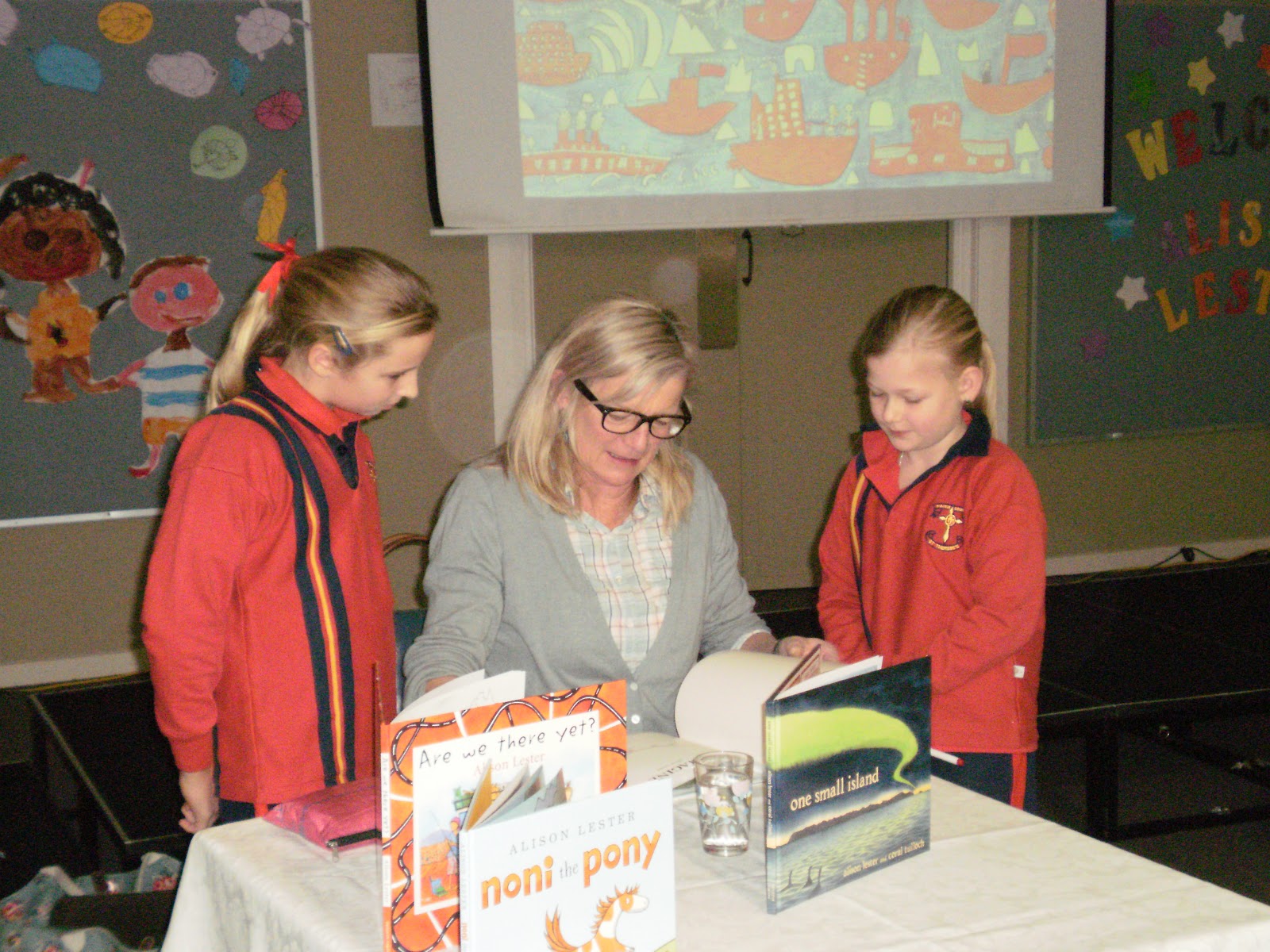
Two Days With Alison Lester - by Patsy Jones


Alison signs books for her fans!


I was fortunate to spend two days with one of the Australian Children’s Literature Alliance’s 2012-2013 Children’s Laureates this last week – Alison Lester.

The Tasmanian CBCA Committee was contacted by the office of the Australian Children’s Literature Alliance (ACLA - http://www.childrenslaureate.org.au/) during the school holidays – Alison was coming to Tasmania at the same time as her Are we there yet? National Year of Reading (NYR) exhibition. She was to be here for four days 18 – 21 June, and would be working with children from the Margate Primary School, the Kingston Primary School, St Therese’s Primary School, and the Bruny Island District School in that time.

CBCA (Tas.) Inc. Committee member Carol Fuller volunteered to assist Alison for one day and I set aside two days to assist her, and arranged an evening with her for CBCA (Tas.) members as well. This was very well attended despite the short notice – two families made the trip down to Hobart especially to attend! We were interested to hear about Alison’s position as Children’s Laureate, after which she and Coral Tulloch discussed the origin and development of their joint publication, One small island, which is shortlisted for the 2012 Eve Pownall Award and has been awarded The Wilderness Society's 2012 Environment Award for Children's Literature, non-fiction section.

My two days with Alison were extremely interesting and enjoyable – but hard work! Alison appeared to cope with the work load very readily – I suppose her previous experience in working with schools and presenting her publications stood her in good stead!

During my day at Kingston, Alison showed children over the NYR exhibition based on her 2005 Picture Book of the Year, Are we there yet? , which will travel to every state during the National Year of Reading. The exhibition showcases the journals, maps, illustrations (both draft and final), and text which formed the basis of the completed book, published in 2004.

Alison conducted a story time session with younger students using Big Book versions of a couple of her books, and led workshops for some older Kingston groups. These workshops were very interesting for me, totally untutored as I am in watercolour skills. A demonstration of basic watercolour techniques and an opportunity for children to practise these techniques with supervision from Alison provided a wonderful experience for the fortunate children who were present.

On the following day at St. Therese’s, the older class group also worked on watercolour techniques and skills, and it was very impressive to see the quality of work completed from these students. Younger children enjoyed a story time session, while the middle group was pleased to see a slide presentation, with commentary from Alison, of her childhood and adult experiences as both beginner and accomplished illustrator.

During her time in Tasmania, Alison spent two days at the Kingston Library (where she worked with children from Margate and Kingston Primary Schools), a day at Moonah with children from St. Therese’s Primary School, and a day on Bruny Island. My time with her was spent at Kingston and Moonah, and the opportunity to talk to teaching staff and children was very valuable. The staff whom I met from both schools are to be congratulated on their enthusiasm and encouragement of the children’s interactions with Alison.

Alison with members of the CBCA

Patsy Jones

Thursday, 21 June 2012

Criminally good - Penny Garnsworthy on Artemis Fowl


Criminally good ...
 
That's the byline from Eoin Colfer's book Artemis Fowl and the Lost Colony. In May I was fortunate enough to attend the CBCA national conference in Adelaide and privileged to meet one of my favourite children's authors, Eoin Colfer who hails from Ireland and was one of the keynote speakers at the conference.
I thought I had read all the Artemis Fowl books - not necessarily in order - but a review of the website http://www.artemisfowl.com/ (which is fantastic I might add) has in fact revealed I am two short. Plus (and Eoin mentioned this as he was signing a book for me at the conference) the final book in the series is due for release soon. What a sad day it will be when I read the last line of Artemis Fowl, The Last Guardian. And even sadder I should think, for Eoin. But then once I have read the remaining three, I'll simply start reading the series all over again, and this time in order.

But I digress ... Artemis Fowl is a 12 year old brilliant criminal mastermind ... well he was 12, and he was a brilliant criminal mastermind, but somewhere along the line Artemis grew up (as some of us do) and although still brilliant, he eventally changed from being a criminal into a mastermind who apprehends criminals. But these are no ordinary criminals; most of them aren't even human; they're armed, they're dangerous, they're technologically advanced and they live underground. And it is here the fun and excitement begins.

Colfer's stories centre on a crime, and the battle between good and evil. Sometimes that battle takes place here on earth, other times beneath us in the complex world of the fairies. But there's always a world to save. And although there's some violence, Colfer doesn't glamorise crime and young Artemis always has a lesson to learn. They're a great read, for all ages and I guess you could say his books are ... criminally good.

Sunday, 10 June 2012

Convict Stories - by Maureen Mann


Recently, I’ve been spending a lot of enjoyable time doing some online research about Tasmanian convicts. Coincidentally – or is it cause and effect? – I have read several books with Tasmanian convicts as an important part of the tale. Here are two of them.

The first was an adult book, the challenging Vogel-winner The Roving Party by Rohan Wilson. It’s a complex story, set at the time of the Black Wars in Tasmania, about John Batman, farm-hand Gould, four downtrodden convicts and Black Bill, brought up by white society but retaining his traditional point of view . It gives an interesting version of the main character before he left his place of birth to establish Melbourne. It’s a heart-wrenching novel with black humour but elements of hope. Though adult in audience, it will appeal to some mature young adults.

I then followed this with the CBCA Younger Readers Short List Nanberry: Black Brother White by Jackie French. It’s set in the first ten or so years of Sydney and is a great mix of historical fact combined with the author’s fictitious characters. The reader comes to understand life in those early years: the squalor as well as the hardships, corruption and the threats to and challenges for the Aboriginal population. It was a book which sent me investigating because I wanted to know more about that period of our history.

Historical novels for me create a sort of time travel, allowing me to visit another era. The successful ones mean that I have an improved understanding of the past and a personal recognition that I may not have fared very well had I been alive at that time. I come away from some of my research with the same feeling. What would the convicts I have been investigating think of what I am doing?

And now I have just finished Orson Scott Card’s Pathfinder, written for young adults. This is pure fantasy, set in Garden a world established 11,191 years ago, with many similar elements to historical fiction but nothing to do with Tasmanian convicts. Rigg is able to see all the paths traced by people in the past as they move through the landscape. Umbo can transport people to the past and, if necessary, modify the future. Param can make herself invisible by slowing down time. It’s a typical fantasy quest where the main characters have to meet their challenges but the reader constantly needs to keep thinking because there are some complex paradoxes discussed. It’s long – 662 pages – so not for the faint-hearted, but a good book to make the reader think.